
Founder’s Daily Planning: 1–3 Priorities Beat the To Do List
By Vora IQ Team
Choose one to three priorities, time block the work, and reset each week. Get routines for founders, copyable day plans, and an automated path with Vora IQ.
- founder daily planner

The founder daily planner approach that works centers on three elements: one to three Most Important Tasks (MITs) chosen each morning, time-blocked execution, and a weekly review that resets priorities. This beats a sprawling to-do list because it forces clarity on what actually moves revenue, and it takes minutes to run. Below, we break down the layouts, routines, templates, and automated alternative that make this stick.
TL;DR:
- Choose a daily layout for frequent calls, a weekly or hybrid view for sprint deadlines, or undated pages when schedules change constantly.
- Keep the planner for priorities, time blocks, and reflection; use the calendar for appointments and deadlines, and a task app for the larger backlog.
- Check the plan around lunch and adjust after disruptions; at day’s end, treat a task rescheduled three times as unlikely to be a priority.
- Digital planners suit calendar sync, reminders, and team visibility, while paper avoids connectivity problems; travelers should confirm offline access before choosing digital.
- Vora IQ generates daily tasks from an adaptive roadmap, and founders in early stages can pair it with paper for execution and milestone tracking.
Vora IQTurn Priorities Into Daily MomentumVora IQ creates daily tasks from an adaptive roadmap, helping founders connect focused execution with their broader business plans.Explore Vora IQ
Table of Contents
- Planner Layouts and Features That Matter for Founders
- How to Run a Founder’s Daily and Weekly Planning Routine
- Templates and Sample Day Plans for Founders
- How Vora IQ Turns Planner Discipline Into an Automated System
- What Founders Actually Need From a Planner
- Build Momentum Without Building the System Yourself
- FAQ
- Sources
Planner Layouts and Features That Matter for Founders
Not every planner layout serves a founder’s chaotic week. Picking the right structure first saves you from abandoning the habit two weeks in.
Daily-per-day planners give each day its own page or spread. They work best for founders juggling many small tasks, calls, and context switches, since there’s room to capture everything without crowding Tuesday into Monday’s margins. Weekly or hybrid planners combine a week-at-a-glance view with daily sections, which suits founders who think in sprints: Monday’s plan has to account for Friday’s deadline. Modular undated systems (loose sheets, index cards, or digital blocks you rearrange) fit founders whose weeks shift so often that a bound, dated book feels wasteful by Wednesday.
Forbes Vetted’s planner roundup recommends daily and hybrid layouts for everyday use, pointing to design and build quality as recurring factors editors weigh when picking a top planner. Business Insider’s 2026 roundup, compiled with input from stationery experts, also leans toward daily and hybrid formats for people managing both ongoing projects and a packed calendar.
Whatever layout you choose, a handful of features separate a planner that gets used from one that gets shelved:
- A dedicated MIT or priority box, so the top one to three tasks aren’t buried in a longer list.
- Hourly or half-hour time blocks, giving your intentions an actual slot instead of floating all day.
- A simple habit tracker, even just a row of checkboxes for the two or three disciplines you’re building.
- Weekly review prompts, built into the layout rather than left to memory.
- Open space for notes and idea capture, since founders think of half their best ideas outside “planning time.”
- Integration capability if you’re going digital, so the planner talks to your calendar instead of duplicating it.
Statistic callout: Editorial roundups and planner reviews repeatedly converge on the same finding: planners succeed when they’re simple, repeatable, and focused on daily priorities rather than exhaustive task lists. The lesson for founders is that less structure, used daily, beats more structure, used occasionally.
Digital versus paper comes down to friction and reliability. Paper never crashes, syncs, or needs a password, which matters when you’re sketching a plan on a plane or in a meeting with no Wi-Fi. Digital tools win when you need integrations: calendar sync, shared visibility with a cofounder, or automated reminders. If you travel often or run a distributed team, prioritize offline reliability or confirm your tool caches data locally. Price brackets for quality paper planners generally run from budget notebooks to premium bound editions, with build quality (binding, paper weight, cover durability) as the signal that separates a planner that survives a year of daily use from one that falls apart by March.
How to Run a Founder’s Daily and Weekly Planning Routine
A planner only works if the routine around it is short enough to survive a bad week. Here’s a sequence you can start tomorrow morning.
- Pick your MITs first thing. Before email, before Slack, write down one to three tasks that would make today a win even if nothing else got done. Give each a rough time estimate: fifteen minutes for a quick decision, ninety for deep work.
- Time-block the rest of the day around them. Put your MITs in your highest-energy hours, then slot meetings, admin, and reactive work into the remaining blocks. Leave at least one unscheduled buffer for the inevitable fire.
- Run a midday checkpoint. Around lunch, glance at your plan: are you on track, or did a meeting eat your morning block? Adjust rather than abandon.
- Close the day with a two-minute review. Mark what got done, move unfinished MITs to tomorrow, and drop anything that no longer matters. A task that’s been moved three times is usually not actually a priority.
- Run a weekly review every Friday or Sunday. Look at the metrics that matter (revenue, signups, pipeline, whatever moves your stage), decide what changes next week, and groom your backlog so Monday starts clean.
A dedicated planner-usage write-up from Ella Iconic describes exactly this rhythm: start the week with clarity, plan each day with purpose, and close with a weekly review rather than letting tasks drift unreviewed.
One practical rule prevents the most common planner failure: avoid double-tracking. Your planner holds priorities, time blocks, and reflection. Your calendar holds fixed appointments and deadlines. Your task app, if you use one, holds the long backlog you’re not touching today. When the same task lives in all three, you’ll stop trusting any of them. If you’re protecting planning time from calendar chaos, a tool built for blocking time off and preventing double bookings can keep your calendar from overwriting the blocks you set.
Pro Tip: Keep your evening review under two minutes by asking only one question: “What’s the one thing that has to happen first tomorrow?” Write that down before you close the planner, and tomorrow’s MIT picks itself.
Templates and Sample Day Plans for Founders
Templates remove the blank-page problem. Here’s a daily layout you can copy into any notebook or app, followed by two sample days.
Daily template fields:
- Date and one-line focus for the day.
- MIT box: one to three tasks, each with a time estimate.
- Hour-by-hour schedule from your first working hour to your last.
- Quick task list for anything under fifteen minutes (calls, emails, approvals).
- Notes section for ideas, blockers, or things to revisit.
Weekly review template fields:
- Metrics snapshot: revenue, pipeline, signups, or whatever number tells you if the week moved the business forward.
- Decisions made and decisions still pending.
- What worked, what didn’t, and one change for next week.
- Backlog groomed: what gets promoted to next week’s MITs, what gets cut.
Sample Day A, product and ops-focused founder: 7:30 AM review MITs and inbox triage (fifteen minutes). 8:00 to 10:00 AM deep work on the top MIT, usually a feature spec or bug fix. 10:00 to 10:30 AM team standup. 10:30 AM to 12:00 PM second MIT, customer feedback review or roadmap update. 1:00 to 3:00 PM meetings and support tickets. 3:00 to 4:30 PM third MIT or buffer for whatever broke earlier. 4:30 to 5:00 PM daily review and tomorrow’s MIT draft.
Sample Day B, sales and fundraising-focused founder: 7:30 AM review pipeline and today’s calls (ten minutes). 8:00 to 9:00 AM outreach and follow-ups, batched together. 9:00 AM to 12:00 PM investor or customer calls, back to back where possible. 1:00 to 2:30 PM deck updates or proposal drafting, often tied to the morning’s conversations. 2:30 to 4:00 PM pipeline review and CRM updates. 4:00 to 5:00 PM networking or warm introductions. Founders deep in a raise often lean on a platform like KapVista to source qualified investor introductions, which turns outreach blocks into scheduled conversations instead of cold searches.
Solo founders should keep templates lean: fewer fields, faster fill-in, since no one else is reading the plan. Small teams benefit from adding a shared visibility column: what’s blocked, what needs a teammate’s input, so the planner doubles as a lightweight status board without turning into a project management tool.
How Vora IQ Turns Planner Discipline Into an Automated System
Everything above works because it’s simple. The tradeoff is that a paper or basic digital planner still requires you to manually connect daily tasks back to the bigger picture: is this MIT actually moving your roadmap, or just filling the day?
That’s the gap an AI-native operating system is built to close. Vora IQ treats your business plan, roadmap, and daily tasks as one connected system rather than three disconnected documents. Instead of writing MITs from memory each morning, we generate daily tasks directly from your adaptive roadmap, so your top three priorities are already tied to the milestone you’re working toward. The weekly review habit becomes a built-in rhythm: as your roadmap adjusts to new information, your task list adjusts with it, rather than you reconciling a static plan against a changing business by hand.
We’ve delivered thousands of unique roadmaps and sets of actionable insights across a range of industries, each one shaped around the founder’s specific context rather than a generic template. For founders who want structured guidance without hiring a strategy or operations team, that context-aware automation covers the ground a planner alone can’t: market analysis, financial modeling, and task sequencing that updates as your business does.
If you’re early-stage, pairing a simple paper planner with Vora IQ for the bigger-picture roadmap often works well: paper for daily execution, the platform for strategy and milestone tracking. As your business scales and task volume grows, shifting fully to an automated system tends to save more time than it costs to switch.
Pro Tip: Start by letting Vora IQ generate one week of tasks from your roadmap, then compare it against your current MIT list. The gaps it surfaces usually point to the priorities you’ve been missing.

What Founders Actually Need From a Planner
Most planner advice overcomplicates the problem. Founders don’t need more categories, more colors, or more elaborate systems. We need a short daily ritual that survives contact with a chaotic week, and a weekly checkpoint that keeps us honest about whether the chaos is actually productive.
The planner itself is almost incidental. What matters is whether you pick one to three things that matter before the day gets noisy, and whether you look back often enough to notice when “busy” has quietly replaced “effective.” A fifty-dollar bound notebook and a free AI-native roadmap can both deliver that discipline. The format matters less than the consistency.
Try this for two weeks: pick your MITs every morning before opening email, and run a five-minute Friday review. Notice what changes, not just in output, but in how much less you’re relying on memory to run your business.
— Khalel
Build Momentum Without Building the System Yourself
Running a founder’s planning routine by hand works, but it asks you to be your own strategist, scheduler, and reviewer every single day. We built Vora IQ as an AI-native operating system that handles that connective work for you: your roadmap, your daily tasks, and your weekly priorities stay linked automatically, adapting as your business moves.
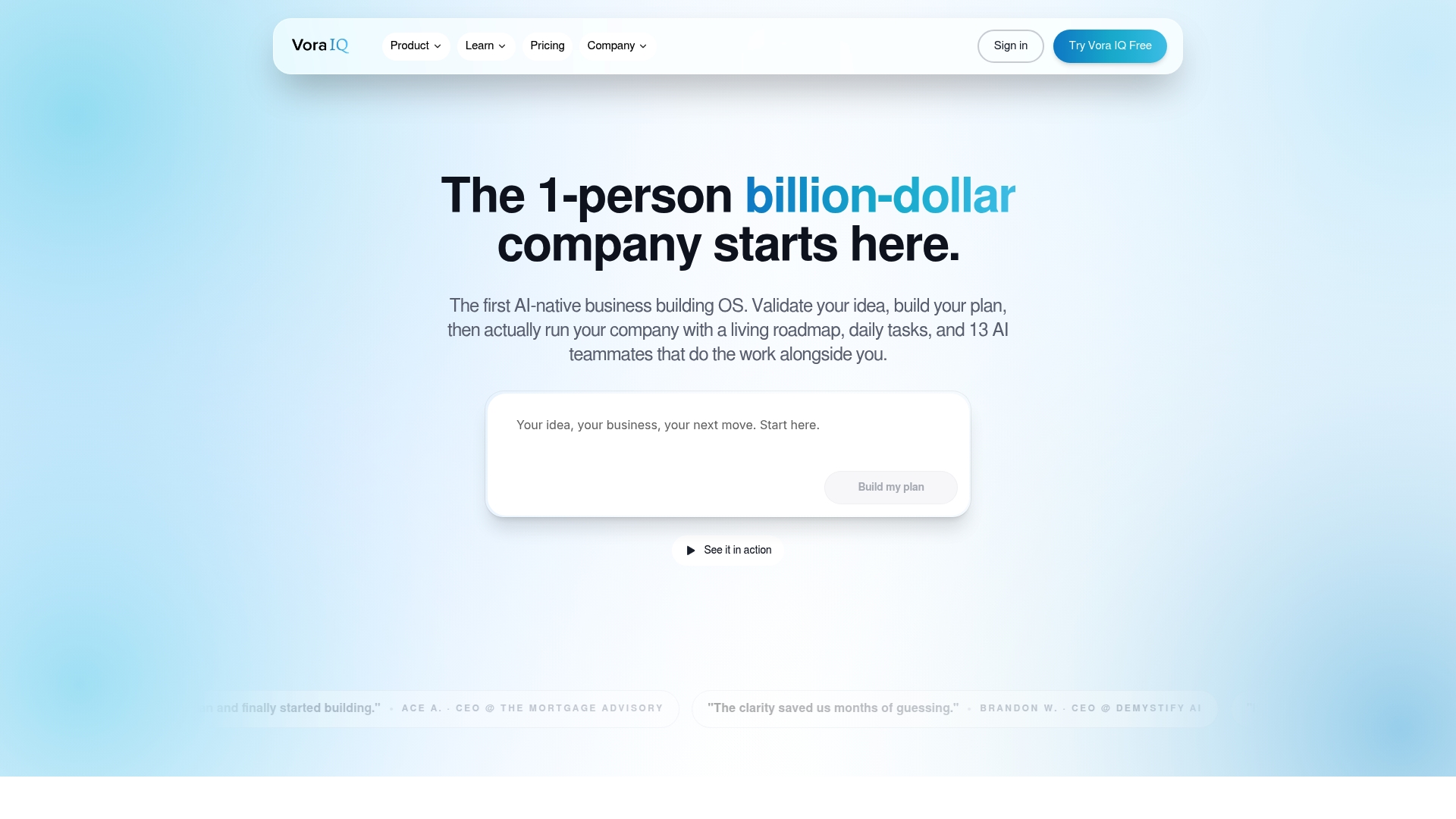
Instead of manually translating a strategic plan into tomorrow’s to-do list, we generate the tasks for you, tied to the milestone they serve. Vora IQ offers subscription plans with monthly and annual billing, and your first 2 Idea Report Cards are free, no credit card required, so you can try it before committing. If you’re ready to replace daily guesswork with a system that already knows your context, get started free on the Vora IQ pricing page.
FAQ
What is the best daily planner layout for founders?
A daily or hybrid layout with a dedicated priority box tends to work best for founders, since it forces you to name one to three MITs before the day fills up. Forbes Vetted and Business Insider both point to daily and hybrid formats as top picks for people managing busy, project-heavy weeks.
How long should founders spend planning each day?
A daily planning routine should take just a few minutes: picking MITs in the morning and reviewing progress at night. First-person planner reviews consistently find that short, repeatable rituals are what drive people to actually keep using a planning system.
Should founders use a paper planner or a digital one?
Paper works well for daily execution since it has no sync issues and no screen distractions, while digital tools shine when you need calendar integration or shared visibility with a team. Many founders pair a simple paper planner for daily tasks with a digital or AI-driven system like Vora IQ for roadmap and milestone tracking.
What should a founder’s weekly review include?
A solid weekly review covers a quick metrics snapshot, the decisions made and still pending, and a backlog grooming step to decide what becomes next week’s priorities. A planner-usage breakdown from Ella Iconic frames this as starting each week with clarity and closing it with honest reflection.
How does Vora IQ fit into a founder’s planning routine?
Vora IQ generates daily tasks directly from your adaptive business roadmap, so your priorities stay tied to your actual milestones instead of a static list you have to update by hand. We offer subscription plans with monthly and annual billing through the Vora IQ pricing page, and your first 2 Idea Report Cards are free.