
AI Business Plan Examples Founders Can Actually Use
By Vora IQ Team
Discover effective AI business plan examples that you can customize and validate for investors, ensuring your startup's success.
- ai business plan examples

Yes, AI can produce usable, investor-ready business plan examples, but only when you pair the output with your own validation and specific prompts. AI won’t invent your unit economics or verify your market size. Copy the example below, run the prompt in How to Get an Investor-Ready Plan, then check the numbers against reality. Tools like Vora IQ build in SBA-ready formatting and TAM/SAM/SOM structure from the start, so you’re not reverse-engineering investor expectations later.
Key Takeaways
AI-generated business plans become investor-ready only when founders validate financial assumptions and market claims before presenting them.
| Point | Details |
|---|---|
| AI drafts narrative sections well | Executive summaries, go-to-market strategy, and team overviews are usually strong AI outputs. |
| Financials need your input | Revenue models, pricing, and unit economics require real data, not model guesses. |
| Validate before presenting | Check TAM/SAM/SOM sourcing, CAC/LTV realism, and forecast assumptions against primary data. |
| Industry benchmarks matter | SaaS, e-commerce, local service, and consulting plans need different financial emphases. |
| Vora IQ turns plans into action | Vora IQ pairs AI plan generation with adaptive roadmaps and task automation for execution. |
Useful Sources and Sample Generators to Explore
Table of Contents
- What Sections Does an AI Business Plan Include?
- Copy-and-Paste Example: Executive Summary and Financial Snapshot
- How AI Business Plan Generators Actually Work
- Step-by-Step: How to Get an Investor-Ready AI Business Plan
- How Vora IQ Approaches AI Business Plans for Founders
- AI Business Plan Examples Across Industries
- When to Trust the AI Draft and When to Hire Help
- Turn Your AI Plan Into a Working Roadmap With Vora IQ
What Sections Does an AI Business Plan Include?
An AI-generated business plan example follows the same skeleton investors have expected for decades: executive summary, market analysis with TAM/SAM/SOM breakdowns, business model and revenue streams, go-to-market strategy, team overview, milestones, financial projections (P&L, cash flow, balance sheet), and an appendix for supporting data.
AI tends to draft the narrative sections well. It’s confident and fast on:
- Executive summaries and company overviews
- Go-to-market positioning and messaging
- Team bios and organizational structure
- Milestone timelines
Where it needs your input is the math. Financial assumptions, pricing logic, and unit economics require your real numbers, not a model’s best guess. Feed it garbage inputs and it’ll hand back a polished, wrong forecast.
Pro Tip: Before you generate anything, write down your revenue model, actual pricing, rough unit economics (even estimates), and a defensible target market size. Those four inputs alone determine whether your AI draft looks like a real plan or a template with your logo on it.
Copy-and-Paste Example: Executive Summary and Financial Snapshot
Here’s a short executive summary you can adapt in five minutes. Swap the bracketed placeholders for your own details and keep the structure.
[Company Name] helps [target customer] solve [core problem] through [product/service], addressing a market that traditional providers have underserved. In year one, we’re targeting [$X] in revenue by acquiring [Y] customers at a [$Z] average price point, with a total addressable market of [$XXM] and a serviceable market of [$XM]. We’re raising [$X] to fund [primary use of funds, e.g., product development and initial hiring] over the next [12/18] months.
That four-sentence structure mirrors what credible sample plans use, including industry-specific examples like Modeliks’ AI and machine learning business plan sample, which pairs a tight summary with defensible market-sizing language rather than vague growth claims.
Now the financial snapshot. Investors skim this before they read anything else.
| Assumption | Placeholder Value |
|---|---|
| Average price per customer | $[X]/month |
| Customer acquisition cost (CAC) | $[X] |
| Monthly new customers (Month 12) | [X] |
| Gross margin | [X]% |
| Year 1 revenue target | $[X] |
| Runway from current funding | [X] months |
Fill each cell with your actual math, not aspirational numbers. If your CAC assumption is a guess, label it as one internally and revisit it after your first 90 days of sales data.
How AI Business Plan Generators Actually Work
Most generators follow the same pipeline: you answer a questionnaire, a language model drafts the narrative sections, connected financial tools generate projections, and you review before exporting. The quality gap between tools shows up in how much of that middle step is automated versus left to you.
Common automation features include:
- TAM/SAM/SOM estimates based on your industry and target market inputs
- Templated P&L, cash flow, and balance sheet generation
- Export formats like PDF and DOCX for investor or bank submission
A roundup of AI business plan generators found that speed and integrations are the main differentiators between tools. Some platforms, like Canva’s Magic Write, lean into design output for pitch-ready visuals, while others prioritize financial depth over polish.
The most common failure mode isn’t bad writing. It’s overconfident revenue forecasts, market-size claims with no supporting math, and benchmarks pulled from the wrong industry entirely. A model will happily project 40% month-over-month growth if you don’t push back on it.
Validate every number the AI hands you against primary sources like industry reports or tools such as Bloomberg’s market data solutions before it goes anywhere near an investor.
Step-by-Step: How to Get an Investor-Ready AI Business Plan
Follow this sequence and you’ll skip the “generic AI slop” version of a plan entirely; for a practical guide on leveraging AI in small business operations, see Use AI Processes For Small Business – SemLocal.
Step 1: Prepare your inputs before you open any tool. Write down a one-line mission statement, your target customer profile, pricing, initial costs, your funding ask, and three to five key milestones. Vague inputs produce vague plans.
Step 2: Use a targeted prompt, not a generic one. For a lean, bootstrapped startup, try: “Generate an executive summary and go-to-market section for a [industry] business targeting [customer], with [$X] initial investment and no outside funding planned.” For a growth-stage startup raising capital, try: “Generate a full business plan including TAM/SAM/SOM analysis, 3-year financial projections, and a competitive positioning section for a [industry] company raising $[X] in seed funding.” The second prompt should push the model toward more rigorous market analysis since investors will scrutinize it harder.
Step 3: Run the validation checklist before you send anything.
- Does the revenue forecast reflect your actual pricing and sales cycle, or a generic growth curve?
- Is the TAM/SAM/SOM breakdown backed by a named source, or just a plausible-sounding number?
- Do your CAC and LTV figures reflect real customer data, or industry averages that don’t apply to you?
- Does the plan avoid overclaiming (“we will dominate the market”) in favor of specific, defensible positioning?
- Is the formatting clean enough for an SBA loan officer or investor to skim in under two minutes?
Pro Tip: Run the same prompt twice, a day apart, and compare outputs. If the revenue numbers swing wildly between runs, that’s your signal the model is guessing, not calculating. Lock in your own assumptions before you trust anything it generates.
How Vora IQ Approaches AI Business Plans for Founders
Vora IQ was built as an AI-native operating system for solo founders, which means plan generation isn’t a standalone feature bolted onto a template library. It’s connected to idea validation, adaptive roadmaps, and daily task automation, so the plan reflects your actual business context instead of a generic industry average.
Here’s what that looks like in practice for a solo founder:
- Answer a structured questionnaire about your idea, market, and pricing
- Get a full plan with auto-generated financial forecasts (P&L, cash flow, balance sheet)
- Convert the plan directly into a 90-day launch roadmap with milestones
- Let task automation handle the follow-through instead of starting a new spreadsheet from scratch
Pro Tip: A plan that sits in a folder does nothing. The real test is whether it turns into a roadmap you actually execute. Vora IQ has generated over 2,400 unique roadmaps across industries, which tells you founders are using the output, not just admiring it.
If you’re weighing this against a bare-bones generator, Vora IQ’s alternatives comparison breaks down the trade-offs in more detail.
AI Business Plan Examples Across Industries
A SaaS founder’s AI-drafted plan leans heavily on recurring revenue metrics: monthly recurring revenue, churn rate, and customer lifetime value dominate the financial section, while the go-to-market strategy usually centers on content marketing or product-led growth.

A local service business, say, a mobile pet grooming company, needs a completely different emphasis. The AI output should focus on service area radius, vehicle and equipment costs, and hourly capacity rather than software metrics that don’t apply. If your generator defaults to SaaS-style KPIs for a local service plan, that’s a sign you need to correct the prompt, not accept the output.
An e-commerce founder’s plan example typically centers on customer acquisition cost by channel, inventory turnover, and gross margin after shipping costs. AI tools often do well here because e-commerce benchmarks are widely published, giving the model more reliable data to draw from. For a deeper look at structuring this type of plan, Vora IQ’s guide to online business plans covers channel-specific assumptions in more detail.
A consulting or professional services plan looks different again: revenue is tied to billable hours or retainer contracts, and the AI-generated milestones section should reflect client acquisition timelines rather than product launch dates. The pattern across all four: AI drafts the structure well, but industry-specific benchmarks are where you need to push back hardest.
When to Trust the AI Draft and When to Hire Help
Use AI drafts for early validation, seed-stage pitch prep, and internal roadmaps. Hire a financial modeler or industry consultant when you’re entering a regulated market, closing a late-stage round, or preparing for acquisition. My rule: complexity plus stakes equals hire a professional. Speed is AI’s advantage. Domain rigor, when regulators or due diligence teams are involved, is not something a language model can substitute for. A SWOT-based decision framework can help you figure out which side of that line you’re on.
Turn Your AI Plan Into a Working Roadmap With Vora IQ
Writing the plan is the easy part. Turning it into a business you actually run is where most founders stall out.
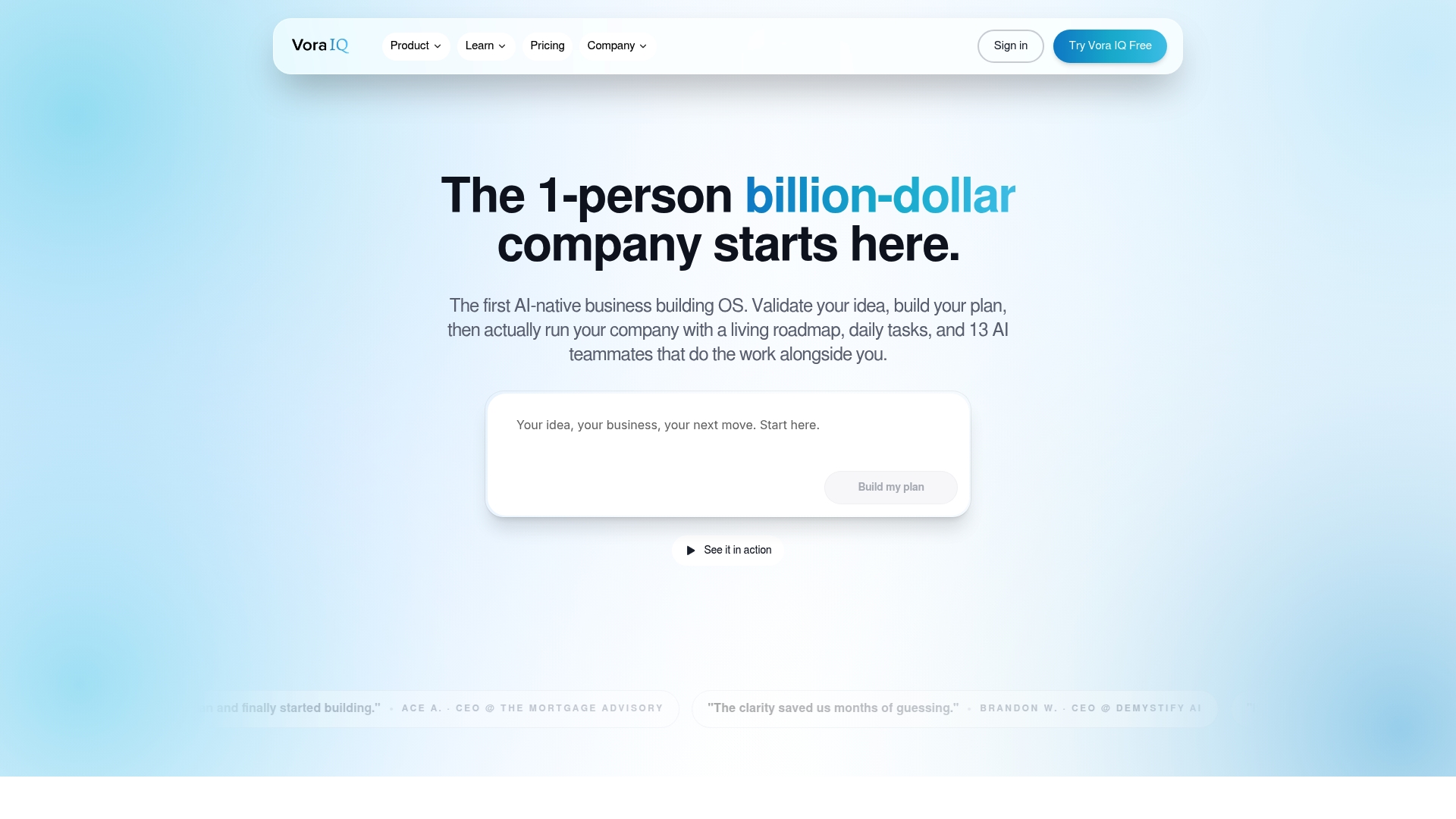
Vora IQ generates investor-ready business plans and then converts them into a living 90-day roadmap, so the plan you just wrote doesn’t sit unused while you figure out what to do next. As an AI-native operating system built specifically for solo founders and early-stage teams, it has already produced over 2,400 tailored roadmaps across industries, pairing plan generation with financial modeling, market analysis, and task automation in one place. If you’re comparing options, see how it stacks up against the DIY founder stack. Get your free Idea Report Card on Vora IQ’s features page and generate your first plan today.