
AI for Strategic Planning: A 2026 Guide for Leaders
By Vora IQ Team
Discover how AI for strategic planning enhances agility, analyzes data, and shapes business success. Learn effective methods for 2026.
- ai for strategic planning

AI for strategic planning is the process of using artificial intelligence to analyze data, predict trends, and generate recommendations that improve how businesses build and execute strategy. This is not a future concept. It is happening now, and the gap between founders who use it and those who do not is widening fast. Integrating AI into planning improves strategic agility by 33.8% over traditional business intelligence tools. That number reflects a real shift in how quickly leaders can read markets, test assumptions, and move. The methods driving this shift include causal discovery, neuro-fuzzy reasoning, and hybrid AI architectures that combine symbolic logic with neural networks. The best results come from pairing these tools with human judgment, not replacing it.
What AI methods power strategic planning today?
The technical foundation of AI for strategic planning rests on four core methods. Each one solves a different problem that traditional planning tools cannot.
Causal discovery identifies which variables actually drive outcomes, not just which ones correlate. Traditional dashboards show you that sales dropped after a price change. Causal discovery tells you whether the price change caused the drop or whether a competitor’s launch did. Research shows causal discovery reaches 96.1% accuracy in corporate strategy contexts. That level of precision changes how confidently you can act on data.
Predictive analytics uses machine learning for strategy by training models on historical and real-time data to forecast market shifts, customer behavior, and competitive moves. When paired with neuro-fuzzy reasoning, which blends neural pattern recognition with rule-based logic, the system can explain its predictions in plain language. That explainability matters enormously when you need board-level buy-in.
Knowledge graphs map relationships between entities: customers, competitors, regulations, and market signals. They give AI a structured memory that improves the quality of scenario generation over time.

| AI Method | Primary Strategic Use | Key Advantage |
|---|---|---|
| Causal discovery | Root cause analysis | 96.1% accuracy in signal detection |
| Predictive analytics | Market and revenue forecasting | Processes real-time and historical data |
| Neuro-fuzzy reasoning | Scenario generation and explanation | Human-readable outputs |
| Knowledge graphs | Competitive intelligence mapping | Structured relational memory |
| Hybrid architectures | Risk management and board reporting | Explainable logic trails |
Hybrid AI architectures combine symbolic logic with neural networks to produce recommendations that a risk committee can actually audit. That auditability is what separates enterprise-grade AI planning tools from black-box systems.
Pro Tip: Before selecting any AI planning tool, ask the vendor whether its outputs include an explanation of the reasoning chain. If the answer is no, the tool is not ready for board-level decisions.
How does AI improve planning compared to traditional methods?
Traditional business intelligence tools report what happened. AI-driven strategic decisions predict what will happen and recommend what to do about it. That shift from reporting to prescribing is the core improvement.
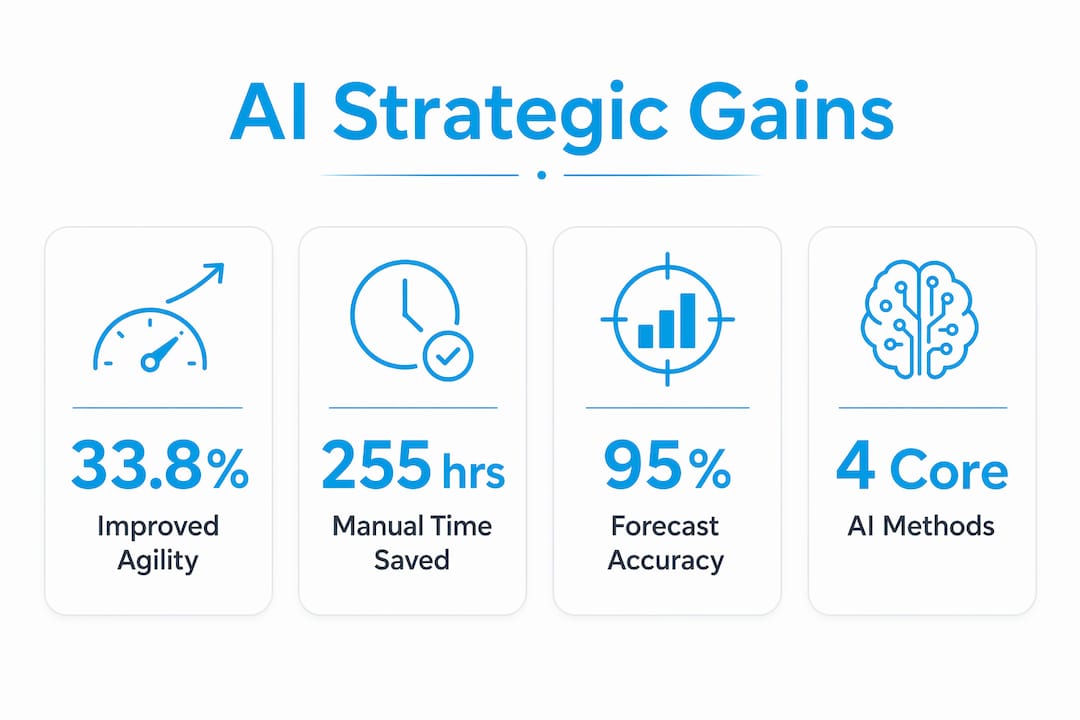
The efficiency gains are concrete. AI saves up to 255 manual work hours per entity per year by digitizing and analyzing legacy unstructured documents. For a solo founder or small team, that is months of reclaimed time. Those hours go back into execution, not data wrangling.
The accuracy gains are equally significant. AI-integrated models increase optimization efficiency by up to 10.8% compared to traditional algorithms when processing financial and market data. A 10.8% improvement in optimization efficiency compounds across every strategic decision you make in a year.
Here is where AI outperforms manual planning most clearly:
-
Competitive signal detection: AI achieves 88.2% accuracy with 20+ days lead time on competitive signals. That lead time lets you respond before a competitor’s move reaches your customers.
-
Scenario simulation: AI runs hundreds of market scenarios in minutes. Manual planning runs three to five scenarios per quarter at best.
-
Data consolidation: AI handles data consolidation and compliance identification automatically, freeing strategists for complex judgment calls.
-
Assumption testing: AI surfaces hidden assumptions in your strategy that human teams routinely miss because they are too close to the plan.
The practical implication is clear. AI does not make you a better strategist by thinking for you. It makes you better by removing the low-value work that crowds out high-value thinking. You can explore what founders actually automate to see where the line sits between automation and human judgment.
What frameworks work best for integrating AI into your planning workflow?
The most effective integration model is called Symbiotic Planning. Symbiotic Planning positions AI as the strategy proposer and humans as the final decision authority. AI generates options, surfaces risks, and runs scenarios. You authorize, refine, and execute. Neither side operates alone.
The CORE framework gives this model structure. CORE stands for Collaboration, Options, Refinement, and Execution. It works like this:
-
Collaboration: Define the strategic question clearly before touching any AI tool. Vague inputs produce vague outputs. Write the question as a testable hypothesis: “If we enter the Midwest market in Q3, will we reach break-even within 18 months?”
-
Options: Let AI generate multiple strategic paths using predictive modeling and scenario simulation. Do not edit at this stage. The goal is breadth, not quality control.
-
Refinement: Apply human judgment to filter AI-generated options. Check for ethical constraints, stakeholder impact, and context the AI cannot access. Human-in-the-Loop governance uses AI to surface hidden biases, then requires human audits before any option advances.
-
Execution: Translate the approved option into a living roadmap with assigned owners, milestones, and checkpoints. Build reauthorization triggers into the plan so AI outputs get reviewed as conditions change.
Identifying strategic pain points first before selecting tools is the single most common mistake founders avoid when they get AI integration right. Tool-driven adoption, where you buy the tool and then find a use for it, consistently underperforms outcome-driven adoption.
Pro Tip: Run a data audit before any AI integration project. Skipping data preparation leads to hallucinated AI insights that look credible but are built on dirty inputs. Clean data is not optional. It is the foundation.
What steps can you take right now to start using AI for strategy?
You do not need a data science team to start. You need a clear process and the discipline to follow it.
-
Map your highest-friction planning tasks. Where do you spend the most time gathering data, reconciling numbers, or building scenarios manually? Those are your entry points for AI. Market scanning, assumption testing, and competitive monitoring are the three areas where AI delivers the fastest return.
-
Audit your data assets. AI is only as good as the data you feed it. Before choosing any tool, catalog what data you have, where it lives, and how clean it is. Unstructured data in old spreadsheets, email threads, or PDF reports needs extraction and cleaning before it becomes useful.
-
Match tools to specific challenges. Matching AI tools to defined strategic challenges produces better outcomes than adopting tools based on general reputation. If your core problem is competitive intelligence, choose a tool built for signal detection. If your problem is roadmap clarity, choose a tool built for planning and execution.
-
Run a pilot with human oversight. Start with one strategic question and one AI tool. Set a 30-day window. Compare the AI-generated output against your existing process. Document where AI added value and where it missed context.
-
Scale what works, drop what does not. After the pilot, formalize the workflows that improved your decision quality. Build reauthorization checkpoints into every AI-assisted process so outputs stay current as your market shifts. Explore AI tools built for founders to find options matched to early-stage strategic needs.
The founders who get the most from AI planning are not the ones with the most tools. They are the ones with the clearest questions.
Key Takeaways
AI for strategic planning delivers the greatest value when it handles data-intensive tasks and humans retain final decision authority over every strategic output.
| Point | Details |
|---|---|
| AI improves strategic agility | Integrating AI improves agility by 33.8% over traditional BI tools. |
| Hybrid architectures build trust | Combining symbolic logic with neural networks produces explainable, auditable recommendations. |
| Data preparation is non-negotiable | Dirty or unstructured data produces inaccurate AI outputs regardless of tool quality. |
| Symbiotic Planning governs well | The CORE framework keeps humans in authority while AI generates and refines options. |
| Match tools to pain points | Outcome-driven tool selection consistently outperforms tool-driven adoption. |
The uncomfortable truth about AI and strategic control
Most founders I talk to want AI to tell them what to do. That is the wrong ask, and it is also the most dangerous one.
AI is exceptional at pattern recognition across large datasets. It is poor at understanding the political dynamics of your board, the trust deficit with a key customer, or the personal risk tolerance that shapes every decision you actually make. When you treat AI output as a final answer rather than a starting point, you hand over the part of strategy that only you can do.
The explainability requirement is not a technical nicety. It is a governance necessity. If you cannot trace why an AI system recommended a particular market entry or pricing move, you cannot defend that decision to investors, partners, or your own team. Hybrid AI systems that blend symbolic and neural logic exist precisely because black-box outputs fail at the board level.
The other trap is over-automation of the assumption-testing phase. AI surfaces assumptions well. It does not validate them against lived experience, customer relationships, or the kind of qualitative signal you pick up in a sales call. AI’s value is maximized on labor-intensive data tasks, not on the judgment calls that define your competitive edge.
My honest recommendation: use AI to build the analysis, stress-test the assumptions, and generate the options. Then sit with the output for 24 hours before you authorize anything. The pause is where your strategic judgment does its best work.
— Khalel
How Voraiq puts this into practice for founders
Voraiq is built specifically for solo founders and early-stage entrepreneurs who need AI-driven planning without a full team behind them. The platform’s AI Co-Founder and roadmap features handle the data-heavy work: market analysis, assumption testing, and adaptive roadmap generation. You get the output of a strategy team without the overhead.
Vora IQ has delivered over 2,400 unique roadmaps across industries, each tailored to the founder’s specific context. The platform builds human oversight into every workflow, so you stay in authority over every decision while AI handles the analytical load. If you are ready to move from manual planning to AI-assisted strategy, see how founders use Voraiq to build traction faster and with more confidence.
FAQ
What is AI for strategic planning?
AI for strategic planning is the use of artificial intelligence to analyze data, forecast trends, and generate strategy recommendations. It improves decision quality and reduces the manual work required to build and test strategic plans.
How does AI improve strategic agility?
Integrating AI into planning improves strategic agility by 33.8% compared to traditional business intelligence tools. The gain comes from faster scenario generation, real-time data processing, and earlier detection of competitive signals.
What is the CORE framework for AI planning?
CORE stands for Collaboration, Options, Refinement, and Execution. The CORE framework structures human-AI cocreation so AI proposes strategic options and humans retain final decision authority at every stage.
Do I need clean data before using AI planning tools?
Yes. Skipping data preparation causes AI systems to produce inaccurate or irrelevant outputs regardless of the tool’s quality. A data audit and cleaning phase is required before any AI integration produces reliable results.
Can AI replace human judgment in strategy?
AI does not replace human judgment. It handles data consolidation, scenario simulation, and assumption surfacing so human leaders can focus on the complex, contextual decisions that require experience, ethics, and stakeholder awareness.