
AI SWOT Analysis: A Decision-First Guide for Founders
By Vora IQ Team
Unlock effective decision-making with our AI SWOT analysis guide. Transform insights into action with practical steps and tools for founders.
- ai swot analysis

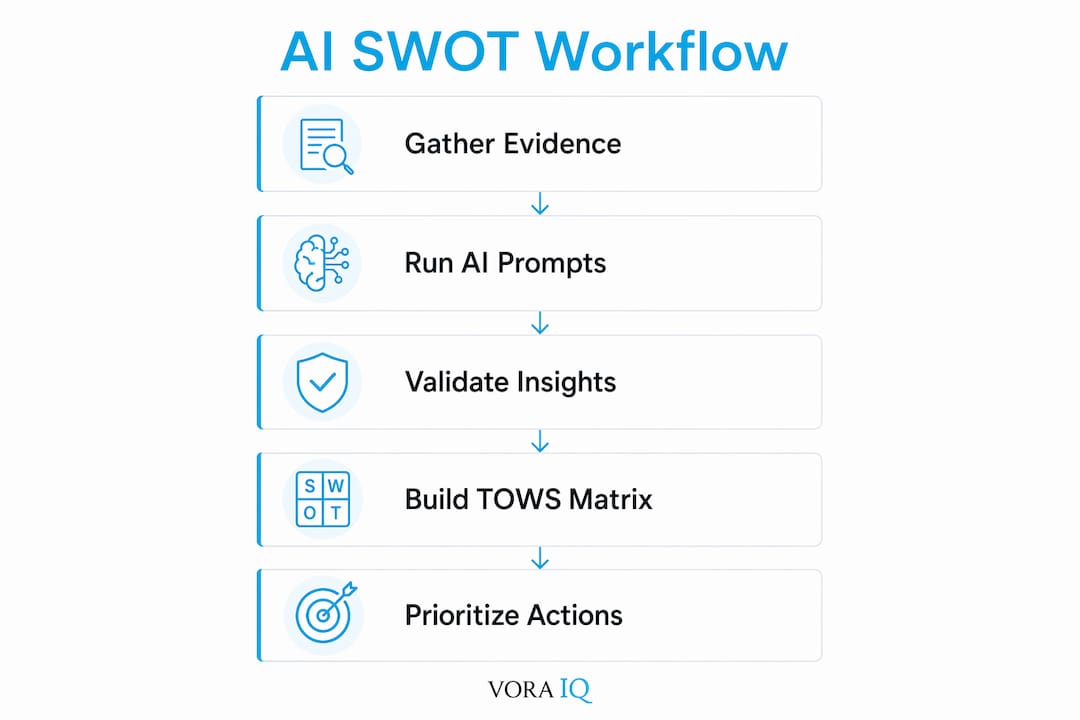
The fastest path to a decision-ready AI SWOT is a three-step workflow: (1) targeted evidence gathering from real data sources, (2) contrarian AI prompting to surface honest strengths and weaknesses, and (3) converting your SWOT into a TOWS action matrix with prioritized, owned moves. Most founders stop at step two and end up with a polished list that never changes anything. The workflow below is built to prevent that.
Your quick-start checklist:
- Gather evidence first (industry reports, Google Trends data, customer feedback, financials)
- Run two-phase prompting in ChatGPT or a similar large language model (LLM): Devil’s Advocate, then Chief Strategy Officer
- Convert every quadrant to TOWS cross-moves and assign an owner, metric, and deadline
Tools you’ll use: Vora IQ for end-to-end workflow, ChatGPT (OpenAI) for LLM drafts, and Google Trends for external signal validation.
Table of Contents
- How do you prompt AI to surface real strengths and weaknesses?
- Which external data sources give you the sharpest opportunities and threats?
- What tools and output formats make your AI SWOT presentable?
- How do you convert a SWOT into a TOWS action matrix?
- Copy-paste prompt bank for every phase
- How long does an AI-assisted SWOT actually take?
- What are the biggest pitfalls in AI-assisted SWOT, and how do you verify outputs?
- Ethical considerations and data privacy in AI business analysis
- Key Takeaways
- The gap between a SWOT and a decision
- Vora IQ runs the full AI SWOT workflow for you
- Useful sources
How do you prompt AI to surface real strengths and weaknesses?
Generic prompts produce generic SWOTs. The fix is role-based prompting: you assign the AI a specific professional identity with a defined mandate before asking a single question.
Two roles work best for internal factors:
- Private Equity Analyst: “You are a ruthless PE analyst preparing a deal memo. List every structural weakness in this business that would reduce its valuation. Be specific. Cite evidence or flag where evidence is missing.”
- Chief Strategy Officer: “You are a CSO with 20 years of turnaround experience. Identify the three most defensible competitive advantages this company holds and explain why each is hard to replicate.”
The role primes the model’s output register. Without it, AI sycophancy bias tends to produce flattering strengths and vague, low-stakes weaknesses.
Your prompt template for internal factors:
Role: [PE Analyst / CSO / Devil's Advocate]
Company description: [2-3 sentences]
Decision horizon: [6 months / 3 years]
Key constraints: [budget, team size, runway]
Evidence to include: [attach revenue data, churn rate, NPS score]
Output format: One-line claim + supporting evidence + confidence score (High/Med/Low)

For solo founders, an operational constraint map sharpens this further. List your tacit knowledge bottlenecks, senior-time constraints, and automatable processes, then ask the AI to prioritize which constraints unlock the highest ROI when removed. That framing produces far more useful weaknesses than “limited marketing budget.”
Pro Tip: Add “Challenge every positive claim I make. If I describe a strength, argue why it might be a liability in a downturn” to any internal-factors prompt. This single instruction breaks the politeness loop and forces the model to stress-test your assumptions.
Which external data sources give you the sharpest opportunities and threats?
AI accelerates research dramatically, but only when you feed it real signals. The model’s training data has a cutoff; your competitive environment does not.
High-value external sources to query with AI:
- Google Trends: Paste a 12-month interest curve into your prompt and ask the model to interpret demand trajectory for your category.
- Industry reports (PDFs): Upload directly to ChatGPT or a document-aware LLM. Ask it to extract the three most relevant threats to your specific business model, not the industry in general.
- Social listening exports: Pull Reddit threads, App Store reviews, or Twitter/X keyword exports as CSVs. MonkeyLearn’s text analytics can cluster sentiment before you feed themes into your SWOT prompt.
- Regulatory trackers: For regulated industries, ask the AI to summarize pending rule changes from FTC, FDA, or SEC filings relevant to your category.
Method checklist for external research:
- Upload primary documents (PDFs, CSVs) rather than asking the model to recall facts from memory
- Require the model to cite the page number or URL for every claim it makes
- Cross-check any statistic against the original source before including it in your SWOT
- Transform raw signals into one-sentence opportunity or threat statements: “Rising search volume for [category] in Q1 2026 suggests an addressable demand gap in [segment]”
That last step matters. Raw data is not a SWOT entry. A validated, one-sentence signal that maps to a specific internal capability or gap is.
What tools and output formats make your AI SWOT presentable?
The right tool depends on which phase of the workflow you’re in. Here’s how the categories break down:
| Phase | Tool category | Example use |
|---|---|---|
| Draft generation | LLM (ChatGPT/OpenAI) | Role-prompted SWOT drafts, TOWS cross-moves |
| Trend research | Google Trends | Demand signal validation, threat detection |
| Text analytics | MonkeyLearn | Sentiment clustering from reviews and social data |
| Visual matrix | AI workspace / diagramming tool | SWOT and TOWS matrix layouts for stakeholder decks |
| End-to-end workflow | Vora IQ | Evidence ingestion, AI teammates, roadmap conversion |
Output formats that actually get used:
- SWOT matrix (2x2): One-line evidence-backed claims per cell, no bullet padding
- TOWS action table: Four quadrants mapped to SO, WO, ST, WT moves with owner and timeline
- One-page brief: Executive summary of top two moves per quadrant, formatted for a board or investor meeting
- Roadmap card: A single prioritized action converted to a milestone with a metric and a deadline
Clean output checklist:
- Every cell contains a claim and an evidence source
- Each action has an owner, a success metric, and a timeline
- A verification note flags any claim that still needs manual cross-check
- File format: PDF for stakeholder distribution, editable doc for iteration
For founders who want to share outputs quickly, AI-generated pitch decks and proposals can pull directly from your SWOT brief without rebuilding the narrative from scratch.
How do you convert a SWOT into a TOWS action matrix?
A SWOT without a TOWS is a description. A TOWS is a decision. The cross-matching logic forces you to ask: given what we’re good at and what the market is doing, what should we actually do next?
TOWS converts descriptive lists into prioritized moves through four cross-combinations:
| TOWS quadrant | Logic | Strategic posture |
|---|---|---|
| SO (Max-Max) | Use strengths to capture opportunities | Offense: double down and expand |
| WO (Min-Max) | Fix weaknesses to access opportunities | Investment: build capability to compete |
| ST (Max-Min) | Use strengths to neutralize threats | Defense: protect position |
| WT (Min-Min) | Minimize weaknesses, avoid threats | Survival: cut exposure, reduce risk |
Working example. Say your SWOT shows: Strength = fast product iteration cycle; Opportunity = growing demand for AI-native tools among bootstrapped founders; Threat = well-funded competitors entering the market.
Your SO move: “Accelerate feature releases targeting bootstrapped founders before funded competitors reach product parity.” That becomes an action: Owner = Product Lead, Metric = two new founder-specific features shipped per quarter, Timeline = 90 days.
Prioritization framework: Score each TOWS move on Impact (1–5) × Urgency (1–5). Moves scoring 20+ go into your 30-day sprint. Moves scoring 10–19 go into your 90-day roadmap. Anything below 10 gets parked.
Action template:
Move: [SO/WO/ST/WT]
Description: [One sentence]
Owner: [Name or role]
Success metric: [Specific, measurable]
Timeline: [30 / 60 / 90 days]
Dependencies: [What must be true first]
Copy-paste prompt bank for every phase
These prompts are ready to paste into ChatGPT or any LLM workspace. Adjust the bracketed fields for your context.
Phase 1: Devil’s Advocate (brutal pre-mortem)
- “You are a Devil’s Advocate hired to kill this business before it wastes another dollar. Here is the company description:. List the five most credible reasons this business will fail in the next 18 months. For each, cite a real market dynamic or operational pattern. Do not soften your answers.”
- “Assume this company’s top three strengths are actually liabilities in disguise. Explain why each strength could become a competitive weakness within two years. Be specific.”
- “What are the three external threats most likely to blindside this business? Rank by probability × impact. Cite your reasoning.”
Phase 2: Chief Strategy Officer (Blue Ocean discovery)
- “You are a CSO identifying unfair advantages. Given this company description and market context:, what is the single most defensible moat this business could build in the next 12 months? Explain the mechanism.”
- “Identify two underserved customer segments this business could own without competing head-to-head with larger players. For each, describe the entry wedge.”
Verification prompts
- “For every claim you just made, provide a source URL or flag it as ‘unverified inference.’ Do not include any claim you cannot support with a citation or a named data source.”
- “Play the role of a skeptical CFO reviewing this SWOT. Which three items are most likely to be wishful thinking? What evidence would change your mind?”
- “List the assumptions embedded in this SWOT that, if wrong, would invalidate the top SO move. Rank them by how likely they are to be wrong.”
Sample output format to require:
Claim: [One sentence]
Evidence: [Source URL or named data point]
Confidence: High / Medium / Low
Suggested next step: [One action]
How long does an AI-assisted SWOT actually take?
Time and cost vary by depth, not by team size alone. Here’s a realistic breakdown:
| Plan | Total time | Key steps | Estimated cost |
|---|---|---|---|
| Fast (solo founder) | 3–5 hours | Evidence pull (1 hr), prompting + iteration (1 hr), TOWS conversion (1 hr), review (30 min) | $20 (LLM subscription + Google Trends free) |
| Thorough (small team) | 10 hours | Deep research (3 hrs), multi-round prompting (4 hrs), stakeholder validation (3 hrs), TOWS + roadmap (3 hrs), expert review (2 hrs) | $100 (LLM + analytics tools + optional consultant hour) |
A faster AI SWOT plan works well for quick checks or initial pitches, while a more thorough approach suits major strategic decisions or annual planning cycles.
Cost drivers to watch: paid LLM tiers (ChatGPT Plus runs $20/month), premium data sources like industry research databases, and optional expert review time. Most solo founders can run a credible AI SWOT for a low cost in direct tool expenses. The real investment is focused founder time, which AI shortens significantly compared to a traditional facilitated workshop.
For founders who want to skip the tool-stacking entirely, AI tools built for startup founders increasingly bundle research, prompting, and roadmap conversion into a single workflow.
What are the biggest pitfalls in AI-assisted SWOT, and how do you verify outputs?
The most common failure mode is not hallucination. It’s stopping at a polished list of bullets that describes the business without driving a decision. AI-driven SWOT must be decision-oriented, explicitly surfacing tension between internal capability and external pressure.
Common pitfalls:
- Sycophancy bias: The model praises your strengths and softens your weaknesses unless you force a contrarian persona
- Recycled clichés: Outputs like “strong brand” or “market uncertainty” appear in almost every AI SWOT regardless of context
- Black-box reasoning: LLMs synthesize patterns without revealing their logic, so a confident-sounding claim may have no traceable source
- False precision: Numeric claims the model generates from memory rather than from documents you uploaded
Verification checklist:
- Require source citations for every factual claim before accepting it
- Cross-check any market size, growth rate, or competitor data against a primary source (SEC filing, industry report, government database)
- Run a stakeholder stress-test: share the draft SWOT with one person who will push back, not validate
- Flag every “High Confidence” AI claim for manual review first, not last
- Never include a SWOT entry you cannot defend with a named source in a board or investor conversation
“Because LLMs are black boxes, demand citations, require cross-checks against primary data sources, and use AI for clustering and pattern-finding rather than final judgment.” — CIA Center for the Study of Intelligence
Pro Tip: After your SWOT is drafted, run this prompt: “Assume everything in this SWOT is wrong. What would the data need to show for that to be true?” The answers reveal your highest-risk assumptions faster than any checklist.
You can also use an AI overview checker to audit how AI systems are summarizing your market or competitive claims, which helps you catch misrepresentations before they reach a stakeholder deck.
Ethical considerations and data privacy in AI business analysis
Feeding sensitive business data into a public LLM carries real risk. Most consumer-tier AI tools use conversation data for model training by default unless you explicitly opt out or use an enterprise API with a data processing agreement.
Before you upload financials, customer lists, or proprietary product specs, check three things: whether the tool’s terms allow training on your inputs, whether your industry has specific data-handling regulations (HIPAA for health, GLBA for financial services), and whether your team members or contractors have consented to their information being processed by a third-party AI system.
For competitive intelligence work, the ethical line sits at how you gather external data. Scraping competitor sites in violation of their terms of service, or using AI to synthesize information from sources you don’t have rights to access, creates legal exposure. Stick to publicly available data: published reports, regulatory filings, Google Trends, and social platforms’ public APIs.
Bias in AI outputs is also an ethical concern, not just a quality one. An AI trained predominantly on large-enterprise case studies will systematically underweight the constraints and opportunities relevant to a solo founder or early-stage team. That’s why the operational constraint map approach matters: it forces the model to reason from your specific context rather than from a generic business archetype.
Finally, if your SWOT informs a decision that affects employees, investors, or partners, the AI’s role should be disclosed. Presenting an AI-generated analysis as independent expert judgment without attribution is a credibility risk, not just an ethical one.
This article is general information, not professional legal or strategic advice. Confirm data-handling obligations with a qualified attorney or compliance professional for your specific situation.
Key Takeaways
An AI SWOT analysis only drives decisions when you combine evidence-first prompting, contrarian validation, and a TOWS conversion that assigns every move an owner, a metric, and a deadline.
| Point | Details |
|---|---|
| Three-step workflow | Gather evidence first, then run contrarian AI prompting, then convert to TOWS with prioritized actions. |
| Contrarian prompting | Use Devil’s Advocate and CSO role prompts to overcome AI sycophancy and surface honest weaknesses. |
| TOWS conversion required | Cross-match SWOT quadrants into SO, WO, ST, WT moves; score each on Impact × Urgency to prioritize. |
| Verify every claim | Require source citations from the AI, cross-check against primary data, and run a stakeholder stress-test before finalizing. |
| Vora IQ accelerates the workflow | Vora IQ maps directly to all three steps, from evidence ingestion and AI-teammate prompting to TOWS-to-roadmap conversion, across 2,400+ founder roadmaps delivered. |
The gap between a SWOT and a decision
Most AI SWOT guides focus on the prompts. The harder problem is what happens after the matrix is filled in. In working through the patterns behind thousands of founder strategy sessions, one thing stands out consistently: the analysis is rarely the bottleneck. The bottleneck is the jump from “we identified a threat” to “here is the specific move we’re making in the next 30 days, owned by a named person.”
AI makes the research phase faster than it has ever been. You can pull a credible first-pass SWOT in a few hours instead of a few days. But that speed creates a new trap: founders generate more analysis than they can act on. The TOWS matrix is not a nice-to-have add-on. It’s the only mechanism that forces you to cross-match what you’re good at against what the market is doing, and to commit to a move rather than a description.
The verification step is equally non-negotiable. The CIA’s own guidance on AI for intelligence analysis makes the point plainly: LLMs synthesize patterns but don’t reveal their reasoning. That’s not a reason to avoid AI. It’s a reason to treat every AI output as a first draft that requires a human to sign off before it drives a real decision.
The founders who get the most out of this workflow are the ones who use AI for the “ugly middle” — data ingestion, clustering, first-pass drafts — and then bring their own judgment to sequencing and prioritization. That division of labor is where the real speed gain lives. Understanding how to validate and humanize AI outputs before they reach stakeholders is what separates a credible strategy from a confident-sounding document.
Vora IQ runs the full AI SWOT workflow for you
Running this three-step workflow manually across multiple tools takes time you probably don’t have. Vora IQ is built specifically for solo founders and early-stage teams who need to move from analysis to execution without a full strategy team behind them.
Vora IQ’s 13 specialist AI teammates handle the phases that slow founders down most: ingesting your evidence (financials, market data, competitor research), running structured analysis through role-specific agents, and converting your TOWS output directly into a living roadmap with assigned tasks. The Pivot agent translates your ST and WT moves into concrete adaptation plans. The Axis agent turns your SO and WO priorities into an executable build sequence. Every output is personalized to your business context, not a generic template.
With over 2,400 unique roadmaps delivered, Vora IQ has the track record to back the workflow. See exactly how it maps to your situation on the Vora IQ use cases page and get your free venture report today.
Useful sources
These are the primary references used to build and verify the guidance in this article. Use them to cross-check any AI output you generate.
- How to Use AI to Perform a SWOT Analysis — U.S. Chamber of Commerce: Practical framework for AI-accelerated SWOT with prompt guidance and speed benchmarks.
- Intelligence and Technology: AI for Analysis — CIA Center for the Study of Intelligence: Authoritative source on LLM black-box limitations and the case for mandatory human verification.
- How to Do SWOT Analysis with AI — SWOTPal: Two-phase Devil’s Advocate and CSO prompting framework; source for sycophancy bias evidence.
- Strategic SWOT Analysis with AI — Jeda.ai: Decision-orientation framework and the case for TOWS as the required next step.
- AI SWOT Analysis — Dreamineering: Operational constraint map methodology for solo founders.
- AI Index — Stanford HAI: Authoritative annual data on AI capability, adoption, and governance gaps.
- Vora IQ Features: Product overview showing how the platform maps to the SWOT-to-TOWS-to-roadmap workflow.
How to use these sources to check AI outputs: When your LLM makes a market-size or competitive claim, search the U.S. Chamber or Stanford HAI sources for a matching data point. If you can’t find one, flag the claim as unverified and either remove it or replace it with a qualitative statement you can defend.