
Best Business Planner Online for Solo Founders in 2026
By Vora IQ Team
Discover the best business planner online for solo founders in 2026. Build a fundable business plan quickly with guided templates and AI support.
- business planner online

The fastest way to build a fundable business plan is to use an online business planner that combines guided templates, AI-assisted writing, and real-time financial modeling in one place. You skip the blank page, avoid the narrative-versus-numbers disconnect that kills most funding applications, and produce a document lenders actually want to read. The U.S. Small Business Administration recognizes two core formats: the traditional comprehensive plan and the lean startup one-pager. Knowing which one you need before you open any tool saves hours.
Here is what a solid online business planning platform delivers:
- Guided templates structured around the nine sections lenders expect
- AI-assisted writing that pulls from your actual business details, not generic filler
- Real-time financial modeling where one revenue change flows through your income statement, cash flow, and balance sheet simultaneously
- Market research integration so your analysis section is grounded in data you can defend
- Pitch deck generation that stays in sync with your plan as it evolves
- Funding readiness review that catches narrative-to-financial inconsistencies before a lender does
Which business planner online options are best in the U.S.?
Four providers stand out for U.S. founders in 2026, each built for a different stage and budget. Businesses that plan and track against their plan grow 30% faster than those that do not, so the tool you pick matters beyond just document production.
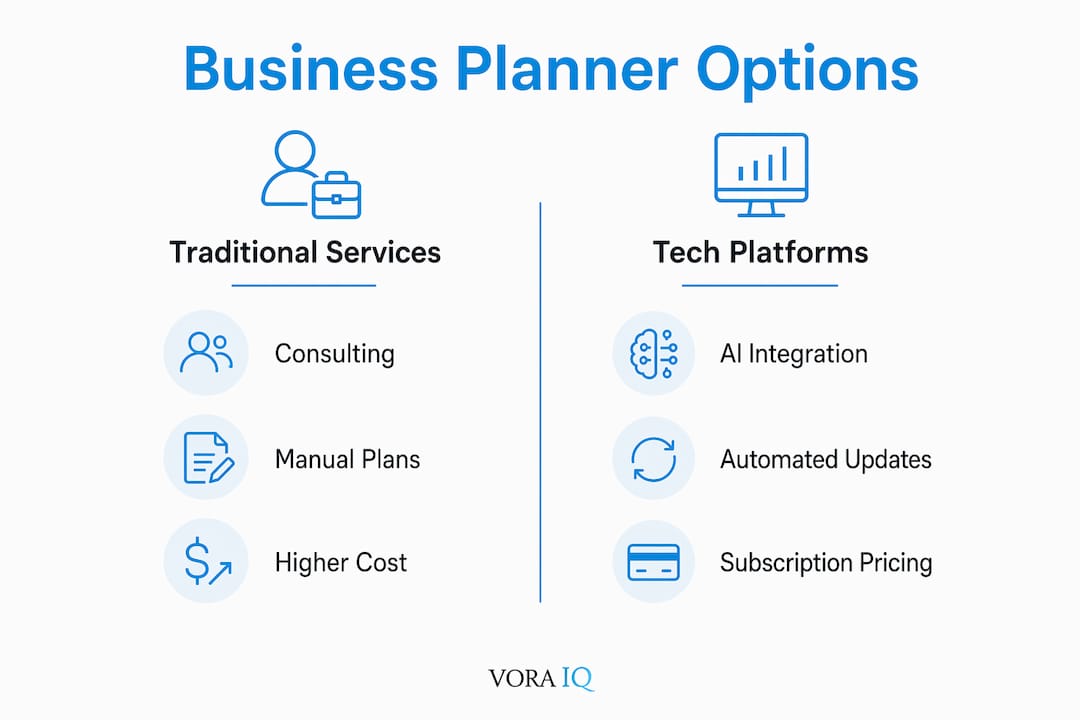
| Provider | Service Type | Features Offered | Pricing | Specializations | Best For | Unique Selling Points | Rating |
|---|---|---|---|---|---|---|---|
| [Business Plans USA | Business Plan Writing Services](https://www.businessplansusa.com/) | Professional writing service | Custom plan writing, market analysis, financial projections | Not publicly listed | Startups, growing businesses | Entrepreneurs wanting a done-for-you plan | Experienced consultants, tailored narrative and financials |
| Bargain Business Plan | Consulting service | Personalized plan guidance, streamlined creation | Budget-friendly tiers | Cost-conscious startups | Founders who need expert help at lower cost | Affordable consulting without premium pricing | — |
| PlanGuru | Financial projection software | Forecasting, KPI tools, performance review | Subscription | Small to mid-sized businesses | Teams needing deep financial modeling | Integrated forecasting built for advisors and owners | 1★ (1 review) |
| Vora IQ | AI-native operating system | Roadmaps, market analysis, financials, compliance, pitch decks, social content, 13 AI teammates | Free Idea Report Card + subscription | Solo founders, early-stage startups | Founders who want end-to-end AI-driven planning | 2,400+ roadmaps delivered; full execution layer, not just a document | — |
Business Plans USA suits founders who want a professional consultant to handle the heavy lifting. Their team produces custom plans with detailed market and financial analysis, which is particularly useful when you are approaching an SBA-backed lender with strict formatting expectations.
Bargain Business Plan fills the gap for cost-conscious founders who still want human guidance. The service focuses on getting a workable plan built without the fees a full consulting engagement typically carries.
PlanGuru takes a different angle entirely. It is software, not a writing service, built specifically for financial forecasting and business decision support. If your bottleneck is modeling scenarios and interpreting KPIs rather than writing narrative, PlanGuru addresses that directly.

Vora IQ operates as a full AI business operating system. Where the others produce a document, Vora IQ produces a living roadmap, competitor analysis, financial model, compliance awareness, and social content, all personalized to your specific business context.
What are the two main business plan formats?
The SBA identifies two formats: traditional and lean startup. Choosing the wrong one wastes time and can cost you a funding opportunity.
Traditional plans run 20 or more pages and are built for institutional lenders, banks, and SBA loan applications. They require five-year financial forecasts, detailed market analysis, and a specific section sequence. Lenders treat non-compliance with that structure as a red flag.
The nine core sections of a traditional plan:
- Executive summary
- Company description
- Market analysis
- Organization and management
- Product or service line
- Marketing and sales strategy
- Funding request
- Financial projections
- Appendix
Lean startup plans are one-page summaries designed for rapid iteration. They work well for internal alignment, early co-founder conversations, and pre-revenue idea validation. They are not appropriate for bank financing or SBA applications.
Pro Tip: Pick your format based on your audience, not your preference. If you are raising debt financing, go traditional. If you are still validating your idea, start lean and expand later.
How do you write your business plan online, step by step?
- Pressure-test your idea first. Before writing a word, use an AI tool or template to pressure-test your core assumptions. Vora IQ runs this as a structured validation step, surfacing market size, competitor positioning, and PMF signals before you commit to a full plan.
- Draft your executive summary last, not first. Write it after your market analysis and financials are complete. The summary should reflect what the plan actually says, not what you hope it will say.
- Build your financial model with linked assumptions. Look for deep data-linking integration where a change to one revenue input automatically updates all three financial statements. Manually maintained spreadsheets break this link constantly.
- Run a narrative-to-financial consistency check. A common reason lenders reject plans is a disconnect between the written narrative and the financial projections. AI-driven tools catch this automatically; manual plans rarely do.
- Generate your pitch deck from the plan, not separately. Building slides from scratch after finishing the plan creates version drift. Use a tool that pulls directly from your plan content so the numbers always match.
- Run a funding readiness review before submitting. Check for gaps a lender will flag: missing five-year projections, unsupported market size claims, and vague use-of-funds sections.
Pro Tip: Never store sensitive financial assumptions or proprietary product details on a free platform without reading its data retention and sharing policy first. Your business model is your competitive edge.
How is AI changing business planning for solo founders?
AI does not just write faster. It changes what a business plan actually is.
A business plan is only useful if it is “alive” — continuously updated, immediately responsive to new data, and built to support constant re-planning rather than sitting as a static document on a shelf.
That shift from static document to living roadmap is where AI-native tools like Vora IQ pull ahead of traditional software. The platform delivers over 2,400 unique roadmaps across industries, each personalized to the founder’s specific business context rather than a generic template.
Key capabilities that define AI-driven planning in 2026:
- Continuous financial updates that reflect real market changes, not last quarter’s assumptions
- Competitor analysis automation that monitors positioning shifts without manual research
- Compliance and legal awareness built into the planning layer, not bolted on afterward
- Social media content generation tied directly to your brand and product context
- 13 specialist AI teammates covering everything from financial modeling to pitch preparation
For a solo founder, this replaces the need for a full team across strategy, finance, marketing, and operations. You get structured guidance and execution support without the overhead.
What does business planning actually cost?
Costs range widely depending on whether you use software, a consultant, or an AI platform.
Professional writing services like Business Plans USA charge consulting fees that vary by plan complexity; pricing is not publicly listed and typically quoted per project. Bargain Business Plan positions itself at the lower end of that consulting range, making it accessible for pre-revenue founders watching runway carefully.
Software tools like PlanGuru use subscription pricing, which suits teams that need ongoing financial modeling rather than a one-time document. AI platforms like Vora IQ start you with a free Idea Report Card, then subscription tiers, giving you a low-risk entry point before committing.
Free tools exist, including templates from SCORE and the SBA’s own resources, but they require you to supply all the research, writing, and financial modeling yourself. The real cost of free is time.
How long does building a business plan take?
A traditional plan built manually takes most founders two to four weeks, assuming they already have market research and financial data on hand. Without that foundation, the timeline stretches further.
AI-assisted platforms compress this significantly. A lean startup plan can be ready in under an hour. A full traditional plan with linked financials and a pitch deck typically takes one to three days using a well-integrated tool, compared to weeks of back-and-forth with a consultant.
The timeline also depends on revision cycles. Static documents require manual updates every time an assumption changes. A living plan built on linked financial logic updates automatically, which cuts revision time from days to minutes.
Do business planning tools connect to your other software?
The best platforms do, and that integration is where real efficiency lives. Connecting your business plan tool to accounting software like QuickBooks or Xero means your plan-versus-actuals comparison happens automatically each month. You see immediately whether revenue is tracking, expenses are drifting, or your cash runway is compressing.
CRM integration adds another layer. When your sales pipeline data feeds directly into your revenue projections, your financial model reflects reality rather than optimism. That connection is what separates a working financial model from a spreadsheet that looks right but breaks under scrutiny.
Vora IQ includes financial modeling with Stripe integration, which is particularly useful for subscription-based and e-commerce founders who need real transaction data flowing into their projections from day one.

What do successful online-built business plans have in common?
Plans that actually secure funding share three structural traits regardless of which tool produced them. First, the market analysis cites specific, verifiable data rather than broad industry estimates. Second, the financial projections are built on named assumptions that a lender can challenge and the founder can defend. Third, the narrative and the numbers tell the same story.
Online tools accelerate all three. AI-assisted market research tools pull from verified sources and feed directly into the plan. Linked financial models make assumptions explicit and traceable. And AI review features catch the narrative-versus-numbers gaps before submission.
The founders who get the most from online planners treat the tool as a thinking partner, not a document generator. They input real data, challenge the outputs, and iterate.
Free vs. paid online business planning: what is the real difference?
Free tools give you structure. Paid tools give you accuracy, speed, and credibility.
SBA templates and SCORE resources are genuinely useful starting points, especially for founders who are still clarifying their business model. They provide the right section structure and force you to think through each component. What they do not provide is AI-assisted writing, linked financial modeling, market research integration, or funding readiness review.
Paid platforms like PlanGuru, LivePlan, and Vora IQ each address different gaps. PlanGuru focuses on financial depth. LivePlan covers the full plan-to-pitch workflow. Vora IQ extends beyond the document into execution, compliance, and ongoing roadmap management. For a comparison of business plan software options side by side, the differences in scope become clear quickly.
The decision usually comes down to what you are building the plan for. Internal use and early validation: free tools work. Lender submission or investor pitch: invest in a paid platform.
What should you know about data security on planning platforms?
Your business plan contains your most sensitive competitive information: your pricing model, your customer acquisition strategy, your financial projections, and your product roadmap. Treat platform security as a non-negotiable filter before you sign up.
Check whether the platform encrypts data at rest and in transit. Confirm whether your plan content is used to train AI models, and whether you can opt out. Review the data retention policy: what happens to your information if you cancel your subscription? Platforms that are vague on these points are worth avoiding regardless of their feature set.
Enterprise-grade platforms publish clear security documentation. If a tool’s privacy policy is hard to find or written to obscure rather than clarify, that tells you something about how seriously the company takes your data.
Vora IQ gives solo founders a full planning and execution system
Most business planning tools stop at the document. Vora IQ starts there and keeps going. For solo founders who need more than a PDF to send to a lender, it functions as an AI-powered planning and execution platform covering roadmaps, market analysis, financial modeling, compliance awareness, brand creation, and social content, all personalized to your specific business.
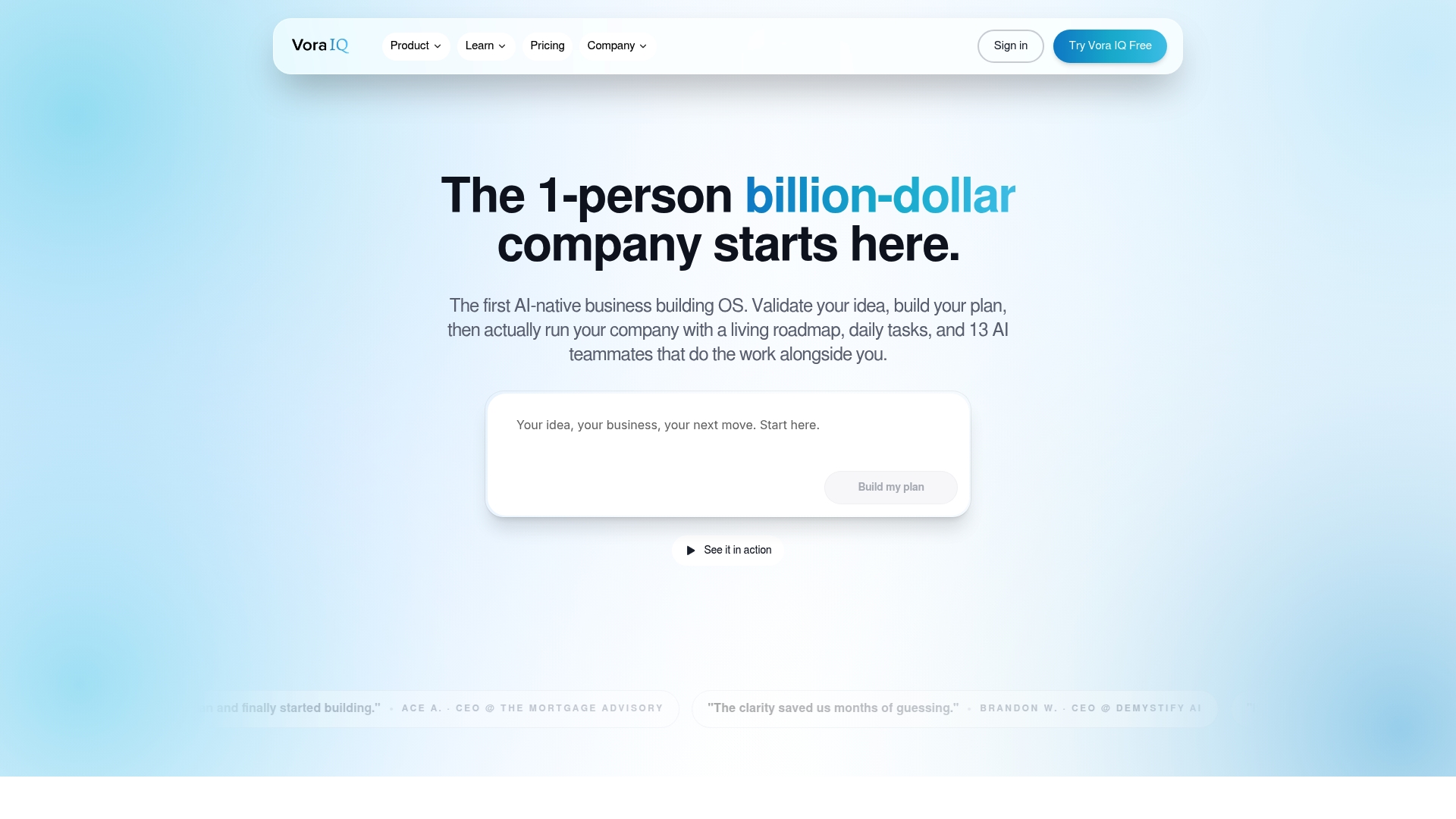
The difference from hiring a consultant or using a standalone tool is scope. You get 13 specialist AI teammates covering the functions a full team would handle, without the overhead. Vora IQ has delivered over 2,400 unique roadmaps across industries, and its free Idea Report Card lets you judge the system before committing. If you want to see which use cases fit your stage, the platform maps its features directly to founder type and business model.
Key Takeaways
The most effective online business planning approach combines the right format for your audience, linked financial modeling, and a tool that keeps your narrative and numbers consistent throughout.
| Point | Details |
|---|---|
| Format determines tool choice | Traditional plans suit lenders; lean startup plans suit early validation. Match the format to your audience first. |
| Linked financials are non-negotiable | Change one revenue assumption and every statement should update automatically. Manual spreadsheets break this. |
| Businesses that plan grow faster | Companies that plan and track against their plan grow 30% faster than those that do not. |
| Free tools have a real cost | SBA and SCORE templates provide structure but require you to supply all research, writing, and financial modeling yourself. |
| Vora IQ extends beyond the document | For solo founders, Vora IQ delivers roadmaps, financials, compliance, and execution support across 13 AI specialist functions. |