
Turn Elevator Pitch Examples Into a One Page Roadmap for Founders
By Vora IQ Team
Founder-focused elevator pitch examples and 4-beat templates: 15–60s scripts, rehearsal drills, and a tool-enabled workflow that turns your pitch into a...
- elevator pitch examples

A founder’s elevator pitch is a 30 to 60 second snapshot with one job: earn a specific next step. It runs through four beats: the hook, why now, what you do plus one proof point, and a small ask. Skip any beat and the pitch drifts into a company description nobody remembers by the elevator doors.
TL;DR:
- Shorter pitches require every word to be highly precise to effectively deliver the core message within 15 to 30 seconds.
- The four-beat framework—problem, why now, solution with proof, and a specific ask—must be strictly followed for clarity and memorability.
- Tailoring your pitch to the audience involves emphasizing market timing for investors, operational metrics for customers, or mutual benefits for partners.
- Regular rehearsal, recording, testing on non-experts, and refining the ask help ensure a natural and impactful delivery.
- Turning your pitch into a tangible plan benefits from tools like Vora IQ, which assists in generating, practicing, and managing follow-up tasks.
Table of Contents
- Elevator Pitch Examples by Length: 15, 30, and 60 Seconds
- The Four-Part Framework Behind Every Strong Pitch
- Tailoring Your Pitch by Audience and Stage
- Rehearsal Drills That Make a Pitch Sound Natural
- How Vora IQ Turns a Pitch Into a Working Plan
- Elevator Pitches Across Different Industries
- Elevator Pitches for Job Seekers and Career Changers
- The Templates Founders Actually Need vs. the Advice They Get
- Build Your Pitch and Turn It Into a Plan With Vora IQ
- Sources
Elevator Pitch Examples by Length: 15, 30, and 60 Seconds
The shorter the pitch, the harder every word has to work. Here’s how the same startup story compresses or expands depending on how much time you get.
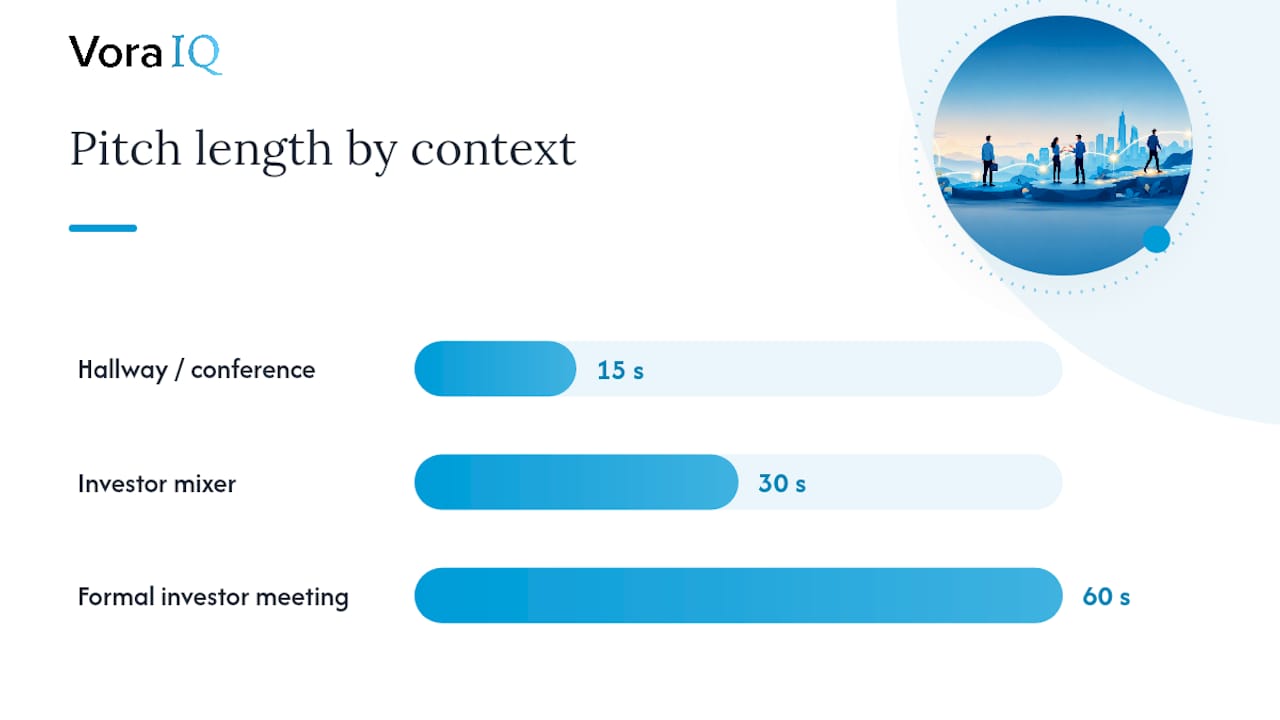
15-second version (hallway, conference, cold intro): We built a deposit tool that recovers it automatically. We’re live with 40 restaurants in Austin. Can I send you a one-pager?"
- Hook/Stakes: “Restaurants lose a noticeable percentage of revenue to no-shows.”
- Specifics + proof: “Deposit tool… live with 40 restaurants.”
- Step/Ask: “Can I send you a one-pager?”
30-second version (investor mixer): “No-show reservations cost independent restaurants thousands a month, and most owners just eat the loss. We built a booking tool that charges a small deposit automatically, refundable if you cancel with notice. We’re raising a seed round to expand to three more cities. Worth 15 minutes next Wednesday?”
60-second version (formal investor meeting): Reservation apps like OpenTable don’t touch the problem because they’re not built to collect payment. We built a deposit and reminder system that plugs into a restaurant’s existing booking flow. We’re raising seed round funding of $750,000 to hire two engineers and expand into Dallas and Houston. Would you be open to a follow-up call to walk through our traction numbers?"
Customer-facing 30-second version (B2B SaaS, selling not fundraising): “Most ops teams manage vendor contracts across spreadsheets, email threads, and whatever their last hire remembers. We built a tool that centralizes contract renewal dates and flags risk automatically. One logistics client cut missed renewals from 12 a year to zero. Want to see it on your contracts in a 15-minute demo?”
Each example follows the four-part structure and closes with a specific, low-friction ask rather than a vague “let’s talk sometime.”
The Four-Part Framework Behind Every Strong Pitch
Every pitch that lands follows the same skeleton, whether it’s for a cannabis logistics startup or a climate hardware company. Miss one beat and listeners either lose the thread or forget to act.
- Hook/Stakes (5 to 10 seconds). Name the problem in a way that makes the listener feel its cost. Skip your company name here; nobody cares yet.
- Shift/Why now (5 to 10 seconds). Explain what changed. New regulation, new technology, a market gap that just opened.
- Specifics/Solution plus one proof (15 to 25 seconds). State what you built in plain language, then back it with exactly one metric. Two proof points dilute the first one.
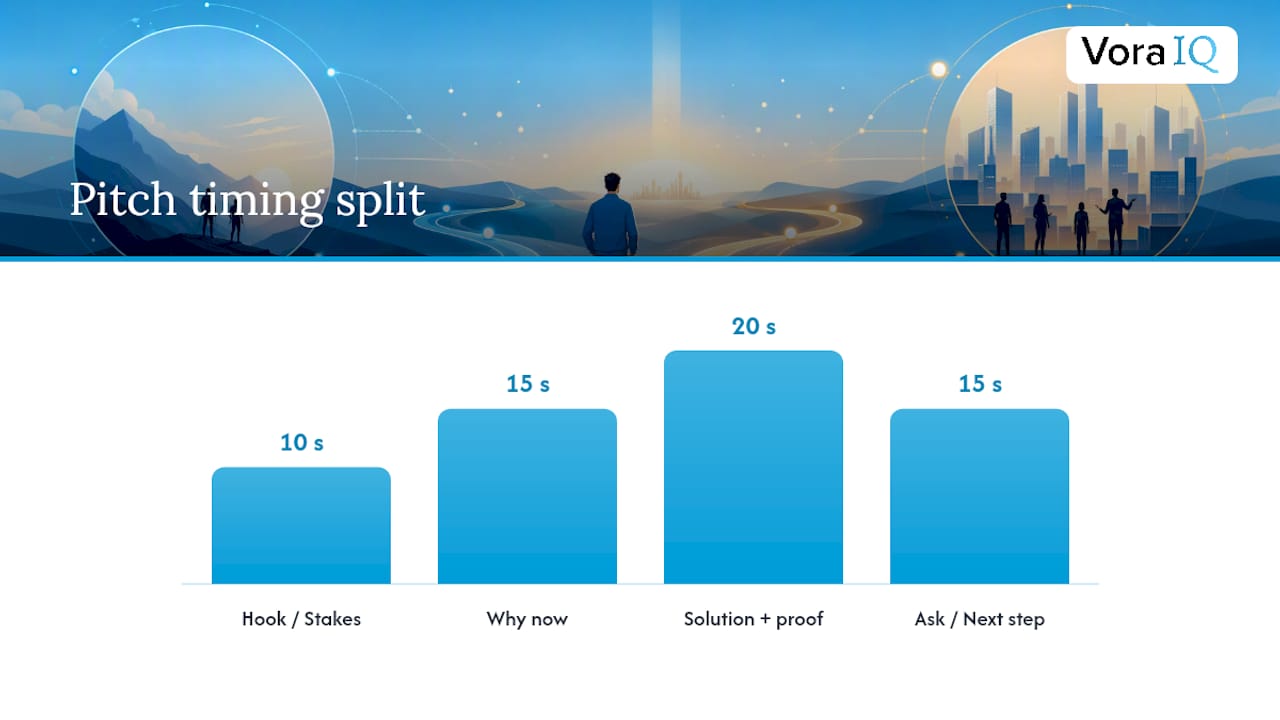
- Step/Ask (5 to 10 seconds). Ask for something small and specific. A recommended timing split for 60 seconds runs Hook 10s, Problem 15s, Solution 20s, Ask 15s.
Pro Tip: Cut every sentence that starts with “we’re passionate about” or “our mission is.” Investors and customers care about the problem’s cost and your evidence, not your motivation.
Don’t reach for jargon like “synergistic” or “disruptive.” Do use plain nouns and one real number. An elevator pitch designed to be remembered always answers what you’re building, why now, why you, and what you want next.
Tailoring Your Pitch by Audience and Stage
The same startup needs at least two versions of its pitch, sometimes three. An investor wants market size and traction. A customer wants to know what changes for them tomorrow. A partner wants to know what’s in it for their business.
- Investors want the “why now” beat expanded. They’re evaluating timing and market size as much as the product.
- Customers want the problem beat expanded and the fundraising language cut entirely. Nobody buying software cares that you’re raising a Series A.
- Partners want to hear how the relationship benefits both sides, so swap your proof point for one relevant to their business.
- Pre-seed founders should lean on the problem and the founder’s unique insight since there’s little traction to show yet.
- Seed-stage and later founders should lead with the proof point (revenue, retention, pilot results) because that’s what separates them from every other pitch in the room.
Prepare two or three versions of your pitch that keep the same four beats but swap the stakes and specifics for the room you’re in.
Rehearsal Drills That Make a Pitch Sound Natural
A pitch that sounds memorized is worse than one that’s rough but conversational. The fix isn’t more polish. It’s more reps under realistic conditions.
- Record and review. Say your pitch into your phone, then watch it back. Most founders discover they talk faster and use more filler words than they think.
- Time it strictly. Run the 30-second version with a stopwatch three times in a row. If you’re consistently over by 10 seconds, cut a clause, not a beat.
- Test on non-experts. A founder guide on pitch clarity recommends practicing on people outside your industry. If they can repeat your problem statement back to you, it landed.
- Practice the ask out loud, separately. Founders often trail off right before the close. Rehearse the last sentence on its own until it feels as natural as the opener.
Pro Tip: Breathe before your proof point, not after. A short pause before your metric makes it land as a deliberate reveal instead of a rushed afterthought.
The most common mistakes are jargon, vague asks (“let’s stay in touch”), and feature dumping, listing five things your product does instead of one thing it solves. Fix each by cutting to one sentence per beat.
How Vora IQ Turns a Pitch Into a Working Plan
Writing the pitch is the easy part. Turning it into a plan you actually execute is where most founders stall. Vora IQ was built to close that gap. Its AI teammates help draft your hook, problem statement, and proof point based on your actual market data, not generic templates, then export the result into a one-pager you can send after the ask lands.
Vora IQ has generated over 2,400 unique roadmaps for founders across industries, and that pattern recognition shapes how the pitch prompts get built: the system knows which proof points tend to land for a SaaS founder versus a hardware founder. Once your pitch is set, Vora IQ’s adaptive roadmap turns your closing ask, whether it’s a call, a demo, or an intro, into tracked tasks so momentum doesn’t stall the next morning.
Elevator Pitches Across Different Industries
A biotech founder and a marketplace founder are solving different problems for different audiences, and their pitches should sound like it. The four beats stay fixed. What changes is which beat carries the weight.
Hardware and climate tech founders should lean hard on the “why now” beat, since regulation or cost curves (falling battery prices, new emissions rules) often explain the timing better than the product itself. A pitch might open with “compliance costs for mid-size manufacturers just tripled” rather than a product description.
Healthcare and staffing startups need a proof point tied to a measurable operational outcome, like fill rate or time-to-hire, since buyers in this space are numbers-driven and skeptical of unproven tools.
B2B SaaS founders should keep the solution beat tight and technical enough to sound credible, but resist naming every feature. One workflow, one metric.
Marketplace startups should state both sides of the market in the hook (who’s supplying, who’s buying) since a one-sided description confuses listeners fast.
Consumer products benefit from a sensory or emotional hook before the stats. Lead with what changes for the customer’s day, then follow with adoption numbers.
Across every industry, the same rule holds: one proof point, not three, and a small ask at the close.
Elevator Pitches for Job Seekers and Career Changers
While this guide focuses on founders pitching a business, the four-beat structure adapts cleanly if you’re introducing a startup idea in a job interview or networking context tied to launching something new, rather than describing your resume.
If you’re a career changer pitching a startup idea to a potential co-founder or early hire, your hook should focus on the gap you noticed in your previous industry. For example: “I spent six years in hospital procurement and watched the same ordering mistakes cost hospitals thousands every month. I’m building software to fix it.” That’s a hook grounded in earned credibility, not a job title.
Your proof point in this context might be a pilot, a waitlist, or even a small paid customer, since career changers often lack company traction but do have domain insight worth stating plainly. Close with a specific ask suited to the room: “Would you be open to advising for equity?” or “Can I walk you through what I’ve built so far?”
The mistake to avoid here is over-explaining your career transition. Investors and collaborators care about the problem and your evidence, not the full story of why you left your last job.
The Templates Founders Actually Need vs. the Advice They Get
Most pitch advice online is generic enough to apply to anyone, which is exactly the problem. “Be concise” and “know your audience” aren’t wrong, but they don’t help a founder sitting at 11 PM trying to cut a 90-second ramble into 30 seconds before tomorrow’s investor call.
What the research behind this guide actually supports is narrower and more useful: one proof point beats three, a small ask beats a broad one, and the timing splits matter more than most founders assume. A pitch that spends 20 seconds on the hook and five on the ask has the ratio backward, and no amount of charisma fixes that math.
The conventional advice oversells personality and undersells structure. Founders don’t need to sound more confident. They need a script with correctly weighted beats and a rehearsed close. Prioritize the framework first, delivery second. A well-structured pitch delivered slightly awkwardly still gets the next meeting. A charismatic pitch with no clear ask usually doesn’t.
— Khalel
Build Your Pitch and Turn It Into a Plan With Vora IQ
Templates and rehearsal drills fix the pitch itself. What happens after the ask lands is where most founders lose momentum, chasing the follow-up call without a plan for what comes next. Vora IQ closes that gap by turning your finished pitch into a working roadmap instead of leaving it as a document that sits in a folder.
Inside Vora IQ, you get a pitch template generator that builds your hook, problem, and proof point from your actual business data, rehearsal prompts to tighten your timing before a real meeting, a one-page export you can send the moment someone asks for details, and a task list that converts your closing ask into tracked next steps. If your pitch ends with “can I send a one-pager,” Vora IQ builds that one-pager for you and keeps the follow-up tasks moving. Compare the full toolkit on the business plan software page, check pricing and plans, or start building your pitch directly at Vora IQ.
Sources
For deeper examples and rehearsal frameworks, see the 60-second pitch framework, timing drills, proof-point guidance, and Vora IQ’s pitch deck generator guide.
- How to build an elevator pitch investors remember — Funded
- How to craft your pitch elevator: The 60-second framework that gets you the room — The Bract Agency
- How to Nail Your Elevator Pitch in 60 Seconds, Every Time | Pitchr
- Elevator Pitch Guide for Founders: Get the Next Meeting — StartupFundraising