
A Founder Operating Rhythm Turns Chaos Into a Weekly System
By Vora IQ Team
Transform chaos into clarity with a founder operating rhythm. Boost decision-making and team alignment with simple weekly practices.
- founder operating rhythm

A founder operating rhythm is the repeating set of meetings, pre-reads, and protected blocks that turn strategy into predictable execution. Skip the elaborate rollout for now and do one thing this week: install a 60-minute weekly leadership sync plus two protected deep-work periods in the mornings. That’s it.
Founders who run on instinct alone tend to relearn the same lessons every quarter. A rhythm fixes that by forcing decisions onto a schedule instead of waiting for a crisis to force them.
What you get within two or three weeks:
- Faster decisions because the same questions get answered the same day every week
- Fewer blindsided moments because problems surface in a sync instead of an inbox at 11 p.m.
- A team that stops asking “what should I be working on” because priorities are visible
Key Takeaways
A founder operating rhythm works because it forces decisions onto a fixed weekly schedule instead of waiting for urgency to force them.
| Point | Details |
|---|---|
| Own the rhythm personally | Founders who delegate cadence before it’s established usually watch it quietly disappear. |
| Use three meeting layers | Run a 60-minute weekly sync, a half-day monthly review, and a full-day quarterly planning session. |
| Enforce the 24-hour pre-read | Circulate data a full day ahead so meetings stay focused on decisions, not explanations. |
| Stage the rollout over 90 days | Start with bookends in weeks 1 and 2, add the sync by week 6, then layer in monthly and quarterly reviews. |
| Automate the mechanical layer | Vora IQ generates pre-reads, scorecards, and decision logs automatically, cutting setup time for the whole rhythm. |
Table of Contents
- What a Founder Operating Rhythm Actually Is
- What Cadence Should a Startup’s Meetings Follow?
- A Founder Week and Meeting Templates You Can Copy Today
- How Do You Install This Rhythm Without Adding Bureaucracy?
- How Do You Know the Rhythm Is Actually Working?
- Why Do Most Founder Rhythms Fall Apart?
- Vora IQ: An AI-Native Way to Install and Sustain This Rhythm
- Sources
What a Founder Operating Rhythm Actually Is
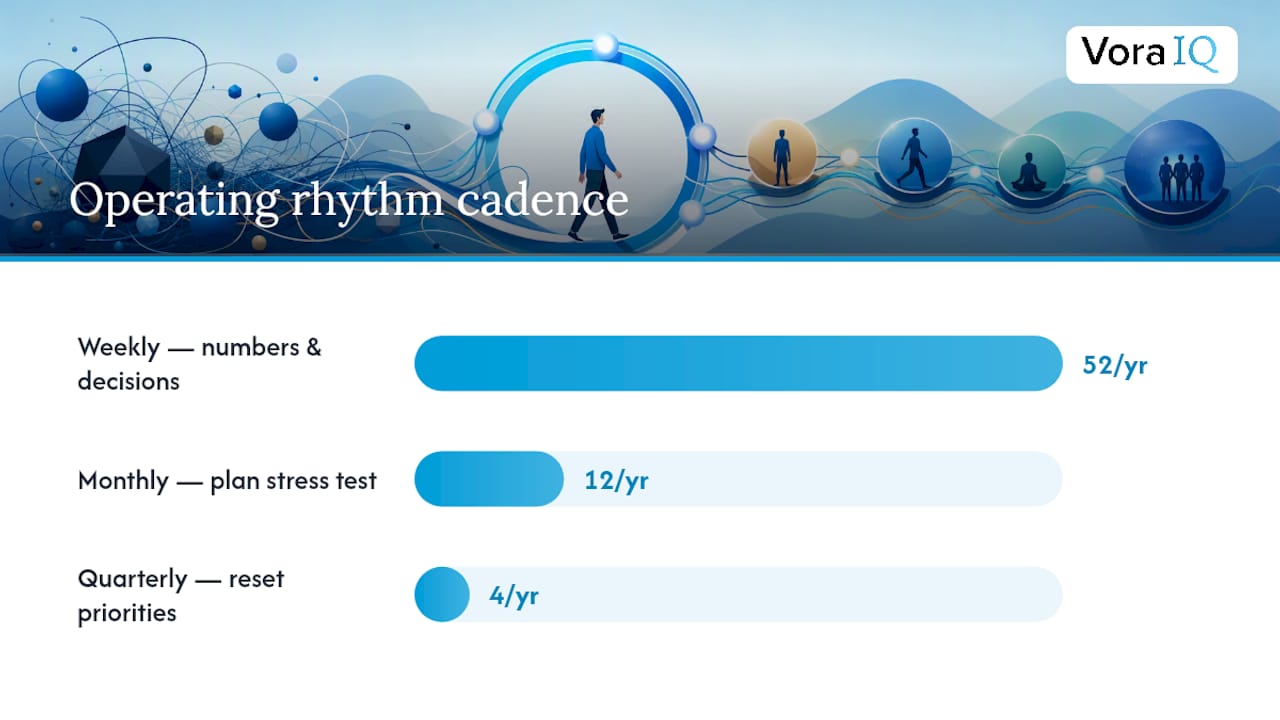
At its core, an operating rhythm is nothing more than meetings, data, and decisions repeated on a fixed schedule. Not a philosophy. Not a culture deck. A weekly sync where the same numbers get reviewed, a monthly checkpoint where the plan gets stress tested, and a quarterly session where priorities reset.
Founders need to own this personally, at least early on. Delegate the rhythm before it’s established and it quietly dies. Owning it doesn’t mean running every meeting forever. It means being the one who enforces the pre-read, kills the meeting that has no decision to make, and protects the calendar blocks that make deep work possible.
Get the rhythm right and three things show up fast:
- Decision velocity. Choices that used to take a week of hallway conversations get made in a 15-minute agenda item.
- Accountability. Named owners with deadlines replace vague “someone should look into that” energy.
- Predictability. Your team can plan their own week because they know what’s coming in yours.
A startup operating system is the broader container for this, but the rhythm is the part that actually runs week to week.
What Cadence Should a Startup’s Meetings Follow?
Most functioning startups run several meeting layers, each with a distinct job. Getting this structure right matters more than getting any single meeting perfect, according to Fairview’s framework for startup operating rhythm.
- Weekly sync (60 minutes). Tactical alignment only. This meeting exists to make decisions, not to explain numbers. If the first 20 minutes go to someone walking through a spreadsheet, the prep failed. Data belongs in a pre-read, not on screen share.
- Monthly business review lasting several hours. This is where you validate whether the plan still holds. Resource allocation gets revisited here. Is the roadmap still realistic given what actually happened last month?
- Quarterly planning (full day, ideally week 10 or 11 of the prior quarter). This sets the next 90 days of priorities. Run it too late and your team starts the new quarter with no target.
Three rules apply across all three layers: circulate data at least 24 hours ahead, assign a named owner to every open item, and keep pre-reads short enough that someone actually reads them.
Pro Tip: If people are asking clarifying questions about the numbers during the meeting, your pre-read wasn’t a pre-read. It was an attachment nobody opened.
A Founder Week and Meeting Templates You Can Copy Today
A structured weekly rhythm with a Monday planning block, protected midweek deep work periods, and a Friday review turns reactive weeks into something closer to a predictable operating system, based on one CEO’s account of rebuilding his own weekly rhythm.
| Day | Focus | Time block |
|---|---|---|
| Monday | Planning bookend, weekly sync | Morning: planning; late morning: 60-minute sync |
| Tuesday | Deep work (build/strategy) | several hours, no meetings |
| Wednesday | Customer or growth time | Calls, demos, partnership conversations |
| Thursday | Deep work (build/strategy) | several hours, no meetings |
| Friday | Review bookend | Afternoon: wins, lessons, next week’s priorities |
Weekly sync agenda, kept to 60 minutes:
- First 10 minutes: triage. What changed since last week that needs airtime?
- Next 30 minutes: decisions only, one item at a time, moving fast on anything already covered in the pre-read
- Final 15 minutes: confirm owners and deadlines for anything decided
Friday review agenda: wins from the week, one lesson learned, next week’s top three priorities, and a short shutdown ritual so Monday doesn’t start from zero.
How Do You Install This Rhythm Without Adding Bureaucracy?
Trying to launch all three meeting layers in week one is how most rhythms die within a month. Stage it instead.
- Weeks 1 and 2: Install just the bookends. Monday planning, Friday review, and two protected deep-work periods in the mornings. Nothing else changes yet.
- Weeks 3 through 6: Add the weekly sync, complete with a pre-read template and a decision log. Keep it to 60 minutes even if it feels rushed at first.
- Months 2 and 3: Layer in the monthly business review, then the quarterly planning session once you have a full month of sync data behind you.
Founders who build this structure by month six tend to avoid becoming the operational bottleneck as headcount grows, according to Velox’s research on startup operating systems. Tell your team what’s changing and why before you start, and commit to the full 90 days before judging whether it’s working. Two weeks of a new habit tells you nothing.
How Do You Know the Rhythm Is Actually Working?
Watch a handful of signals rather than trying to measure everything. Two matter most: action-completion rate (are the things decided in Monday’s sync actually done by the following Monday?) and decision lead time (how long between a problem surfacing and someone deciding what to do about it?).
Two more numbers worth tracking weekly:
- Pre-read compliance. What percentage of attendees actually opened the doc before the meeting?
- Attendance consistency. A sync that keeps losing people isn’t broken by accident. Something about the format or timing is off.
Feed the sync with a small, consistent set of inputs each week: pipeline movement, cash position, and your core usage metric. An OKR framework gives you a natural source for that last one.
When action-completion drops or attendance gets patchy, don’t add more structure reflexively. Sometimes the fix is fewer agenda items, not more process.

Why Do Most Founder Rhythms Fall Apart?
Four patterns break cadence more than anything else, and each has a straightforward fix, per Fairview’s breakdown of common cadence failures.
- Data shows up in the meeting instead of before it. Fix: enforce the 24-hour pre-read template, no exceptions, even when someone’s running late.
- Discussion happens but nothing gets decided. Fix: every agenda item needs a named owner and a deadline attached before the meeting ends, not “we’ll circle back.”
- Too many people in the room. Fix: cap attendance to actual decision-makers. Everyone else gets a written update instead.
- Cadence erodes the moment something urgent comes up. Fix: treat your bookends like a client meeting. An interruption is the exception, not the new normal.
Pro Tip: The first time you cancel your Friday review “just this once,” write down why. You’ll notice the same excuse showing up again within a month.
Vora IQ: An AI-Native Way to Install and Sustain This Rhythm

Building all of this by hand from templates and spreadsheets works, but it’s slow. Vora IQ automates the mechanical parts of the rhythm: pre-read generation, scorecards pulled from your actual metrics, and action tracking that flags what’s overdue before your Monday sync starts.
Here’s how the features map to the rules above:
- Automated pre-reads replace the “someone forgot to send the doc” problem entirely
- Adaptive dashboard templates double as your weekly scorecard input
- Built-in decision logs assign owners and deadlines automatically instead of relying on someone’s meeting notes
Vora IQ has generated more than 2,400 tailored roadmaps for early-stage founders, each built around the specific rhythm their business needs rather than a generic template.
A founder’s take on making this stick
Rhythm isn’t bureaucracy. It’s leverage, the same way a workout schedule is leverage against your own inconsistency. Try the smallest version first: Monday planning, Friday review, one week. See what breaks before you add anything else.
— Khalel
Start Installing Your Rhythm This Week
Building the templates yourself works, but most founders lose momentum by week three because the pre-reads take too long to assemble and the decision log lives in three different tools. Vora IQ handles that mechanical layer automatically: it generates your weekly pre-reads, builds scorecards from your real metrics, and tracks every open action item with an owner and a deadline attached.
If you’ve been meaning to formalize how your startup operating system actually runs week to week, this is the fastest way to see it built out for your specific business rather than copied from a generic deck. Start with a free Idea Report Card at Vora IQ and see your first weekly sync template generated before your next Monday.
Sources
- How to Design an Operating Meeting Rhythm for Your Startup
- The Startup Operating System Every Founder Needs by Month Six