
The Best Idea Validation Tool for Solo Founders
By Vora IQ Team
Discover the best idea validation tool for solo founders. Get a free Idea Report Card from Vora IQ for AI-driven insights and market analysis.
- idea validation tool

Vora IQ is the most practical idea validation tool for solo founders who need a clear answer before they spend a week building. Start with a free Idea Report Card and run an AI market scan today. You get AI-driven market sizing, auto-generated interview scripts, and an adaptive roadmap built on 2,400+ validated engagements across industries. That combination of breadth scan plus structured interviews is exactly what Harvard Business School prescribes as the foundation of reliable market validation.
Table of Contents
- What does an idea validation tool actually do?
- Core features every validation tool should have
- A compact validation workflow you can finish in 2–6 weeks
- How Vora IQ maps its features to each validation step
- What does idea validation cost, and what plan should you start with?
- What outcomes should you expect from a focused validation run?
- How do you pick the right tool? A quick checklist
- Key Takeaways
- The case for AI-first validation (and where it falls short)
- Vora IQ gives you a clear starting point, not a blank page
- Useful sources and further reading
What does an idea validation tool actually do?
An idea validation tool verifies four things before you commit budget: real demand exists, people will pay for a solution, competitors leave a meaningful gap, and you can deliver profitably. Think of it as a gut check backed by real analysis. You use one at three moments in a founder’s lifecycle:
- Pre-prototype: Run an AI market scan to size the opportunity and map competitors before writing a line of code.
- Pre-MVP: Confirm willingness to pay through customer discovery conversations and a smoke test or landing page.
- Pivot hypothesis check: Re-run the scan on a repositioned version of the idea to see whether the signal improves.
Validation methods map to what they prove: landing pages prove attention, pre-orders prove willingness to pay, and interviews prove problem depth. A solid tool supports all three, not just one.
Core features every validation tool should have
Not every feature matters for every idea type. Consumer apps driven by viral growth need different signals than B2B SaaS products. Use this table to match features to your situation.

| Feature | What it proves | Skip if… |
|---|---|---|
| AI market sizing | Addressable demand exists | You already have primary research |
| Competitor mapping | Gap in the market is real | Your category has zero established players |
| Hypothesis stress-test | Core assumptions are sound | You’ve already run structured interviews |
| Willingness-to-pay indicators | Someone will spend money | Consumer virality is the only growth lever |
| Interview guide generation | Problem depth is confirmed | You have a seasoned sales team doing discovery |
| Validation roadmap | Next experiments are ranked | You’re post-revenue with clear PMF signal |
AI-powered competitive analysis workflows are especially useful for B2B founders, where the gap between what incumbents offer and what buyers actually want is the whole opportunity.
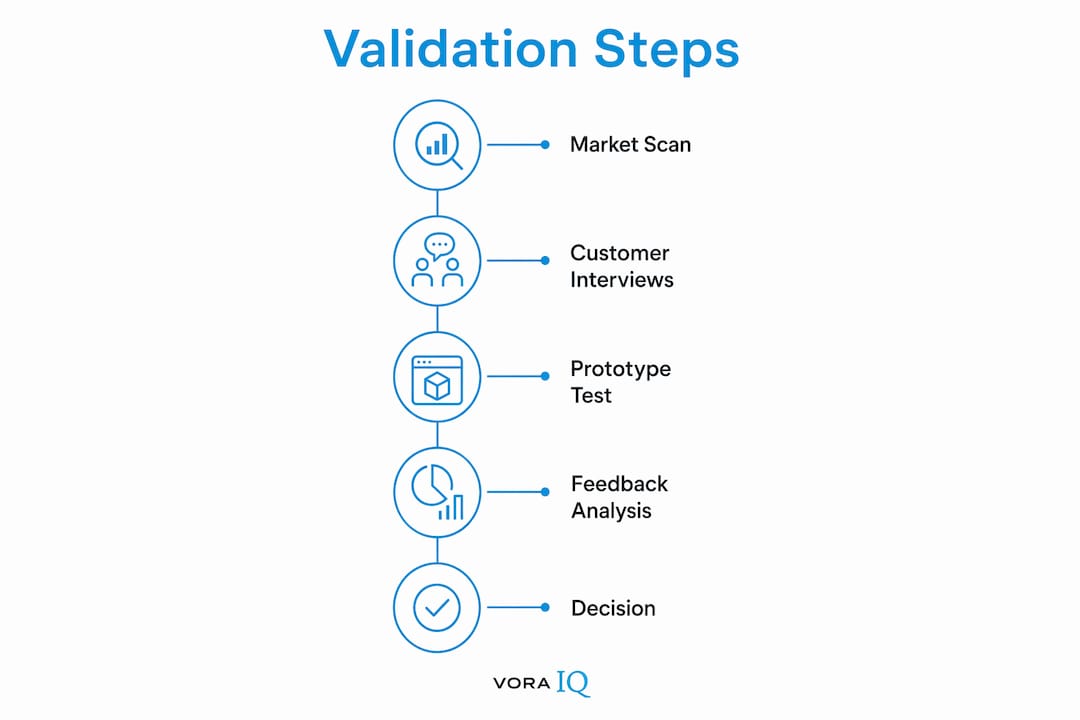
A compact validation workflow you can finish in 2–6 weeks
Combining AI breadth scans with several customer interviews is the highest-confidence approach for solo founders working lean. Here’s the sequence:
- Week 1: AI market scan. Feed your idea into your validation tool. Get market size, competitor gaps, and a ranked list of assumptions to test. Cost: $0–$50 (free tier or entry plan).
- Week 2: Customer discovery. Run a batch of 5–10 customer discovery interviews with people who match your target persona. Use the interview script your tool generates. Focus on problem frequency and what they currently use to solve it.
- Week 3: Smoke test. Build a simple landing page or a “fake door” feature. Drive traffic via organic posts or a small paid campaign. Trend-tracking tools like Exploding Topics help you find the right search terms to target.
- Week 4–6: Pre-order or concierge MVP. If smoke-test conversion looks promising, offer a pre-order or manually deliver the service to a handful of early customers. This is your willingness-to-pay proof.
Lean validation stacks run from $0 for a quick filter up to $200–$500 for smoke tests, and $1,000+ for pre-orders and supplier sampling. Pick the lowest-fidelity test that addresses your riskiest assumption first.
Pro Tip: Ask interviewees to describe the last time they dealt with the problem, not whether they’d use your solution. Behavioral recall beats hypothetical intent every time.
How Vora IQ maps its features to each validation step
Vora IQ’s feature set is built around the exact workflow above. The market analysis module runs the AI breadth scan in minutes, surfacing addressable market size, competitor positioning, and demand signals. The interview guide generator produces a ready-to-use discovery script tailored to your specific idea and target persona. After interviews, the adaptive roadmap ranks your next three experiments by speed and cost, so you always know what to test next.
AI maps opportunity quickly; interviews confirm depth. Vora IQ is built on that principle. The platform’s 13 specialist AI teammates each handle a distinct part of the validation and planning process, from financial modeling to compliance awareness, so you’re not stitching together five separate tools.
2,400+ roadmaps delivered. Vora IQ has generated over a large number of unique roadmaps and validated engagements across industries, giving solo founders a proven, repeatable path from raw idea to clear go/no-go signal.
A founder building a B2B productivity tool used Vora IQ’s market scan to identify that their primary competitor left a gap in onboarding support for non-technical users. Three interviews confirmed the pain was acute. The roadmap flagged a concierge MVP as the fastest proof point. They had a paying customer within five weeks, without writing a single line of product code.
What does idea validation cost, and what plan should you start with?
Pricing for validation tools follows a predictable shape. Here’s what to expect:
- Free entry point: Run one full AI market scan and generate one interview script. Use this to judge output quality before paying anything.
- Monthly plan: Covers ongoing scans, roadmap updates, and access to the full feature set. Right for founders actively iterating on an idea.
- Annual plan: Lower per-month cost, often with add-ons like custom landing page creation. Right once you’ve confirmed the idea has legs and you’re moving into execution.
Vora IQ starts you with a free Idea Report Card and no credit card required, so you can judge the quality of the AI-driven analysis before committing a dollar. Paid plans bill immediately, monthly can be cancelled anytime, and every plan is backed by a 14-day money-back guarantee. Once you are in, run the market scan, generate the interview script, and export the roadmap. Those three outputs tell you whether the tool fits your workflow.
Budget the full several-week stack at $0–$500 for most solo founders, depending on whether you add paid traffic for a smoke test.
What outcomes should you expect from a focused validation run?
The goal of a validation run isn’t certainty. It’s a clear signal that reduces your biggest risk before you spend serious time or money.
Signal thresholds matter. If a substantial portion of interviewees describe the problem unprompted and multiple express willingness to pay a specific price, that’s a strong PMF signal worth acting on.
Founders who complete a structured validation run typically reach one of three outcomes: a confirmed go signal with a clear customer segment, a pivot opportunity where a narrower version of the idea has stronger demand, or a clean no-go that saves months of misallocated effort. Each outcome has real value. A no-go at week two costs you almost nothing compared to a no-go at month eight post-launch.
Vora IQ’s validation guides document case outcomes across industries, showing how founders used pivot recommendations to reposition ideas that had weak initial signals into products with paying customers.
How do you pick the right tool? A quick checklist
Speed and evidence quality are the two variables that separate good validation tools from bad ones. Run through this list before you commit:
- Speed of insights: Does the tool return a market scan in minutes or days? Slow tools break momentum.
- Evidence types: Does it surface purchase signals (search volume, pre-order data) or just attention signals (clicks, impressions)?
- Interview support: Does it generate a discovery script, or does it leave you to write your own questions?
- Exportable rationale: Can you share the output with a co-founder, investor, or advisor without re-explaining everything?
- Repeatability: Can you re-run the scan on a repositioned idea without starting from scratch?
Red flags to avoid: tools that report only click-through rates as proof of demand; opaque methodology with no explanation of how signals are weighted; no interview support at all; and no free trial or a trial so restricted it tells you nothing.
To test a vendor during the trial, run one market scan, generate one interview script, and export a 3-experiment validation roadmap. If any of those three outputs is missing or vague, the tool won’t serve you when the stakes are higher.
Key Takeaways
The most reliable idea validation process combines an AI market scan with several customer interviews and at least one smoke test, run in sequence over 2–6 weeks.
| Point | Details |
|---|---|
| Start with an AI scan | Run a market scan first to size demand and map competitors before talking to anyone. |
| Interview for depth | Conduct 5–10 discovery interviews to confirm problem frequency and willingness to pay. |
| Match tests to hypotheses | Use landing pages to prove attention, pre-orders to prove payment intent, and interviews to prove problem depth. |
| Budget realistically | A lean validation stack costs $0–$500; most solo founders need no more than the entry plan plus a small smoke-test budget. |
| Vora IQ for end-to-end validation | Vora IQ covers the full workflow: AI market scan, interview scripts, adaptive roadmap, and 2,400+ proven engagements. |
The case for AI-first validation (and where it falls short)
Most founders default to a landing page test because it feels like evidence. It isn’t. A click-through rate tells you someone found your headline interesting, not that they have the problem you think they have or that they’d pay to solve it. The AI-first approach flips the order: you map the structural demand before you write any copy, which means your landing page, if you build one, is testing a hypothesis you already have reason to believe.
That said, AI analysis alone isn’t enough. The market scan narrows your target; the interviews confirm whether the pain is real and acute enough to drive a purchase. Knowing when to stop validating and start operating is its own skill. The risk isn’t that founders validate too much; it’s that they run smoke tests in a loop and never commit. Use the signal thresholds above as your exit criteria. When 5–10 interviewees confirm the problem and several name a price, you have enough. Move.
Vora IQ gives you a clear starting point, not a blank page
Solo founders who try to validate ideas with spreadsheets and cold outreach spend weeks getting to the same place Vora IQ reaches in an afternoon. The platform runs the AI market scan, generates your interview script, ranks your next experiments, and builds an adaptive roadmap that updates as your idea evolves. No agency fees. No six-month retainer. Just a free Idea Report Card that puts real analysis in your hands on day one.
Vora IQ has delivered over 2,400 roadmaps to solo founders across industries. Your free Idea Report Card gives you a real read on the idea before you pay anything, which is exactly what you need to start week one of the workflow above. Check the use-case page to see how founders in your category are using it, then get your report and run the scan before you spend another day guessing.
Useful sources and further reading
Build your validation knowledge with these guides, then run the workflow inside Vora IQ:
- 5 Steps to Validate Your Business Idea — Harvard Business School’s structured market-validation framework; read this before your first interview.
- How to Validate a Product Idea Before You Waste a Single Dollar — Practical breakdown of validation methods and what each one proves.
- How to Validate a Product Idea in 6 Steps — Exploding Topics guide on pairing trend signals with keyword research.
- How to Validate a Startup Idea With AI — Vora IQ’s internal guide on combining AI scans with customer discovery; start here for the platform-specific workflow.
- How to Validate a Business Idea Before You Waste 6 Months Building It — Stepwise checklist from Vora IQ’s blog for founders who prefer a structured approach.
- You Validated Your Startup Idea. Now What? — Vora IQ guide on post-validation next steps once you have a go signal.