
PandaDoc Alternatives for Solo Founders: AI OS That Builds and Executes
By Vora IQ Team
Discover the top PandaDoc alternatives for solo founders. Vora IQ automates proposals, pitch decks, and execution for your business.
- pandadoc alternatives

Vora IQ is the top pick for solo founders who need more than a document tool. It generates investor-ready proposals, pitch decks, and business plans through AI agents, then converts those documents into living roadmaps and automated tasks. With 2,400+ roadmaps delivered, a free Idea Report Card to start, and Stripe integration built in, it covers the full job-to-be-done in one place.
TL;DR:
- Vora IQ produces proposals, pitch decks, and business plans through AI agents, then automates execution through adaptive roadmaps.
- Techstars notes that solo founders who maintain auditable plans and clear roadmaps are significantly more fundable.
- Free Idea Report Card to start; integrates with Stripe, Google Workspace, and calendar tools.
Also consider by category:
- AI-first deck builder: Tools that generate slides from live Sheets data, ideal for founders who live in Google Workspace.
- Business-plan engine with scenario modeling: Platforms that combine real-time research, three-statement financials, and milestone tracking.
- Collaborative presentation OS: Deck-native tools built for team storytelling and brand consistency.
Table of Contents
- How do the best PandaDoc alternatives compare for solo founders?
- How to choose the right AI-native OS for your startup
- What should you expect from a true AI-native OS?
- Who should pick Vora IQ vs. the other categories?
- Key Takeaways
- The tool won’t carry you — but it can keep you honest
- Vora IQ: the one platform worth evaluating first
- Useful sources
How do the best PandaDoc alternatives compare for solo founders?
The table below maps each category to the dimensions that actually move the needle for a solo founder: outputs, automation, integrations, and pricing shape.
| Dimension | Vora IQ | AI Deck Builder | Business-Plan Engine | Collaborative Deck OS |
|---|---|---|---|---|
| Best for | Solo pre-seed founder needing full OS | Google Workspace-native deck workflow | Investor-grade plan + milestone tracking | Team storytelling and brand decks |
| AI-native features | specialist agents incl. Scribe, Pivot | Slide generation from Sheets/Docs | Real-time research + scenario modeling | AI layout and copy suggestions |
| Outputs | Proposals, pitch decks, business plans, brand kit, product specs | Pitch decks (Google Slides) | Business plans, financial models | Pitch decks, presentations |
| Automation & roadmaps | Living roadmaps, task automation, adaptive pivots | Deck sync with live data | Milestone tracking | Limited |
| Integrations | Stripe, Google Workspace, calendar, CRM | Google Sheets, Slides | Varies by platform | Slack, Figma, limited CRM |
| Pricing & trial | Subscription, free Idea Report Card to start | Free tier + paid plans | Free trial, paid tiers | Free tier + paid plans |
| Ease of setup | Guided onboarding, context-aware agents | Moderate (requires Sheets setup) | Moderate | Low friction |
Vora IQ stands out because its Scribe agent doesn’t just draft a proposal — it ties that document to a roadmap and task queue. That chain from document to execution is what separates an operating system from a template library.
AI deck builders work well when your financial model already lives in Google Sheets. Integrations that read Sheets and Slides live keep investor numbers in sync and cut revision cycles from days to hours. The trade-off: they stop at the deck.
Business-plan engines with scenario modeling are strong for founders who need a rigorous three-statement financial model before they can build a deck. AI business-plan tools that combine real-time research and scenario modeling produce investor-grade plans and convert them into trackable milestones. They rarely automate the execution layer.
Collaborative deck tools (like Pitch) shine for teams that need brand-consistent storytelling across multiple contributors. For a solo founder carrying everything alone, the collaboration overhead rarely pays off.
Pro Tip: If you’re a bootstrapped solo founder raising capital, prioritize the platform that links your business plan directly to your pitch deck and roadmap. Switching tools mid-raise costs you more time than any feature saves.
How to choose the right AI-native OS for your startup
Start with outcomes, not features. Ask yourself: do I need a document, or do I need a document that becomes a plan that becomes a task list?
Outcome-first checklist:
- Does the platform produce all three outputs you need: proposal, pitch deck, and business plan?
- Can it sync live financial data into slides automatically?
- Does it export clean .pptx and PDF files? AI deck generators produce rapid first drafts, but founders must verify export fidelity before committing to a tool.
- Does automation extend to tasks and milestones, or stop at document generation?
- Is pricing transparent with no hidden seat limits?
Questions to ask on a demo:
- What data sources does the AI pull from when building a business plan?
- Can I export a .pptx and a PDF from the same draft without reformatting?
- How does the platform handle automation triggers when a milestone slips?
- What happens to my data if I cancel?
Red flags: No editable export format. Automation that only works inside the platform’s own ecosystem. Pricing that hides per-seat costs until checkout.
What should you expect from a true AI-native OS?
A genuine AI-native operating system does more than generate text. It connects your plan to your execution.
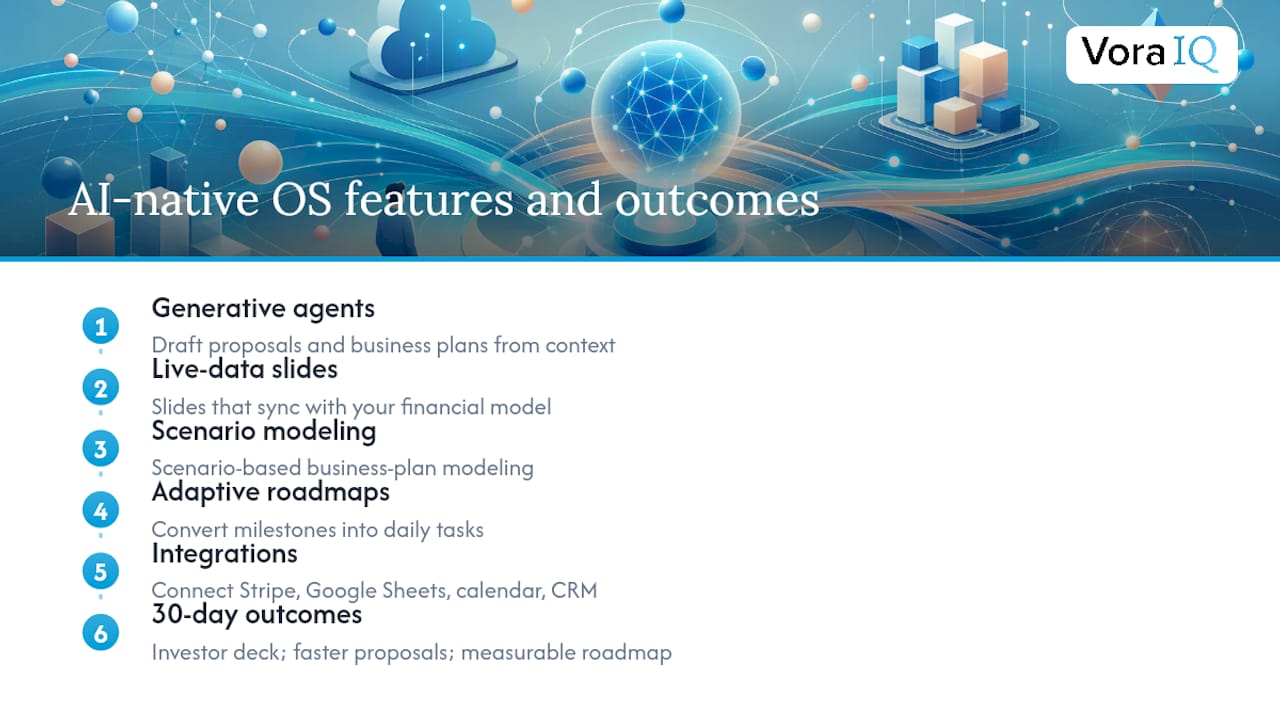
The core feature set worth expecting: generative agents that draft proposals and business plans from your context, live-data slide generation that syncs with your financial model, scenario-based business-plan modeling, adaptive roadmaps that convert milestones into daily tasks, and integrations with Stripe, Google Sheets, calendar, and CRM tools.
Expected outcomes after 30 days of disciplined use: one investor-ready deck produced from a structured input, a repeatable proposal workflow that cuts draft time significantly, and a roadmap with measurable milestones you can show an advisor or investor. Vora IQ’s feature set links AI-generated plans and proposals to living roadmaps and automation, which is the specific chain that turns a document tool into an operating system.
The practical day-to-day change is this: instead of rebuilding your investor update from scratch each month, you pull from a roadmap that already tracks what moved. That shortens follow-up emails and reduces rework on decks.
Who should pick Vora IQ vs. the other categories?
Three founder profiles, three clear answers.
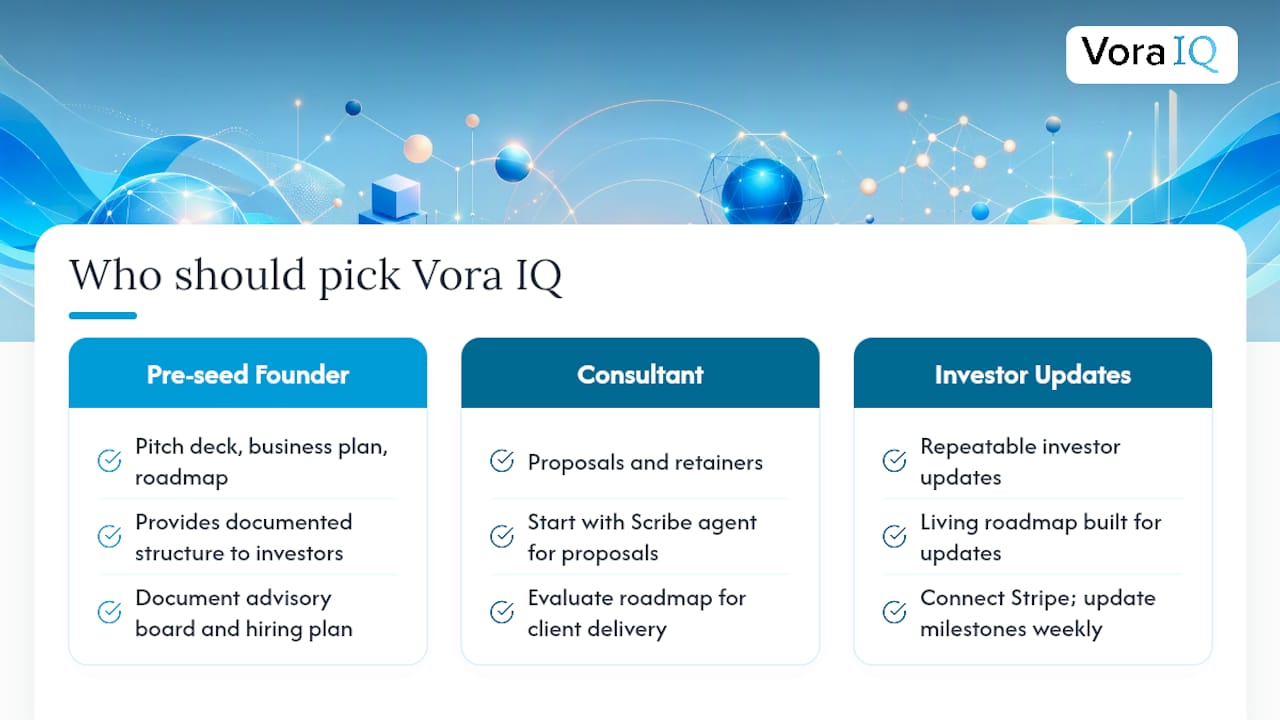
Solo pre-seed founder raising capital: Vora IQ. You need a pitch deck, a business plan, and a roadmap that proves operational maturity to investors. Advisory boards and an articulated hiring plan are the mitigations investors expect from solo founders — Vora IQ gives you the documented structure to show both.
Consultant selling proposals and retainers: Start with Vora IQ’s Scribe agent for proposals, then evaluate whether the roadmap layer adds value for your client delivery workflow. If you live entirely in Google Workspace, an AI deck builder may complement it.
Founder needing repeatable investor updates: Vora IQ’s living roadmap is built for this. Connect your Stripe data, update milestones weekly, and generate a fresh investor summary without rebuilding the deck.
Your 7–14 day evaluation: Import one existing business plan, generate a pitch deck from it, set up a roadmap with three milestones, and connect one integration (Stripe or calendar). If those four steps feel fast and the exports look clean, you have your answer.
Key Takeaways
For solo founders, the right PandaDoc alternative is an AI-native OS that links document creation to execution automation, not just a faster way to sign files.
| Point | Details |
|---|---|
| Lead with outcomes | Choose a platform that produces proposals, pitch decks, and business plans and converts them into roadmaps. |
| Export fidelity matters | Always test .pptx and PDF exports during evaluation before committing to any platform. |
| Migration in 30 days | Audit templates, run a pilot document, map integrations, then cut over with exported fallback copies ready. |
| Auditable plans build trust | Solo founders who maintain clear roadmaps and documented plans are more fundable, per Techstars. |
| Vora IQ as recommended pick | Vora IQ links AI drafting, business-plan modeling, living roadmaps, and Stripe automation in one platform with 2,400+ roadmaps delivered. |
The tool won’t carry you — but it can keep you honest
Solo founders face a specific trap: the platform becomes the plan. You spend a week building a beautiful deck and mistake it for traction. The deck is evidence. The roadmap is the discipline.
Tooling accelerates product builds but does not eliminate distribution, sales, and operational work. An AI-native OS amplifies a disciplined process — it does not replace one. The founders who get the most from these platforms are the ones who schedule a 30-minute investor-update sprint every week and document every decision in the roadmap, not just the wins.
Build your advisory board early. Document your hiring plan. Use the roadmap as an auditable record, not a to-do list. The tool gives you the structure; you supply the judgment.
Vora IQ: the one platform worth evaluating first
You’ve just mapped the full field of AI-native alternatives for solo founders. Most platforms do one thing well — a deck, a plan, or a proposal. Vora IQ does all three and then automates what comes next.
In 30 days, a focused founder can complete one investor-ready pitch deck, one full business plan with scenario modeling, and an automated roadmap with task assignments and a Stripe integration. The Scribe agent handles proposals and structured plans tied to your specific context. The living roadmap converts those documents into daily execution. No rebuilding from scratch every time an investor asks for an update.
Start with the free Idea Report Card, import one existing plan, and run the export check. If the .pptx and PDF come out clean and the roadmap feels like yours, you’ve found your OS.
Useful sources
- Solo founders are riskier — the best ones prove they’re worth the bet | Techstars
- How Startups Build Pitch Decks with AI in Google Slides | o11 Blog
- How to Create a Pitch Deck with AI (Investor Guide 2026)
- AI Business Plan Writer: Create Investor-Ready Plans with AI-Powered Research, Financial Modeling & Strategic Execution
- Solo founders are lying to themselves · Jia Wei Ng
- The Solo Founder’s Journey: Building Alone and Winning | Bullpen Blog | Bullpen
- Vora IQ
- How Vora IQ Works — AI Co-Founder, Roadmaps & Business Validation | Vora IQ
- Scribe — Proposals and plans that win the room | Vora IQ