
Validate in 48 Hours: Smoke Test Landing Pages for Founders
By Vora IQ Team
A founder-first playbook to validate demand fast. Build a smoke test landing page, aim for 200 cold visitors, and run a 48 hour validation weekend.
- smoke test landing page

A smoke-test landing page is a bare-bones page you push real traffic to, built to measure one thing: will strangers take a low-commitment action, usually an email sign-up or a pre-order click, for something that doesn’t exist yet. It’s the fastest gut check you can run before writing a line of product code. Use it when you have a hypothesis about demand and need real behavior, not opinions, to confirm or kill it.
TL;DR:
- Cold traffic from paid social requires a minimum of 200 unique visitors and an email capture rate above the threshold specific to the source to validate demand.
- A clear, specific hypothesis outlining audience, action, and promise helps produce actionable results and reduces ambiguity in test outcomes.
- Combining CTA click-through rates with form fill or pre-order conversions provides the most accurate measure of genuine interest.
- Results within a few percentage points of thresholds need more data, typically expanding sample sizes to 300-400 visitors, before drawing conclusions.
- Honest follow-up messaging and transparency are essential, and avoid deceptive patterns or false scarcity to maintain trust and comply with regulations.
Vora IQValidate Your Next Business IdeaVora IQ helps founders validate ideas with AI-driven insights, actionable plans, adaptive roadmaps, and task automation.Explore Vora IQ
Table of Contents
- What Is a Smoke Test Landing Page (Fake Door vs. Painted Door)?
- How Do You Turn a Vague Idea Into a Testable Hypothesis?
- [Step-by-Step: Build and Launch a Smoke-Test Landing Page That Actually Converts](#step-by-step-build-and-launch-a-smoke-test-landing-page-that-actually-convertshttpstradewindsunitedmediacomlanding-page-design)
- Metrics, Thresholds, and Sample Sizes That Actually Mean Something
- How Do You Drive Traffic and Budget the Test?
- How Do You Read the Results and Decide What’s Next?
- Ethics and Transparency Rules for Fake-Door Tests
- Where AI Speeds Up Repeatable Validation
- A Founder’s Checklist for a 48-Hour Smoke Test Weekend
- Try a Faster Way to Validate Your Next Idea
- Sources
What Is a Smoke Test Landing Page (Fake Door vs. Painted Door)?
You’ll hear three terms tossed around like they’re interchangeable: smoke test, fake door, and painted door. They’re close cousins, not identical twins.
A smoke-test landing page is the whole-concept version. You build a standalone page describing a product or service that doesn’t exist, drive traffic to it, and measure who tries to sign up. A fake-door test (sometimes called a painted-door test) is often the same idea applied inside an existing product or app. Instead of a landing page, it’s a button, a menu item, or a banner that leads nowhere real yet. Click it, and you find out demand exists without a single engineer touching a database. Coursera’s breakdown of painted-door testing describes it as advertising a feature as if it’s live and counting who reaches for it.
Both approaches answer the same underlying question: will people act, not just say they would. That distinction matters because fake-door tests measure behavior instead of opinion, which is a stronger predictor of real purchase intent than any survey response.
Here’s when this method fits and when it doesn’t. It’s right for testing net-new demand, pricing sensitivity, or whether a specific promise resonates with a specific audience. It’s the wrong tool when you already have paying customers and are deciding between two feature implementations. That’s an A/B testing landing page problem, not a fake-door one. Fake doors work best pre-revenue, before you’ve committed engineering time.
How Do You Turn a Vague Idea Into a Testable Hypothesis?
Founders skip this step constantly, then wonder why their smoke test produced a mushy, unusable result. A landing page without a sharp hypothesis just measures curiosity, not intent.
Use this template: [specific audience] will [take this action] because [this promise] solves [this problem]. Pass or fail gets defined by a number before launch, not after you see how the data looks.
- Weak hypothesis: “People will like our app for freelancers.” No audience precision, no action, no threshold.
- Strong hypothesis: “Freelance graphic designers managing 5+ clients will join a waitlist for automated invoice chasing if we promise to save them 3 hours a week, with a pass defined as 20% email capture from 200 cold visitors.”
The second version tells you exactly what to build on the page and exactly how you’ll judge it.
Your primary action matters just as much as your promise. An email opt-in tests curiosity about a category. A “book a demo” or “join waitlist” click tests willingness to invest a little more time. A pre-order or deposit click tests whether people will part with money, which is the strongest signal available and the one that should carry the most weight if your business model depends on upfront payment.
Step-by-Step: Build and Launch a Smoke-Test Landing Page That Actually Converts
You don’t need a developer or a design team for this. You need a headline, one promise, one action, and a way to track what happens. Here’s the sequence that works, drawn from the standard fake-door test runbook: state the hypothesis, build the door, drive real traffic, capture the action, show an honest follow-up, and compare results to your threshold.
- Write the headline and value proposition first. State the problem you solve and the outcome you promise in one sentence each. Skip the clever wordplay. Clarity converts, cleverness doesn’t.
- Pick one call to action and build the page around it. Don’t offer three different buttons. A single CTA, whether it’s “Join the Waitlist” or “Reserve My Spot,” keeps your data clean and your page focused.
- Decide between a form and a CTA-only flow. A single email field usually outperforms a three-field form. If you’re testing pre-order intent, a “Pre-Order Now” button leading to a payment intent page (without actually charging anyone) tests commitment more precisely than an email box ever could.
- Set up tracking before you launch, not after. UTM parameters on every traffic source and basic event tracking on your CTA click and form submission are non-negotiable. Without this, you can’t tell a cold-social visitor from a warm-list click, and channel context is everything when you’re grading results.
- Build two or three copy variants for your headline and CTA. This is where A/B testing landing page principles matter, even in a scrappy smoke test. Test “Save 3 hours a week” against “Never chase an invoice again” and see which pulls harder.
- Choose a no-code builder that supports tracking out of the box. Most quick landing-page builders on the market today handle analytics integration natively, which matters more than visual polish at this stage. UX-focused smoke-testing guidance consistently points to a single, obvious CTA as the biggest lever on conversion, ahead of design flourishes.
- Write your follow-up page or confirmation message before you launch, not during. Whoever signs up needs to land somewhere honest, not a dead end.
Pro Tip: Write your headline five different ways before picking one. The version you’re most excited about is often the one that sounds best to you, not to a stranger scrolling past an ad. Test the boring, literal one against your favorite. It usually wins.
Your follow-up messaging deserves its own attention. Tell sign-ups plainly that you’re gauging interest and building toward a launch. “We’re validating demand for this right now, join the list and we’ll keep you posted” is honest and still creates a real waitlist asset. Never take payment on a pre-order test unless you can genuinely deliver or refund. A landing page that implies a working product, then goes silent for six months, burns trust you’ll want later when you actually launch.
Metrics, Thresholds, and Sample Sizes That Actually Mean Something
Three numbers matter on every landing-page smoke test: unique visits, email capture rate (ECR), and CTA click-through rate. Together they tell you whether people showed up, whether they cared enough to act, and whether your offer, not just your traffic, is the problem.
The number that trips up most first-time founders is treating a single conversion rate as universal truth. It isn’t. Context is everything, and benchmarks are meaningless without knowing the traffic source.
| Traffic source | Pass threshold (email capture rate) | Why the bar differs |
|---|---|---|
| Cold paid social | Above the threshold | Strangers with zero context, so even modest capture signals real pull |
| Cold paid search | Above the threshold | Searchers already have intent baked in, so the bar sits higher |
| Warm email list | Above the threshold | Existing trust inflates results, so warm numbers need a much higher bar to mean anything |
| Community posts (forums, groups) | Comparable to cold paid social, judged case by case | Mixed intent and trust levels depending on the community |
These channel-calibrated thresholds come from cold-traffic behavior specifically, and they only hold up at sufficient scale.
That’s the second piece founders underweight: sample size. A minimum of 200 unique cold visitors is the practical floor for treating a result as a decision rather than noise. It’s also four people, and four people is not a market. If your result sits close to your threshold line, whether just above or just below, expand to 300 to 400 uniques before you commit to a direction. A borderline pass at n=200 can flip to a clear fail at n=350, and that gap has ended more than one premature product build.
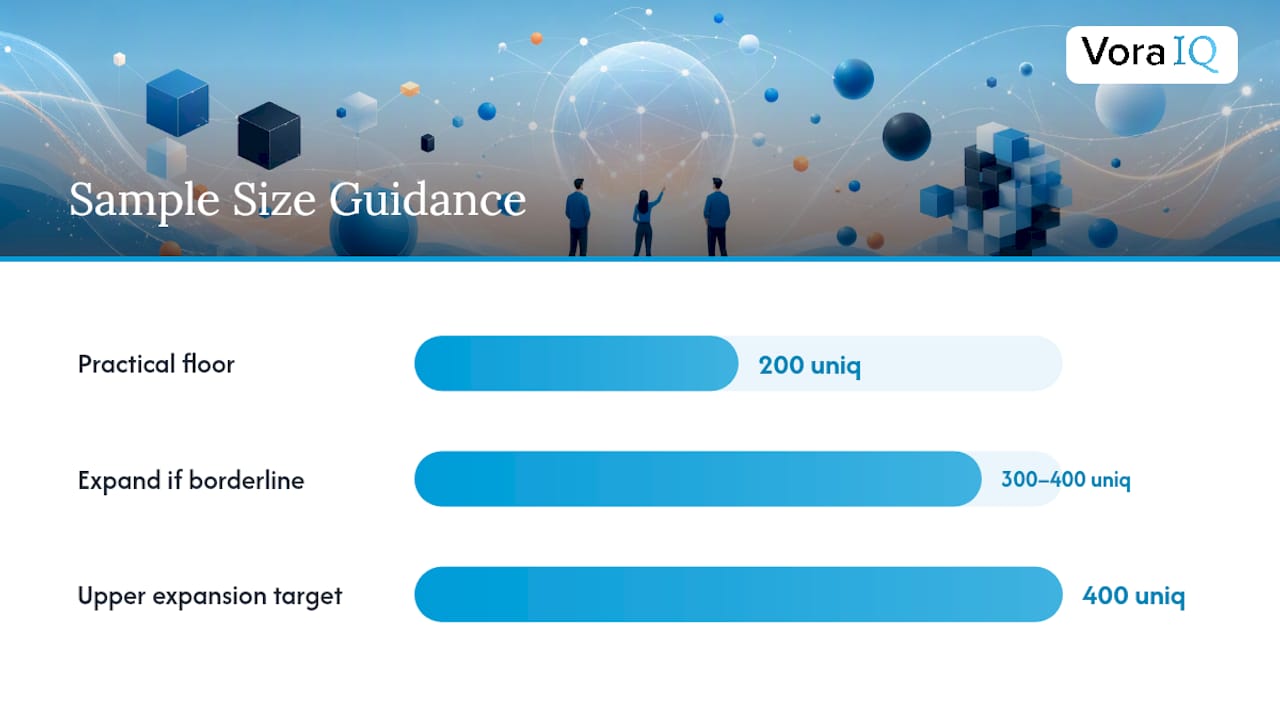
Treat anything within a few percentage points of your threshold as inconclusive rather than a verdict. Statistical noise at small sample sizes is real, and the fix is more data, not more optimism.
How Do You Drive Traffic and Budget the Test?
Your traffic channel shapes both your results and your interpretation of them. Pick the channel that matches how your real customers will eventually find you, not the cheapest one available this week.
Cold paid social (Meta, TikTok, LinkedIn ads) reaches people with zero prior context, which makes it the harshest and most honest test of your core promise. Expect to spend somewhere in the low hundreds of dollars to reach 200 uniques, depending on your audience’s niche and your ad platform’s current costs. Budget a few days for delivery and creative iteration.
Cold paid search (Google Ads on relevant keywords) captures people already searching for a solution, so conversion tends to run higher, but keyword costs vary wildly by category and can eat a budget fast in competitive niches.
Warm email lists convert best of all, but only tell you whether people who already trust you like the idea, not whether strangers will pay for it. Treat warm results as a ceiling, not a market forecast.
Community posts (relevant subreddits, Slack groups, niche forums) cost nothing but your time and credibility. They’re useful for early signal and qualitative color, but volume is unpredictable and self-selection bias runs high.
A few things that reliably improve cold performance:
- Lead your ad creative with the specific outcome, not the product category.
- Target by behavior or interest group tied to the problem, not broad demographics.
- Test at least two distinct promise angles before concluding the whole concept is weak.
If cold traffic underperforms, don’t assume the idea is dead. Test the message before you bury the concept.
How Do You Read the Results and Decide What’s Next?
Every smoke test lands in one of three buckets, and each demands a different next move.
- Fail. Your capture rate came in under threshold with a solid sample size. Don’t scrap the idea outright. Run five to eight short customer interviews with people who visited but didn’t convert, if you can identify or reach any, and dig into why the promise didn’t land. Reposition the offer and consider testing again with a sharper hook, following the same validation framework you started with.
- Borderline. Your number sits within a few points of the threshold. Expand your sample to 300 to 400 uniques before drawing conclusions, and run a second creative variant to see if a different angle clarifies the signal.
- Pass. You cleared the threshold with a real sample. Move immediately into five to eight discovery calls with sign-ups to confirm what they actually expect, then start planning pre-orders or an MVP scope around what you learn.
Pro Tip: Watch for a high CTA click-through rate paired with a low form-fill rate. That combination usually means your headline is compelling but your ask, whether it’s the form length or the commitment level, is the actual friction point. Fix the ask before you touch the headline again.
Watch for three red flags regardless of which bucket you land in: a sample size under 200 treated as conclusive, a warm-list result presented as proof of broad market demand, and a high click-through rate masking a form people abandon once they see it. Any of these can turn a shaky test into a false green light.
Ethics and Transparency Rules for Fake-Door Tests
Run these tests honestly or don’t run them at all. Never collect payment for something you can’t deliver or promptly refund. Every follow-up page or confirmation email should say plainly that you’re gauging interest, not confirming a shipped product, and every sign-up should get an easy way to opt out.
Skip deceptive design patterns, like implying a countdown or fake scarcity that doesn’t exist. That’s not just a trust issue; it edges toward regulatory risk depending on your market and claims. Avoid fake-door tests entirely when the promise involves regulated claims (health, financial guarantees, legal services) you can’t yet substantiate. Once someone opts in, keep them updated on real progress. Silence after a sign-up is the fastest way to poison a list you’ll want to reactivate later.
Where AI Speeds Up Repeatable Validation
Running one smoke test manually is doable in a weekend. Running a repeatable validating landing pages process, hypothesis, page, tracking, follow-up, interview script, every time you have a new idea, is where most founders lose momentum. Vora IQ builds hypothesis templates, adaptive roadmaps, and follow-up automation into one workflow so the setup work shrinks each time you test. The platform has generated a large number of unique roadmaps across different founder situations, which means the templates behind a test aren’t generic guesses; they’re built from patterns across a range of businesses. Once a test passes, that same system helps you move straight into pre-order or MVP planning without starting your next planning cycle from a blank page.
A Founder’s Checklist for a 48-Hour Smoke Test Weekend
Here’s how I’d spend a weekend running this myself. Friday evening: write your hypothesis and headline variants, pick your primary action, and get tracking live before you sleep. Saturday morning: launch cold traffic on one channel, not three. Splitting a small budget across multiple channels just weakens your sample everywhere at once. Saturday afternoon through Sunday: let the data accumulate and resist checking every hour. Early numbers lie.
The tradeoff nobody mentions: your best weekend result will still be a small sample. Treat it as a strong directional signal, not gospel. What I watch for most is a page that gets clicks but no form fills. That’s not a failed idea. That’s a friction problem hiding a good one.
— Khalel
Try a Faster Way to Validate Your Next Idea
Vora IQ is the alternative to piecing together your own smoke-test stack, spreadsheet hypotheses, a page builder, a separate analytics tool, by handing you a system built specifically for early-stage validation.
Instead of rebuilding your tracking setup and follow-up sequence from scratch every time you have a new idea worth testing, Vora IQ gives you validation templates that already encode the hypothesis structure and threshold logic covered above, plus automated follow-up so sign-ups don’t go quiet while you’re heads-down on the next step. The analytics dashboard tracks your results against your predefined pass/fail line automatically, and if you need sharp ad or landing-page copy fast, Echo, Vora IQ’s AI social content agent, can draft variants for you to test. Once a manual smoke test has proven the concept works, see how founders and early-stage teams put Vora IQ to use turning that signal into a real roadmap, and start with a free Idea Report Card to run your next validation cycle without rebuilding your process from zero.
Sources
For the metrics, thresholds, and sample-size guidance in this piece, Bright Curios’s breakdown of landing-page smoke test metrics is the most detailed channel-by-channel reference available. For definitions and the broader painted-door methodology, Coursera’s guide to painted-door testing covers the concept clearly for founders new to the term. The step-by-step runbook, including ethics guidance on honest follow-up messaging, comes from Exponentially’s fake-door test guide. For examples of in-product fake doors and pairing experimentation with behavioral analytics, see Amplitude’s overview of fake-door testing methods. Once your test passes, Vora IQ’s guide from validated idea to MVP covers the next stage in detail.
- The Landing-Page Smoke Test Done Right: Metrics, Thresholds, and What a Pass Looks Like - Bright Curios
- Painted Door Test: A Method for Validating Product Ideas | Coursera
- Fake Door Test: How to Validate Demand Before You Build | Exponentially