
Sprint Planning for Startups: Validate Fast, Skip the Guesswork
By Vora IQ Team
Master sprint planning for startups with fast validation techniques. Learn the key signs of success to ensure your idea's viability.
- sprint planning startup

Run a 48 to 72 hour proof sprint, or a one-week variant if your idea needs deeper interviews, and call it validated only when three things line up: a real commitment (money changes hands, or someone signs an LOI), your interviews converge on the same pain point, and your landing page clears a minimum conversion bar. Skip any one of those and you have a hunch dressed up as data.
Here’s the reasoning in plain terms:
- Commitment beats curiosity. A $1 pre-pay or a signed letter of intent tells you more than fifty “sounds cool” comments ever will.
- Interviews need to agree, not just exist. Eight conversations that all point to the same frustration outweigh twenty scattered opinions.
- Conversion sets the floor. A landing page pulling under 5% conversion is a signal to pivot, not a reason to “test more.”
Why this matters: CB Insights found lack of market need causes roughly 42% of startup failures. A structured sprint is the direct countermeasure.
Block the time on your calendar this week. Everything below is the playbook for running it.
Key Takeaways
A validated startup idea requires a real commitment signal, converging interview evidence, and a landing page conversion rate that clears a pre-set threshold, all decided before testing begins.
| Point | Details |
|---|---|
| Pick the right timebox | Use 48–72 hours for a fast go/kill call; extend to one week for deeper interviews and traffic. |
| Require commitment, not curiosity | A $1 pre-pay, deposit, or signed LOI beats a waitlist every time as proof of demand. |
| Set thresholds before testing | Lock in your go/pivot/kill rules in writing so results can’t quietly shift the goalposts. |
| Let AI handle synthesis, not decisions | Use AI for market scans and transcript patterns; keep the final call a human judgment. |
| Use a system built for repeat sprints | Vora IQ generates sprint-ready roadmaps and automates the setup so founders can run validation repeatedly instead of once. |
Table of Contents
- How Do You Plan a Sprint for Startup Validation?
- What Does a Sprint Planning Checklist Look Like Day by Day?
- What Are the Go, Pivot, and Kill Rules?
- How Should Solo Founders Use AI During a Sprint?
- What Traps Wreck Startup Validation Sprints?
- Why Repeatable Sprints Need a System, Not Willpower
- Run Your Next Sprint Inside Vora IQ
- Frequently Asked Questions
- Sources
How Do You Plan a Sprint for Startup Validation?
Sprint planning for a startup isn’t the same discipline as Agile sprint planning for software teams picking backlog items. It’s a compressed, timeboxed test of a business idea, built to produce a go, pivot, or kill decision before you’ve sunk months into building something nobody wants. The format you choose depends on how much runway you have this week and how much ambiguity your idea carries.
The 48 to 72 hour sprint suits full-time solo founders or anyone willing to burn a long weekend on a single question. Fluenta’s proof sprint framework treats this window as enough time to run a landing page test, gather a handful of paid intents, and check competitor revenue signals, all with hard pass/fail rules baked in from the start. It won’t give you deep customer insight, but it will tell you fast whether an idea is dead on arrival.
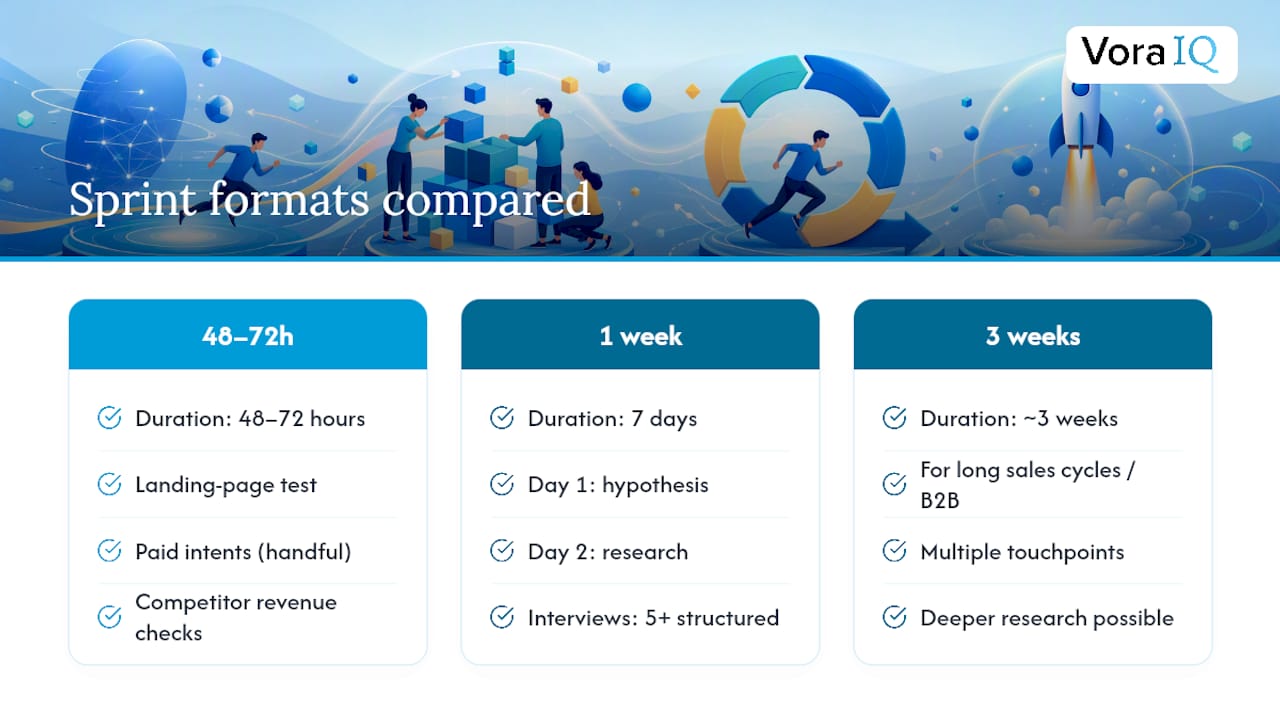
The one-week sprint trades speed for depth. You get room for five or more structured interviews, a slower-building landing page test, and multiple days of traffic instead of a single afternoon spike. Needmvp’s seven-day playbook assigns a hypothesis to day one, research to day two, interviews to day three, and traffic tests across the back half of the week, with conversion thresholds set before testing starts.
A three-week variant exists for ideas with longer sales cycles or B2B buyers who need multiple touchpoints, but most solo founders overbuild here. Unless your product genuinely requires a longer feedback loop, a longer sprint usually means you’re avoiding the decision, not improving it.
Minimal tooling covers you for any of these: a landing-page builder like Carrd or Framer, Stripe for payment capture, a scheduling tool for interviews, and whatever AI assistant you’re already using for research and synthesis.

What Does a Sprint Planning Checklist Look Like Day by Day?
A reproducible sprint checklist removes the guesswork about what to do next. Here’s the sequence that shows up across validated playbooks, adapted for a solo operator instead of a team.
- Prep. Write your problem as one sentence. Build a list of your ideal customer profile and 30 specific outreach targets. Get your tools ready: landing page template, Stripe or Carrd account, calendar link.
- Research. Spend an hour mining Reddit, Twitter, and G2 reviews for complaints in your space. Check competitor pricing pages and any visible revenue signals. Run a quick market-size sanity check.
- Interviews. Book and run 8 to 12 short calls with people from your outreach list. Ask what they’ve already tried, what they’re paying for a workaround, and what would make them pay for a real fix today. Score each call on a simple scale: does this person describe acute pain unprompted, yes or no.
- Smoke test. Ship a one-page site on Carrd or Framer with a clear paid call-to-action. Run a $50 to $200 ad test or push it into a relevant community where your ICP actually hangs out.
- Willingness-to-pay check. Accept a $1 pre-pay, a refundable deposit, or a signed LOI. Screenshot the Stripe events. This is your evidence file, not your gut feeling.
- Synthesis. Pull everything into a one-page decision memo: interview themes, conversion numbers, commitment count, and your call.
Pro Tip: Score every interview the moment it ends, not at the end of the week. Memory flatters your idea; notes taken in real time don’t.
Founders who skip straight from idea to landing page, without the research and interview steps, tend to build pages nobody was looking for.
What Are the Go, Pivot, and Kill Rules?
Write your thresholds down before you launch anything. Once results come in, it is too easy to move the goalposts to protect an idea you already love.
A workable set of gates looks like this:
- Go: At least 7 out of 10 interviews describe the same pain point unprompted, landing-page conversion clears 5% from cold traffic (or you land 3+ paid commitments), and you have one paid pre-order or signed LOI in hand.
- Pivot: Interviews converge on a different problem than the one you tested, or conversion is moderate but nobody will actually pay yet.
Weight the evidence in this order: money first, interview convergence second, clicks last. A LOI or a paid pre-order outranks a hundred landing-page visits every time.
When signals conflict, don’t relitigate the decision alone. Loop in an accountability partner or a small brain trust to break the tie, then timestamp your decision memo the day you make it. That timestamp is what stops you from quietly redefining “success” three weeks later.
How Should Solo Founders Use AI During a Sprint?
AI earns its place in a validation sprint by doing the repetitive work fast, not by making the final call for you. Solo founders using AI as a research assistant can compress what used to take days into a single afternoon.
A workable 60 to 90 minute daily routine:
- 30 minutes: Run a market scan prompt to summarize competitor positioning, pricing, and visible complaints.
- 30 to 45 minutes: Feed interview transcripts into an AI tool for pattern synthesis. Ask it to flag disagreement, not just consensus.
- 15 to 30 minutes: Generate and test landing-page headlines or ad copy variants based on the exact language customers used in interviews.
Pro Tip: Ask your AI tool to summarize negative signals separately from positive ones. It’s easy to let enthusiasm drown out the two people who told you flatly this wouldn’t work.
The guardrail matters as much as the workflow. AI is built for speed and pattern detection here, not for the go/kill decision itself, which should stay a human call backed by the evidence you collected.
What Traps Wreck Startup Validation Sprints?
A few habits quietly sabotage otherwise well-run sprints. Spot them early and they’re easy to fix.
- Waitlists feel like validation. They aren’t. An email address costs nothing to give. Convert every waitlist signup into a $1 deposit, a booked call, or a signed pilot LOI before you count it as evidence.
- Confirmation bias creeps in fast. You’ll unconsciously ask leading questions that confirm what you want to hear. Pre-write your interview script and stick to it.
- Running three experiments at once feels efficient. It isn’t. For a solo founder, serial testing produces clearer signals than juggling parallel tests, and it protects your judgment from fatigue.
Pro Tip: Build one off-day into any sprint longer than 72 hours. A tired founder reads ambiguous signals as positive ones.
Why Repeatable Sprints Need a System, Not Willpower
Most founders don’t fail validation sprints because they lack discipline. They fail because rebuilding the scaffolding, the landing page, the interview tracker, the decision memo template, from scratch every time eats the hours that should go toward actual customer conversations.
Vora IQ, built as an AI-native operating system for solo founders, was designed around exactly that gap. It has generated over 2,400 unique roadmaps and actionable plans, and its structure maps cleanly onto sprint phases: market analysis for your research day, content generation for your landing page and outreach copy, and task automation so the mechanical steps run in the background while you focus on interviews and the go/kill call. That’s the difference between a sprint you run once and one you can repeat every time you have a new idea worth testing.
Run Your Next Sprint Inside Vora IQ
If you’ve made it this far, you already know the mechanics work. What usually breaks is the setup time. Vora IQ hands you a sprint template built for solo founders instead of a blank page: goals, tasks, and timelines generated from your specific idea, not a generic checklist you have to adapt yourself.
Open the features page to see how Vora IQ turns market analysis, landing-page copy, and daily task automation into one continuous workflow instead of six disconnected tools. If outreach and content are your bottleneck, Echo handles the social posting and community pushes that feed traffic into your smoke test while you’re running interviews. Start with a free Idea Report Card, import your sprint’s decision checkpoints, and let the platform carry the busywork so your next validation sprint takes hours to set up instead of a full day.
Frequently Asked Questions
How long should a startup validation sprint run? Most solo founders should start with a 48 to 72 hour sprint. Extend to a one-week format only if your idea needs more than five or six interviews or a slower-building traffic test to reach a reliable conversion signal.
How many customer interviews count as enough for a sprint? Eight to twelve short interviews is a practical range for a compressed sprint. Fewer than five gives you too little pattern data, while returns diminish past roughly fifteen conversations.
Is a waitlist good enough to validate a startup idea? No. A waitlist measures interest, not commitment. Convert it into a $1 deposit, a booked demo call, or a signed letter of intent before treating it as real validation evidence.
What conversion rate on a landing page signals real demand? Playbooks commonly use 5% or higher from cold traffic as a moderate-to-strong demand signal, though a smaller sample with three or more paid commitments can carry equal weight.
Can AI replace human judgment in a validation sprint? No. AI speeds up market scans, transcript synthesis, and copy iteration, but the go, pivot, or kill decision should stay a human call grounded in the commitment signals and interview evidence you collected.