
3–5 Pillars in 90 Days: Founder First System for Startup Content
By Vora IQ Team
For founders: pick and run 3–5 startup content pillars using a 4 criteria scoring test, a one page matrix, and a plan to test them for 90 days.
- startup content pillars

Content pillars are the 3 to 5 core topics your startup consistently creates content around, each tied to your expertise and your product. Most solo founders should start with exactly 3. Small teams can stretch to 5. Fewer pillars mean you go deeper, publish faster, and build real authority instead of scattering effort across ideas nobody remembers.
TL;DR:
- Focusing on 3 to 5 core content pillars fosters deeper expertise, easier consistency, and better tracking of meaningful engagement rather than superficial metrics.
- Prioritize pillars with high expertise, audience interest, business relevance, and enough surface area to support at least 20 distinct pieces of content.
- Use a scoring framework to select pillars and allocate 40 to 60 percent of content to your hero topic while supporting funnel stages with other pillars.
- Build a simple content matrix for formats, repurpose long-form content across channels, and allocate 30 to 60 minutes weekly to idea capture and planning.
- Measure success through engagement quality signals such as shares, DMs, and comments linked to pipeline impact over a 9 to 12-week window.
Table of Contents
- What Are Startup Content Pillars, and Why Do They Matter?
- How Do You Choose the Right Pillars? A 4-Criteria Test
- What Do Real Startup Pillar Sets Look Like?
- How Do You Turn Pillars Into a Repeatable Content Workflow?
- How Do You Know If a Pillar Is Actually Working?
- What Mistakes Sink Startup Content Pillars?
- How Does a Startup Operating System Support Content Pillars?
- Why Discipline Beats Coverage for Founders
- Sources
What Are Startup Content Pillars, and Why Do They Matter?
A content pillar is a hub topic, not a piece of content itself. Think of it as the trunk of a tree: your pillar is “founder mental health,” and the spokes branching off it are individual posts, threads, or videos that each tackle one angle of that trunk. This hub-and-spoke model is how topical authority gets built in search and, increasingly, in AI-generated answers that cite sources with concentrated expertise on a subject.
Founders often confuse pillars with formats. A pillar is “customer onboarding strategy.” A format is a LinkedIn carousel, a YouTube video, or a Twitter thread. You can express one pillar in a dozen formats without ever touching a second topic.
For a resource-constrained founder, narrow pillars beat broad ones for a few concrete reasons:
- Topical authority compounds. Search engines and AI models reward sites that publish depth on a few subjects over shallow coverage of many.
- Consistency gets easier. Three topics you know cold are far less draining than ten you have to research each week.
- Burnout drops. A 3 to 5 pillar structure removes the “what do I post today” paralysis that kills momentum in month two.
- Reporting simplifies. You can track performance pillar by pillar instead of guessing which of forty scattered posts actually moved the needle.
Startups that try to cover everything, product updates, industry news, personal reflections, customer stories, hiring, fundraising, end up mastering none of it. Pick fewer lanes and drive them harder.
How Do You Choose the Right Pillars? A 4-Criteria Test
Picking pillars by gut feeling is how founders end up with a content calendar full of topics that sound good but generate nothing. A scored framework fixes that. Run every candidate topic through four criteria, score each 1 to 5, and keep only the highest scorers.

Expertise. Can you speak on this topic without external research every time? If you’re Googling basics before every post, it’s not a pillar, it’s a stretch.
Audience need. Does your actual audience search for or engage with this topic? Check your own DMs, comment sections, or customer support threads for recurring questions.
Business relevance. Does this topic connect, even loosely, to what you sell? A fintech founder writing about productivity hacks might get engagement, but it rarely turns into pipeline.
Depth. Can you sustain 20 or more pieces of content on this topic without repeating yourself? A pillar needs enough surface area to support 5 to 10 distinct subtopics at minimum.
Here’s how scoring plays out in practice. Say a B2B SaaS founder is weighing “AI in accounting” as a pillar. Expertise scores a 4 (she’s spent three years building accounting software). Audience need scores a 5 (her customers ask about this weekly). Business relevance scores a 5 (it’s literally her product category). Depth scores a 4 (she can list a dozen subtopics without straining). That’s an 18 out of 20, an easy yes. Compare that to “startup fundraising tips,” where she scores a 2 on expertise because she’s never raised a round herself. Skip it.
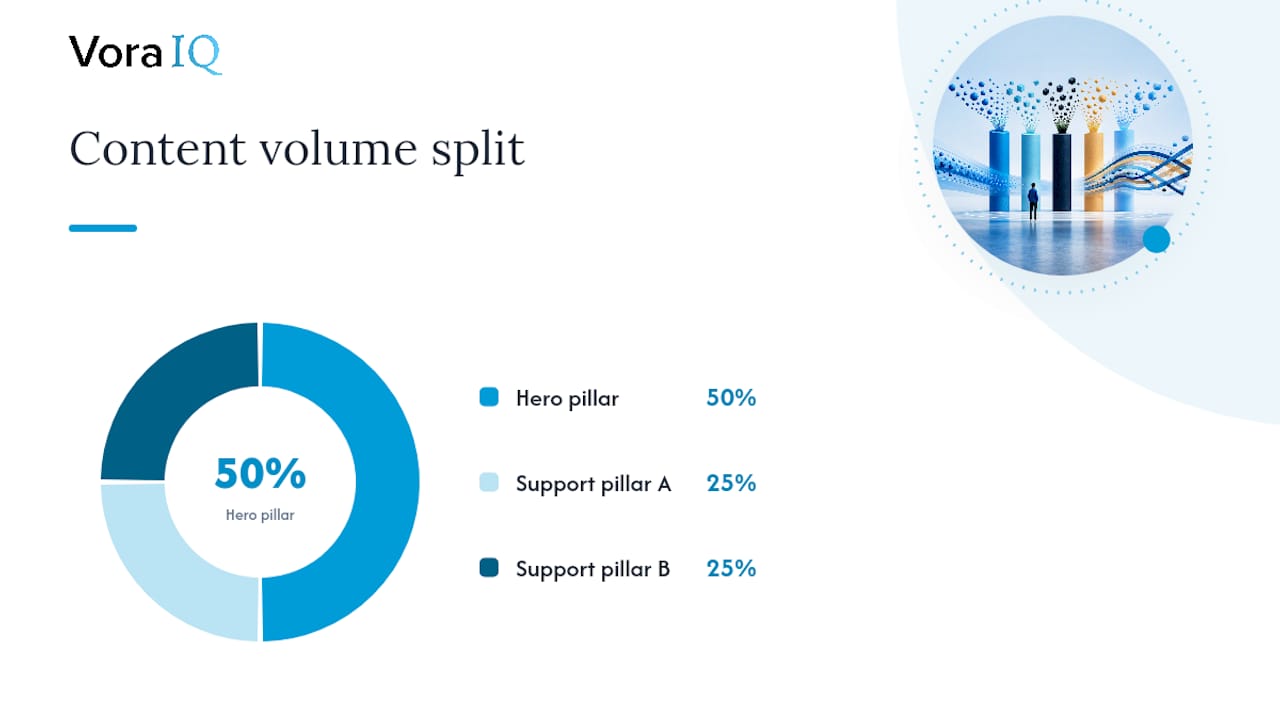
Once you’ve scored your candidates, the framework used by early-stage startups recommends designating one as your hero pillar, the topic that gets 40 to 60 percent of your content volume, while the remaining pillars support different funnel stages: one for top-of-funnel awareness, one for consideration, one for late-stage trust building.
Pro Tip: Build a simple spreadsheet with your four criteria as columns and every candidate topic as a row. Score honestly. The topics you’re tempted to inflate are usually the ones you should cut.
Expand beyond your starting 3 only after you’ve published consistently for 8 to 10 weeks and one pillar is clearly outperforming, that’s your signal there’s room for a fourth or fifth.
What Do Real Startup Pillar Sets Look Like?
Abstract frameworks are easy to nod along to and hard to act on. Here’s a starter set for a generic B2B SaaS founder, plus three example posts per pillar:
- Educational (how your category works): “The 3 metrics every founder tracks wrong,” “Why most onboarding funnels leak users in week one,” “A 5-minute breakdown of your industry’s biggest misconception.”
- Building in public (your operational reality): “What our churn number looked like at month 3 versus month 9,” “The hiring decision we regret and what we’d do differently,” “Screenshot of this week’s roadmap, unfiltered.”
- Product (what you’re building and why): “Why we built X feature instead of the one everyone requested,” “A walkthrough of the update we shipped this week,” “The customer complaint that shaped our next release.”
For different startup types, the mix shifts. Product-led startups lean heavier on demos and use cases. Founder-led B2B companies weight toward building-in-public and opinion pieces that establish the founder as a credible voice. Consumer startups often add a social proof pillar built from customer stories and reviews.
Platform matters as much as topic. Founder-led programs perform best when they pick one primary channel rather than spreading thin, LinkedIn for B2B founders, short-form video for consumer brands. A single idea, say, “we almost ran out of runway in month four,” can become a LinkedIn text post, an X thread breaking down the numbers, and a 60-second Instagram Reel walking through the lesson. Same pillar, three formats, zero new research required.
How Do You Turn Pillars Into a Repeatable Content Workflow?
Strategy without a system dies in week three; applying SEO content strategies for every website can help maintain consistent execution. The fix is a one-page content matrix: rows are your pillars, columns are formats (long-form, social, email, video), and each cell holds your next content idea for that combination. Glance at it Monday morning and you know exactly what to create.
A workable starting cadence is 3 posts per week, mapped roughly to your pillars in proportion to their hero versus supporting status. If your hero pillar gets 50 percent of volume, that’s roughly 1.5 posts a week on that topic alone, with the remaining slots split across your other two pillars.
Repurposing is where most founders leave value on the table. One long-form piece, a blog post or a recorded customer call, should feed multiple downstream assets:
- Extract 2 to 3 social posts from the core argument.
- Pull a tight quote or stat for an email newsletter segment.
- Cut a 30 to 60 second video clip highlighting the sharpest moment.
The actual founder routine that sustains this doesn’t require a marketing team. Block 30 to 60 minutes weekly, during a walk, after a customer call, right after a product decision, and talk through what happened. Feed that raw material into an AI drafting workflow or hand it to a ghostwriter, and you’ll have 3 to 5 pieces of content by the time you’re done editing.
Pro Tip: Capture ideas the moment they happen, not at your scheduled content time. The best “building in public” material comes from the messy middle of your week, not a Sunday brainstorm.
How Do You Know If a Pillar Is Actually Working?
Vanity metrics lie. Likes and impressions feel good and mean almost nothing about whether a pillar is building your business. Track engagement quality instead: saves, shares, DMs, and comments that reference specific details from your post, those signal real resonance.
Give each pillar time before judging it. Founder-led content programs typically show early engagement signals within 3 to 6 weeks, but pipeline effects, actual leads or signups traced back to content, take 9 to 12 weeks to materialize. Kill a pillar at week two and you’re judging it before it had a chance to work.
Evaluation window: expect directional signals (comment quality, follower growth, save rate) by week 6, and expect to see pipeline impact by week 12. Anything shorter is noise, not data.
Watch for simple attribution signals: people mentioning your content in sales calls, DMs referencing a specific post, or a spike in profile visits after a piece goes out. Decision rule: if a pillar shows zero engagement lift by week 6 AND no qualitative signal (no DMs, no comments, no shares) by week 12, adjust the angle before killing it outright. Full replacement should be rare.
What Mistakes Sink Startup Content Pillars?
The same errors show up across almost every founder who struggles with content:
- Too many pillars. Six or seven topics splits your attention until none of them build depth.
- Platform mismatch. Posting long-form thought leadership on TikTok, or short hooks on LinkedIn where your B2B audience expects substance.
- No business tie. A pillar that gets engagement but never connects to what you sell wastes effort you can’t spare.
- Chasing likes over signal. Optimizing for reach instead of the comments and DMs that actually predict pipeline.
Run a 30/60/90 check: at day 30, confirm you’ve published consistently on all pillars. At day 60, look for engagement signals and cut anything showing zero traction. At day 90, evaluate pipeline impact and decide whether to double down on your hero pillar or swap a weak supporting one. Pivoting a pillar doesn’t mean starting over, keep your posting cadence and audience, just shift the angle while preserving the format and platform that were already working.
How Does a Startup Operating System Support Content Pillars?
Running pillars well means juggling idea capture, scheduling, and repurposing without losing momentum, exactly the kind of operational overhead that derails solo founders. An AI-native operating system centralizes that work: capture a raw idea from your phone, let an adaptive roadmap suggest where it fits your pillar structure, and automate the repetitive scheduling tasks that eat your Monday mornings.
The friction that kills most content strategies isn’t a lack of ideas. It’s the gap between having an idea on a walk and turning it into a scheduled post before the moment passes.
Vora IQ’s approach reflects this directly: its structure connects planning and execution so a founder’s weekly capture routine feeds straight into content generation and scheduling instead of sitting in a notes app, forgotten by Thursday.
Why Discipline Beats Coverage for Founders
The advice underneath everything here is simple: pick 3, document the angle for each, and give the set 90 days before you touch it. Most founders sabotage their own content by chasing breadth the moment engagement feels slow, when the actual problem is usually depth, not variety.
Your one action this week: build the one-page matrix, score your candidate pillars honestly, and pick next week’s three posts before Monday.
Systematizing this doesn’t have to cost you authenticity. The founders who do it best still sound like themselves, they’ve just stopped reinventing their topic list every Sunday night.
— Khalel
Sources
- Content Pillars: What They Are & How to Build Them for SEO & AI Visibility
- Social media content pillars
- Content Pillars for Startups: How to Choose Your 3-5 Core Topics