
Startup Proposal Templates That Win Clients and Investors
By Vora IQ Team
Discover winning startup proposal templates that help you create customized drafts in under an hour and impress clients and investors.
- startup proposal template

Start with the editable one-page investor or client proposal template, customize the executive summary and statement of work (SOW), and you have a persuasive draft in under an hour. That is the fastest path. Free editable templates from Canva and Microsoft Word cloud get you moving immediately in DOCX, Google Docs, or PDF. Two targeted edits do most of the work: restate the client’s problem in their own words, and define three to five concrete deliverables in the SOW. According to DocuSign’s proposal guidance, clear deliverables and well-scoped agreements are the primary drivers of proposal success and the best defense against costly scope disputes.
- One-page template: fastest path for quick outreach, warm investor intros, or pilot offers
- Short proposal suitable for RFP responses, corporate partner pitches, or investor follow-ups (typically a few pages)
- Formats: DOCX for editing, Google Docs for collaboration, PDF for distribution
- AI-assisted option: Vora IQ’s Scribe auto-populates a context-aware draft from your business details, cutting first-draft time to minutes
Key Takeaways
A strong startup proposal combines the right template format, a client-language problem statement, a scoped SOW, and a single clear ask — written in that order, with the executive summary drafted last.
| Point | Details |
|---|---|
| Match template to recipient | Use a one-page summary for quick outreach; use a 3–5 page proposal for investor or partner asks. |
| SOW clarity prevents disputes | Define deliverables, acceptance criteria, and scope boundaries explicitly to avoid costly disagreements. |
| Write the executive summary last | Draft every other section first so the summary accurately reflects the complete proposal. |
| Two proof points close the gap | Attach traction signals (a metric, a pilot result, or a reference) to make the ask credible. |
| Vora IQ Scribe accelerates drafting | Use Scribe to auto-populate a context-aware first draft, then edit for client language and export. |
Table of Contents
- What startup proposal template should you use?
- How to download and customize your template fast
- How do you write a persuasive startup proposal?
- What goes in each proposal section?
- A sample executive summary and SOW you can copy
- How should your proposal look for investors vs. clients?
- Common proposal mistakes that kill deals
- How long does it take and what does it cost?
- How Vora IQ speeds up your proposal workflow
- What actually matters most when writing a startup proposal
- Your fastest path to a tailored proposal with Vora IQ
- Sources
What startup proposal template should you use?
Not every opportunity needs the same document. Matching the template to the recipient is the first decision that determines whether your proposal gets read.
- One-page investor summary: rapid outreach, warm intros, or pre-seed asks where the reader wants the headline numbers fast
- 3–5 page fundraising proposal: seed or Series A asks; StartupProject’s fundraising template recommends covering executive summary, problem, solution, market, traction, model, team, financials, and the ask across 5–10 pages
- Client-facing project proposal + SOW: service engagements, agency contracts, or consulting retainers where deliverables and acceptance criteria matter most
- Enterprise PoC/pilot proposal: GenAI Fund’s best-practice guide recommends keeping these relatively short with a company snapshot, capabilities, fit, PoC approach, outcomes, and budget
- Pricing table + contract appendix: attach to any proposal where payment terms, milestones, or legal scope need to be explicit
- Slide/PDF summary (PPTX): useful as a leave-behind after a live pitch; pairs well with a written proposal for investor meetings
DOCX files give you the most editing flexibility. Google Docs makes real-time collaboration with a co-founder or advisor easy. PDF locks formatting for distribution. PPTX works when the recipient expects a visual deck alongside the written document.
How to download and customize your template fast
Getting from blank page to finished draft is a three-part move: get the file, adapt the structure, export cleanly.
- Download or duplicate. Grab the DOCX from Canva or Microsoft Word cloud, or duplicate the Google Doc to your own drive. Never edit the master template directly.
- Update brand elements. Swap in your logo, brand colors, and contact details on the cover page before touching any content.
- Replace placeholders in order. Work through the SOW first (deliverables, milestones, acceptance criteria), then the pricing table, then the problem statement. Write the executive summary last.
- Add your proof points. Drop in two to three traction signals: a customer quote, a pilot result, or a relevant metric. Keep each to one sentence.
- Export a locked PDF. Use “Export to PDF” or “Print to PDF” for the version you send. Never share a live editable link as your primary distribution copy.
- Name and store the file clearly. Use a convention like
ClientName_ProposalV1_YYYYMMDD.pdfand keep the editable source in a single cloud folder. Version notes go in the filename, not scattered across email threads.
Pro Tip: Keep one canonical editable source, either a DOCX or a Google Doc, and export a fresh PDF each time you revise. This prevents version drift and means you always know which file is current.
How do you write a persuasive startup proposal?
A structured, page-by-page process is the fastest way to produce a proposal that reads as professional and complete. Work through these nine steps in order, but write step one last.
- Client research and discovery. Before writing a word, capture the recipient’s stated goals, current pain points, and success metrics. Review their website, recent announcements, or RFP language.
- Define your single-sentence value proposition. Name the specific outcome you deliver and the metric that proves it. Vague promises lose proposals; a concrete target wins them.
- Draft the problem statement in the client’s language. Forbes Advisor’s guidance is direct: restating the client’s problem in their own words demonstrates discovery and improves conversion. Use their terminology, not yours.
- Present the solution and define the SOW. State exactly what you will deliver, what you will not deliver, and how you will deliver it. Scope clarity here prevents disputes later.
- Timeline and milestones with success metrics. Attach a date and a measurable outcome to each milestone. “Phase 1 complete” is not a milestone. “MVP live, 50 beta users onboarded by March 31” is.
- Pricing and payment terms. Tie each payment to a deliverable or milestone, not to a calendar date alone. This aligns incentives and reduces payment disputes.
- Team and proof points. Two to three sentences per key person, focused on relevant experience. Add traction signals: revenue, users, pilot results, or a named reference customer.
- Risks, assumptions, and light legal terms. One sentence per material risk. State your assumptions about client inputs, timelines, and dependencies explicitly.
- The ask and clear next steps. End with a single, specific call to action: sign here, schedule a call, or approve the pilot budget. Ambiguous endings kill momentum.
Shopify’s 8-step proposal guide reinforces writing the executive summary last, once every other section is complete, so the summary accurately reflects the full document.
What goes in each proposal section?
Use this as your fill-in checklist. Every section has a job; none should run longer than it needs to.
- Problem statement starter: “Your team currently spends [X hours/dollars] on [pain point], which limits [outcome the client cares about].”
- SOW starter: “We will deliver [specific output] by [date], measured by [metric]. This scope excludes [explicit boundary].”
- Team bio starter: “[Name] led [relevant project] at [company], resulting in [outcome].”
- Proof point format: one sentence, one metric, one named context. No paragraphs.
For fundraising proposals, StartupProject recommends covering financials and the explicit use of funds tied to runway milestones, typically across 5–10 pages total.
A sample executive summary and SOW you can copy
Executive summary example:
Acme Analytics helps mid-market e-commerce brands reduce cart abandonment by surfacing real-time behavioral signals at checkout. We have validated the approach with three pilot customers, achieving an average 18% reduction in abandonment rate over 60 days. We are seeking a $250,000 seed investment to hire two engineers and reach 20 paying customers by Q4 2026.
SOW excerpt:
- Deliverable 1: Behavioral analytics dashboard, live in the client’s environment within 30 days of contract signing
- Deliverable 2: Weekly performance report (automated) delivered every Monday at 9:00 AM
- Deliverable 3: 60-day pilot review session with documented outcomes against agreed success metrics
- Acceptance criteria: Dashboard loads in under 3 seconds; report accuracy verified against client’s own analytics within a 2% variance
- Out of scope: Custom integrations beyond the three named platforms; data migration from legacy systems
Swap [Acme Analytics], [mid-market e-commerce brands], and the specific metrics for your own details. For enterprise PoC proposals, GenAI Fund’s template adds a “fit” section that maps your capabilities directly to the enterprise’s stated initiative. If you need to anonymize a reference customer, use “a Series B SaaS company in [vertical]” rather than leaving the field blank.
How should your proposal look for investors vs. clients?
Design is not decoration. The layout signals whether you understand the reader’s context before they read a word.
- Margins and type: 1-inch margins, 11–12pt body font (Inter, Georgia, or Calibri), 14–16pt for section headings. White space is not wasted space; it makes dense information readable.
- Investor-facing tone: metrics first, narrative second. Lead every section with the number or outcome, then explain. Keep the document under five pages unless the investor explicitly requested a full deck.
- Client-facing tone: benefits first, SOW details second. Clients want to know what changes for them, then how. Empathetic language in the problem statement builds trust before the pricing page.
- Visual signals: include a product screenshot or a one-line demo link only when it directly supports a claim. Customer logos require permission. A simple timeline diagram replaces three paragraphs of milestone prose.
- Accessibility: use PDF bookmarks for proposals longer than three pages. Ensure color contrast meets basic readability standards. Every CTA button or linked section should be clearly labeled.
Adobe’s proposal writing guide recommends a clear table of contents for any proposal over four pages, so the reader can navigate directly to pricing or the SOW without scrolling.
Common proposal mistakes that kill deals
Most rejected proposals share the same handful of problems. Fixing them is faster than starting over.
- Vague deliverables. “We will improve your marketing” is not a deliverable. Name the output, the format, and the acceptance criteria.
- Pricing opacity. A single lump-sum number with no line items invites negotiation on the wrong axis. Break it down.
- Generic language. Using your own jargon instead of the client’s terminology signals that you did not do discovery. Forbes Advisor is explicit: echo the client’s words to build trust.
- No clear ask. A proposal that ends with “let us know if you have questions” has no momentum. State the exact next step and who takes it.
- Overlong proposals. A 20-page proposal for a $15,000 project tells the client you do not understand their time. Match length to deal size and complexity.
Quick fix checklist: add explicit deliverables with acceptance criteria, attach a milestone-linked payment schedule, and close with a single approval CTA.
How long does it take and what does it cost?
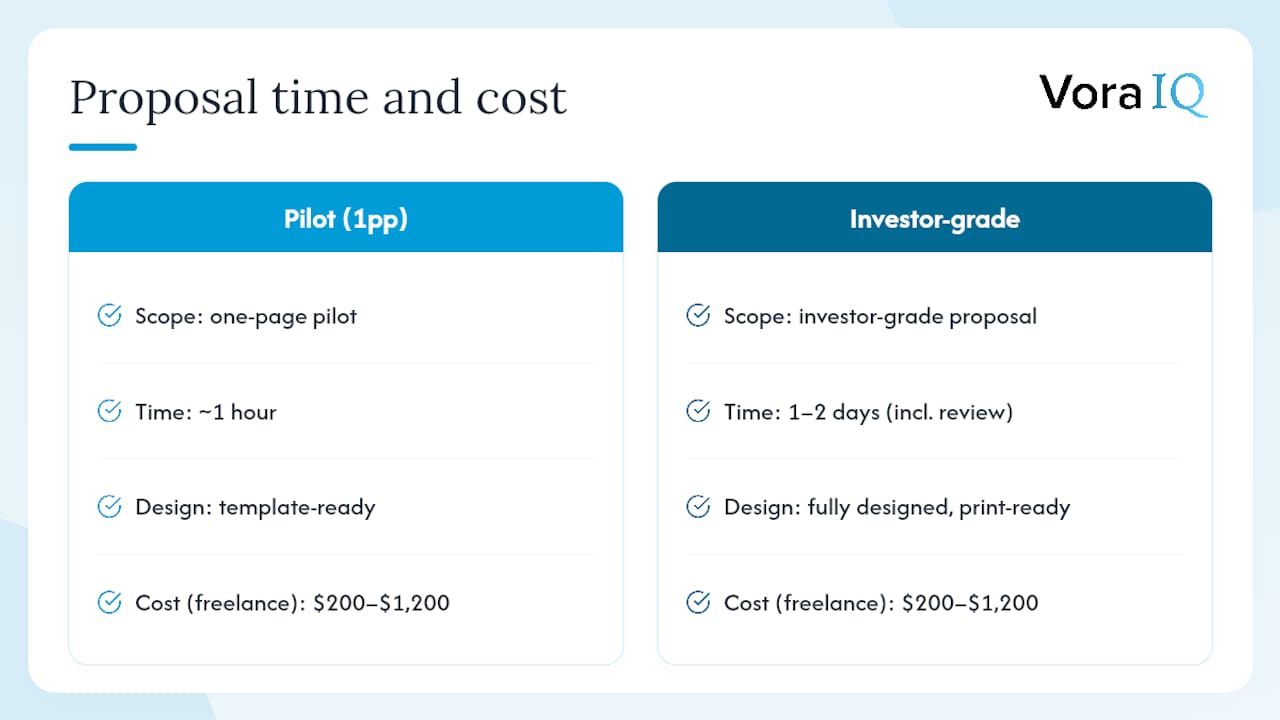
For investor-grade fundraising proposals, budget one to two days including review cycles. A one-page pilot offer can be ready in an hour with a solid template. The freelance range of $200–$1,200 reflects the difference between a basic copy edit and a fully designed, print-ready document.
How Vora IQ speeds up your proposal workflow
Solo founders do not have a proposal team. Vora IQ is built for exactly that gap.
- Prebuilt proposal templates: investor summary, client SOW, and PoC proposal formats ready to customize
- Adaptive context: Scribe reads your business context and mirrors the recipient’s terminology automatically, applying the same discovery principle Forbes Advisor recommends
- Roadmap integration: deliverables and milestones in your proposal stay connected to your living roadmap, so updates flow through rather than creating version drift
- Export options: DOCX, Google Docs, and PDF from a single source
- Over 2,400 unique roadmaps generated across industries, giving Scribe real pattern recognition for what works in your sector
For founders who also need a pitch deck alongside the written proposal, Vora IQ’s pitch deck generator covers the visual layer. The AI tools overview for founders compares where AI-assisted drafting fits in a broader workflow.
What actually matters most when writing a startup proposal
Most founders spend too long on the design and not enough on the ask. The proposal’s job is to get a “yes” to one specific next step, not to impress with formatting.
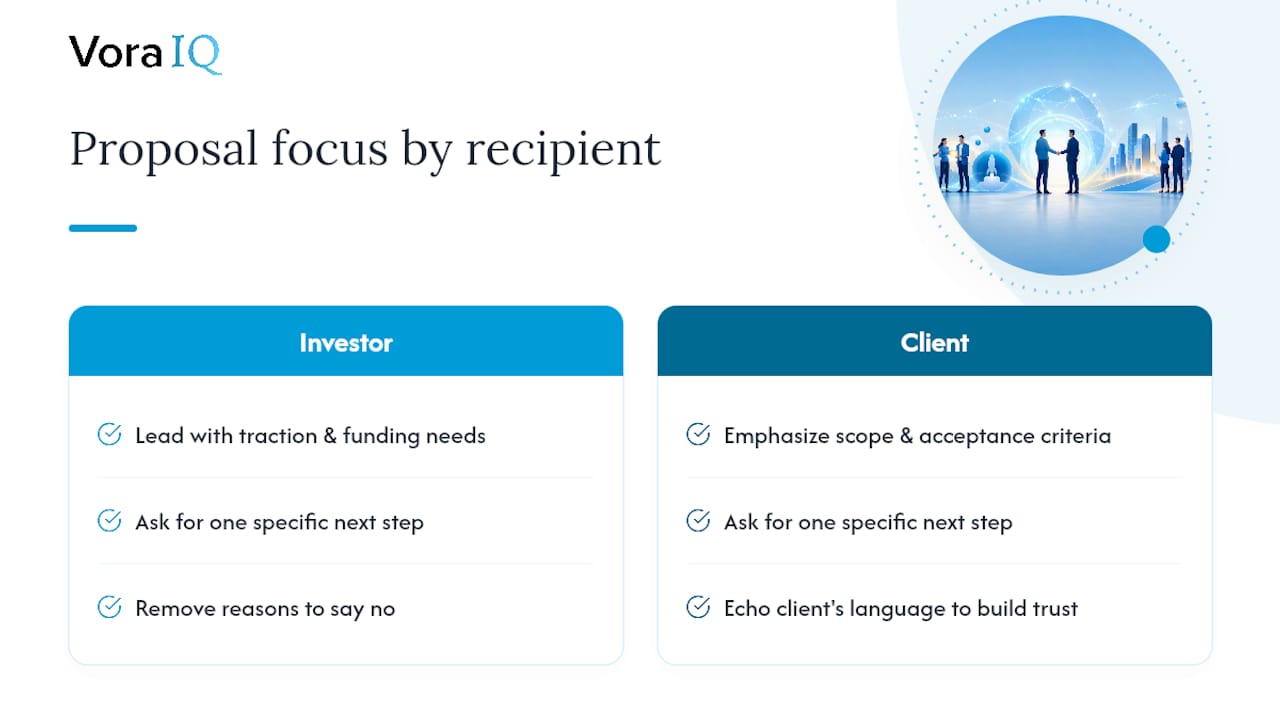
The single rule worth internalizing: if your recipient is an investor, lead with traction and funding needs. If your recipient is a client, emphasize clear scope and acceptance criteria. Both audiences are busy and looking for a reason to say no quickly. Your job is to remove that reason before they find it.
Building trust online matters throughout the proposal process, and proven trust-building strategies apply as much to written proposals as to any other client touchpoint. A proposal that echoes the client’s language, scopes the work precisely, and ends with a clear ask does not just win the deal; it sets the tone for the entire working relationship.
The founders who iterate fastest win. Send a draft, get a reaction, tighten the SOW, and resend. A polished proposal that arrives two weeks late loses to a clear, direct proposal that arrives today.
Your fastest path to a tailored proposal with Vora IQ
Writing a proposal from scratch is slow. Customizing a generic template is faster. Having an AI that already knows your business, your market, and your target client is faster still.
Vora IQ’s Scribe agent takes your business context and produces a first-draft proposal in minutes, not hours. It applies your traction data, mirrors client language, and outputs a document you can export directly to DOCX, Google Docs, or PDF. Start with your free Idea Report Card, load your business profile, and run Scribe on your next investor ask or client pitch. See who Vora IQ is built for and whether it fits your current stage. The first draft is waiting.
Sources
- How To Write A Business Proposal (DocuSign)
- How To Write An Effective Business Proposal (Forbes Advisor)
- How to write a business proposal (QuickBooks)
- Free, printable, editable proposal templates for work or … (Canva)
- free online business proposal templates and AI editing tools (Microsoft Word cloud)
- Best Practices & Template for Startup Proposals - GenAI Fund
- Startup Fundraising Proposal Template: How to Write One That Gets Funded (StartupProject)
- How To Write A Business Proposal In 2026 (+ Template) - Shopify