
Terms of Service for Startups: The Founder's Drafting Guide
By Vora IQ Team
Master your startup's Terms of Service with practical tips and essential clauses to minimize legal risks and enhance user agreements.
- terms of service for startups

A Terms of Service is the contract that defines what users can do on your product, caps your startup’s legal exposure, and spells out how disputes get resolved. Before you write a single clause, make one decision: how will users accept it? Clickwrap (an explicit “I agree” checkbox) holds up in court far better than browsewrap (a quiet footer link nobody clicks). Pick your governing state next. Delaware and California dominate startup incorporation, but your ToS should name the state where you actually want to litigate or arbitrate.
Two more things belong in that first draft:
- A working link to your Privacy Policy — the two documents are legally and practically inseparable
- A DMCA notice-and-takedown clause if your product hosts any user-generated content, from comments to uploaded files
Get these three decisions right first, and every other clause becomes a matter of filling in specifics rather than starting from scratch.
Key Takeaways
A startup’s Terms of Service protects the business only when clickwrap consent, clear liability caps, and a registered DMCA agent all work together as one system rather than isolated clauses.
| Point | Details |
|---|---|
| Choose clickwrap first | Require an affirmative “I Agree” click at sign-up and checkout rather than relying on a footer link. |
| Register your DMCA agent | List a designated agent with the U.S. Copyright Office if your product hosts any user content. |
| Cap liability at 12 months’ fees | Use the prior-year-fees structure as your default cap, with carve-outs for gross negligence. |
| Name your arbitration forum | Reference AAA rules explicitly and include a class action waiver for enforceability. |
| Log every acceptance event | Track user ID, timestamp, and terms version to prove consent if disputes arise. |
| Map flows before drafting | Tools like Vora IQ help founders connect user-journey mapping with draft clause generation before counsel review. |
Draft Your First Version Without Starting From a Blank Page
Mapping every user flow, payment touchpoint, and content-upload path before you write a clause is the step most founders skip, then regret. Vora IQ was built to close that gap. As an AI-native operating system for solo founders, it helps you document your actual product flows, generate structured first-draft language tied to your specific business model, and keep a version history as your terms evolve alongside your roadmap.
This isn’t a replacement for an attorney’s review, and nothing here should be treated as one. It’s the difference between handing your lawyer a blank page and handing them a structured draft that already reflects how your product actually works, which typically means a faster, cheaper review. If you’re mapping your legal touchpoints alongside your business plan already, see how Vora IQ works or explore the Axis planning agent to connect your roadmap and your drafting in one place. Start with a free Idea Report Card at Voraiq and bring your first structured ToS draft to counsel instead of a blank document.
A Founder’s Honest Take on Legal Perfectionism at Launch
Founders waste weeks agonizing over liability cap language for a product with twelve users. That energy is better spent getting any enforceable clickwrap agreement live, then revisiting the details once you have real customers and real leverage to negotiate. Your first few users aren’t going to sue you over a slightly generous liability cap. They’re far more likely to walk away because your sign-up flow felt sketchy or your terms were nowhere to be found.
Clarity beats legalese every time at this stage. A plain-English clause your users actually understand, backed by a clean consent log, holds up better than dense boilerplate copied from a company ten times your size. Revisit your ToS seriously at three points: your first outside funding round, your first enterprise customer, and your first meaningful international user base. Before that, a solid, honest, clearly presented agreement is doing its job.
— Khalel
Table of Contents
- What Should a Startup’s Terms of Service Actually Include?
- How Does the DMCA Protect Startups That Host User Content?
- Should Your Startup Require Arbitration Over Lawsuits?
- Why Does Clickwrap Consent Hold Up Better Than a Footer Link?
- How Should Startups Write Billing and Refund Terms?
- What Do Real Terms of Service Clauses Look Like?
- How Do You Actually Draft and Publish a Startup ToS?
- Where Does Vora IQ Fit Into Startup Legal Drafting?
- When Should You Update Your Terms of Service?
- How Should Startups Handle Data Security Beyond the Privacy Policy?
- Does Your ToS Need to Account for Users Outside the U.S.?
- Sources
What Should a Startup’s Terms of Service Actually Include?
Every clause in a terms of service for startups document does a specific job. Skip one and you leave a gap a plaintiff’s attorney or a hostile user can walk through. Here’s what each section needs to accomplish, and the practical choices you’ll face writing it.
-
Definitions and acceptance. Define your product, your company, and the user in the first paragraph. State plainly that continued use, account creation, or clicking “I Agree” constitutes binding acceptance. Vague definitions are the number one reason ToS disputes drag on: courts need to know exactly what was agreed to before they can enforce anything.
-
Access and permitted use. Set an age minimum (13 for general use under COPPA, higher if you’re not built for kids at all). List prohibited activities explicitly: no scraping, no reverse engineering, no reselling access, no using the service to build a competing product. Generic startup law guidance stresses that copy-pasting another company’s prohibited-use list is risky. Your product has its own abuse vectors, and your ToS should name them, according to GLS Startup Law.
-
Accounts and user responsibilities. Users must keep credentials confidential and report unauthorized access. Make clear the account holder, not you, bears responsibility for activity under their login unless they promptly report a breach.
-
User content: licenses, moderation, and takedowns. If users upload anything, you need a license to host, display, and distribute it. Keep this license limited: “a non-exclusive, worldwide, royalty-free license to use, reproduce, and display content solely to operate and improve the service.” Avoid claiming ownership of what users create. Reserve the right to remove content that violates your policies without needing to explain every decision in advance.
-
Intellectual property ownership. State clearly that your app, code, trademarks, and design belong to you. Grant users a limited, revocable license to use the product, not the underlying technology. This is where most consumer-app EULAs, including Apple’s standard developer EULA, draw a hard line: users get a license to use the software, never a transfer of rights in it.
-
Service availability and disclaimers. You are not promising 100% uptime. Say so directly: “The service is provided on an ‘as is’ and ‘as available’ basis” and you disclaim guarantees of uninterrupted or error-free operation.
-
Warranty disclaimers and limitation of liability. This is the clause that actually protects your runway. Disclaim implied warranties of merchantability and fitness for a particular purpose to the extent your state allows (some states restrict how far you can disclaim). Cap your total liability at a defined dollar figure, commonly the fees the user paid in the prior year, a structure widely used in startup service agreements according to Contract.DIY’s startup templates.
-
Indemnification. This clause flips the shield around: it requires the user to cover your legal costs if their misuse of the product, violation of the agreement, or infringing content triggers a third-party claim against you. Founders often draft this too narrowly. Push for indemnification covering breach of the agreement, violation of law, and infringement of third-party rights, not just a single narrow scenario.
-
Termination, data return, and survival. Reserve the right to suspend or terminate accounts for violations, non-payment, or at your discretion with notice. Specify what happens to user data after termination (export window, deletion timeline) and which clauses survive termination: IP ownership, indemnification, and limitation of liability should all outlive the relationship.
Pro Tip: Don’t draft these clauses in isolation from your actual product flow. Walk through your own sign-up, payment, and content-upload screens while you write, and note every point where a user hands you data, money, or content. Each one probably needs its own line in the ToS.
How Does the DMCA Protect Startups That Host User Content?
If your product lets users post, upload, or comment, the Digital Millennium Copyright Act is the single most important piece of federal law in your ToS. Section 512 of the DMCA offers a “safe harbor”: platforms that follow its notice-and-takedown process generally aren’t liable for copyright infringement committed by their users, even when infringing material slips through.
That protection isn’t automatic. You have to register a designated agent with the U.S. Copyright Office’s DMCA directory and keep the listing current. Miss a renewal or list stale contact information, and you risk losing safe harbor exactly when you need it most.
Your ToS should spell out the takedown mechanics clearly:
- What a valid takedown notice must contain (identification of the copyrighted work, the infringing material’s location, a good-faith statement, and the complainant’s signature)
- How users can file a counter-notice if they believe content was removed in error
- Your timeline for acting on notices (courts expect “expeditious” removal, not a specific day count)
- How you handle repeat infringers, since safe harbor requires a policy for terminating repeat offenders
Registering an agent and building this workflow is a low-effort, high-value compliance step, the kind of thing you can set up in an afternoon and rarely think about again until you need it. Operationally, that means someone (even if it’s just you) checks a dedicated inbox for takedown notices, logs each one, and documents the response. Skip this and you’re personally exposed to claims that would otherwise be your users’ problem, not yours.
Should Your Startup Require Arbitration Over Lawsuits?
Arbitration clauses trade the possibility of a jury trial for a faster, private, generally cheaper resolution process, and most early-stage startups choose to include one. The trade-off cuts both ways: arbitration limits your legal bills if a dispute arises, but it also limits your options if you’re the one with a legitimate grievance against a user.
A workable arbitration clause needs a few specific pieces:
- A named forum and rule set. Referencing the American Arbitration Association’s rules gives both sides a known, established procedural framework rather than an ambiguous “binding arbitration” phrase that courts may struggle to enforce.
- A class action waiver. Require disputes to proceed individually, not as class actions, if you want to avoid the cost of aggregated claims. Courts generally uphold these waivers when they’re clearly disclosed.
- A clear governing-law and venue clause. State which state’s law governs the agreement and, for any claims that fall outside arbitration, which court has jurisdiction.
- Carve-outs. Most startups exclude small claims court and injunctive relief (for IP violations, for instance) from the arbitration requirement.
Courts assessing whether a user genuinely consented to arbitration look closely at how the clause was presented, not just whether it existed somewhere in the document. Buried in paragraph 47 of a wall of text, an arbitration clause is far more vulnerable to challenge than one flagged clearly during account creation.
Pro Tip: Reference the AAA’s consumer arbitration rules specifically if you’re a B2C product. AAA maintains separate rule sets for consumer and commercial disputes, and citing the wrong one can create ambiguity about which procedures and fee structures actually apply.
Why Does Clickwrap Consent Hold Up Better Than a Footer Link?
Presentation is the difference between a ToS that protects you and one that a judge tosses out. Clickwrap, where a user must actively check a box or click “I Agree” before proceeding, gives you a clear, timestamped record of affirmative consent. Browsewrap, where the terms simply exist as a link somewhere on the page, asks a court to infer the user read and agreed to something they may never have seen. Courts increasingly favor clickwrap because it removes that guesswork.
Follow this sequence when implementing it:
- Present the acceptance checkbox clearly at critical moments, such as sign-up and checkout, to secure explicit user agreement.
- Display important terms clearly near points of user action, like subscription buttons and arbitration clauses, rather than burying them in footer links, to enhance enforceability, as advised by WilmerHale’s startup guidance.
- Log every acceptance event. Store the user ID, timestamp, IP address, and the exact version of the terms they accepted. This record is your evidence if a dispute ever reaches arbitration or court.
- Version and date every revision. Keep an internal archive of every past version of your ToS, so you can prove which terms applied to which user at which point in time.
Require re-acceptance whenever you make a material change: new fees, a new arbitration clause, or an expanded data-use right. Cosmetic edits, like fixing a typo, don’t need it. But if you’re changing what users owe you or what rights they’re giving up, silence isn’t consent.
Pro Tip: Set a calendar reminder to audit your consent logs quarterly. Founders build this system once at launch and forget to check whether it’s still capturing data correctly six months later, right when their user base (and legal exposure) has grown.
How Should Startups Write Billing and Refund Terms?
Money clauses get read more carefully than almost anything else in your ToS, usually by a user who’s already upset about a charge. Precision here prevents chargebacks and support tickets alike.
- State the billing cycle plainly. Monthly, annual, or usage-based, and specify exactly when the charge hits (first of the month, sign-up anniversary, and so on).
- Auto-renewal needs its own explicit clause, not a buried assumption. Tell users the subscription renews automatically unless canceled and give the cancellation deadline relative to the renewal date.
- Write a specific refund policy, not a vague promise. “No refunds except as required by law” is common and defensible for SaaS. If you offer pro-rated refunds, define the math: unused days divided by billing period days, multiplied by the fee paid.
- Cap your liability at a defined figure. The prevailing structure in startup service agreements ties the cap to fees paid in the prior 12 months, an approach that protects your survival while remaining negotiable for larger enterprise deals, according to industry templates from Contract.DIY.
- Carve out exceptions to your liability cap for gross negligence, willful misconduct, and confidentiality breaches. Blanket caps with no exceptions make sophisticated customers nervous and can look unconscionable to a court.
- Address your payment processor’s role. If you use Stripe or a similar processor, clarify that chargeback disputes route through the processor’s process first, and note your PCI compliance posture if you handle any card data directly.
Get these numbers wrong and you’ll find out fast, usually through a spike in chargebacks or a support inbox full of confused users who thought their trial had ended.
What Do Real Terms of Service Clauses Look Like?
Legal language doesn’t have to read like a wall of Latin. Below are compact, plain-English starting points for four of the clauses founders struggle with most. Treat these as drafting scaffolding, not finished legal text. Every startup’s risk profile is different, and a lawyer should review the final version before you publish it.
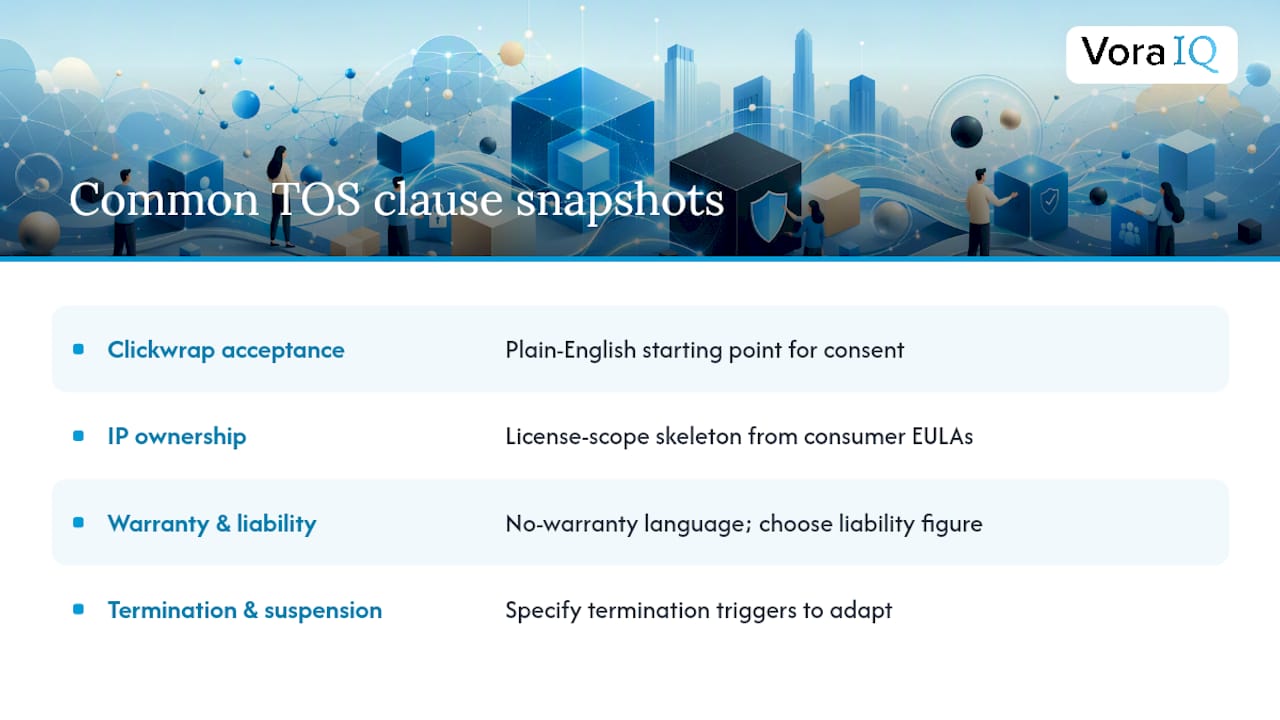
Clickwrap acceptance:
IP ownership and license:
Warranty disclaimer and liability cap:
Termination and suspension:
These snippets mirror the structure used in common consumer-app EULAs, including the license-scope and no-warranty language Apple applies to its own developer agreements. Adapt the specifics: your license grant, your liability figure, your termination triggers, but the skeleton holds across most SaaS and app businesses.
How Do You Actually Draft and Publish a Startup ToS?
Getting from blank page to published, enforceable Terms of Service follows a predictable sequence. Skip a step and you’ll likely find the gap the hard way, usually during a dispute.
- Decide your acceptance model and governing state first. Clickwrap versus browsewrap, and which state’s law governs, are foundational choices that shape every clause you write after.
- Map every user flow that touches legal risk. Sign-up, payment, content upload, account deletion. List each one before drafting a single clause.
- Draft clause by clause using the checklist above, then implement clickwrap at each critical touchpoint you mapped.
- Test the actual consent flow yourself. Click through sign-up and checkout as a user would. Confirm the checkbox appears, the terms link works, and the acceptance event logs correctly.
- Record your first version and timestamp it. This becomes version 1.0 in your internal archive.
- Publish, then build your change-notice process for the inevitable future update.
Watch for specific triggers that mean it’s time to get a lawyer involved rather than relying solely on templates: closing a funding round, signing your first enterprise or regulated customer (healthcare, finance), or expanding to users outside the U.S. where privacy regimes like GDPR create obligations your domestic ToS never anticipated. Templates and generators, including tools like Terms.Law’s service agreement generator, work well for getting a first draft off the ground. They’re not a substitute for review once real money and real risk are on the line.
Pro Tip: Do this mapping exercise before you write a single clause, not after. Founders who draft the ToS first and reverse-engineer the user flow later almost always miss a touchpoint, usually the one that matters most.
Where Does Vora IQ Fit Into Startup Legal Drafting?
Most solo founders don’t have a general counsel on speed dial when they’re mapping out their sign-up flow at 11 p.m. That gap between “I need this legally sound” and “I don’t know where to start” is exactly where structured tooling earns its keep.
Vora IQ was built as the first AI-native operating system designed specifically for solo founders and early-stage entrepreneurs, and legal and compliance awareness is one piece of a much larger toolkit that spans idea validation, adaptive roadmaps, and daily task automation. Instead of treating your product plan and your legal groundwork as separate projects, Vora IQ keeps them connected to the same business context you’re already building.
Here’s what that looks like in practice for a founder working through a ToS:
- Map your actual user journeys (sign-up, payment, content upload) inside the same platform where you’re already building your operating system for the business, so legal touchpoints don’t get discovered after launch.
- Generate structured first-draft language for clauses tied to your specific business model, rather than starting from a generic template disconnected from your actual product.
- Keep a version history of decisions as your product and customer base evolve, the same adaptive-roadmap thinking Vora IQ applies to your business plan.
Vora IQ has powered more than 2,400 unique roadmaps and sets of actionable insights across a range of industries, and legal-readiness tasks fit into that same adaptive structure rather than sitting in a separate binder. None of this replaces an attorney’s sign-off. It shortens the distance between “I know I need a ToS” and “I have a solid draft ready for review.”
When Should You Update Your Terms of Service?
Update your ToS whenever something material changes: new pricing, a new arbitration clause, expanded data collection, or a shift in what rights users grant you over their content. Cosmetic fixes, like correcting a typo or reformatting a section, don’t require the same process.
For material changes, give users actual notice, not just a quiet edit to the page. Common, defensible approaches include an email to registered users, an in-app banner on next login, or a “Terms last updated [date]” notice paired with a summary of what changed. The method matters less than the fact that a user had a genuine opportunity to see the change before it took effect.
Whether you need active re-acceptance depends on the stakes. Adding a new arbitration clause or a fee increase generally warrants requiring users to click “I Agree” again before continuing to use the service. Minor clarifications can proceed with notice alone, paired with a “continued use constitutes acceptance” clause, though that clause carries less legal weight for high-impact changes than it does for small ones.
Keep a dated archive of every version you publish. If a dispute surfaces about something that happened eight months ago, you need to know exactly which terms were live on that date, not just what your current page says. This is the same version-tracking discipline that protects you in a DMCA dispute or an arbitration challenge: a clear paper trail beats a confident claim every time.
How Should Startups Handle Data Security Beyond the Privacy Policy?
Your Privacy Policy covers what data you collect and why. Your ToS should cover what happens when something goes wrong with that data, and that’s a distinct set of obligations most founders overlook until they need them.
Include a clause describing your general security posture: reasonable administrative, technical, and physical safeguards appropriate to the sensitivity of the data you hold. You’re not promising an unbreakable system, since no honest founder can. You’re committing to a standard of reasonable care.
Address breach notification directly. Most states have their own data breach notification laws with specific timelines and required content, so your ToS should commit to notifying affected users “without unreasonable delay” and in compliance with applicable law, rather than naming a single national standard that may not match every state’s requirement.
Clarify data retention and deletion. State how long you keep user data after account closure and what happens to it: deletion, anonymization, or retention for a defined legal or operational period. If you use third-party processors or subprocessors (payment processors, cloud hosts, analytics tools), a brief reference to that fact, with detail deferred to the Privacy Policy, keeps both documents aligned instead of contradicting each other.
Finally, state user responsibilities for their own account security: strong passwords, prompt reporting of suspected unauthorized access, and enabling two-factor authentication if you offer it. Security is a shared obligation, and your ToS should say so plainly rather than implying the burden sits entirely on your infrastructure.
Does Your ToS Need to Account for Users Outside the U.S.?
If your product is available globally, and most web and app products are by default, your ToS needs to anticipate users outside U.S. jurisdiction even if you never intended to sell internationally.
Start with a clear statement of who you’re built for. Many early-stage startups explicitly limit their service to U.S. users, or state that non-U.S. users accept the agreement at their own risk under U.S. law. This doesn’t eliminate foreign legal exposure, but it establishes your intended scope clearly.
If you do have European users, GDPR obligations attach the moment you process their personal data, regardless of what your ToS says about governing law. Your Privacy Policy carries most of that compliance burden, but your ToS should acknowledge the relationship: reference the Privacy Policy for data-subject rights, and consider whether you need a separate EU-facing terms addendum if that user base grows meaningfully.
Arbitration clauses deserve a second look here too. Mandatory arbitration and class-action waivers, common and generally enforceable for U.S. consumers, face pushback or outright unenforceability in several other jurisdictions, including parts of the EU where consumer protection law limits pre-dispute arbitration agreements.
The practical move for most early-stage startups: keep your core ToS U.S.-focused and enforceable, state explicitly which law governs, and revisit international-specific provisions once foreign users become a meaningful share of your base rather than an edge case. Building a global-first ToS before you have global traction usually means over-engineering a document you’ll rewrite anyway.
Sources
Founders drafting their first ToS should bookmark a short list of primary sources rather than relying solely on blog summaries:
- DMCA designated agent directory — U.S. Copyright Office
- Rules — American Arbitration Association (AAA)
- Why your startup needs a Terms of Use and Privacy Policy — WeWork Ideas (WilmerHale guidance)
- Terms & conditions for startups: setting the rules of engagement — GLS Startup Law