
AI Business Advice for Small Business Owners in 2026
By Vora IQ Team
Discover essential AI business advice for small business owners. Learn to implement AI solutions that boost efficiency, reduce costs, and enhance customer...
- ai business advice

Good AI business advice is not about adopting every new tool. It is about deploying artificial intelligence where it solves a specific, measurable problem in your workflow. For solo founders and early-stage business owners, that distinction separates real traction from expensive distraction.
At its core, AI business advice means actionable guidance for integrating AI technologies into your daily operations in ways that produce clear outcomes: faster workflows, lower costs, sharper decisions, and stronger customer engagement. The foundational starting point for most small businesses is not building a custom model. It is wrapping existing foundation models via APIs from providers like OpenAI and Anthropic, which saves months of development time and keeps costs manageable.
Here is what practical AI adoption actually delivers for early-stage businesses:
- Efficiency gains from automating repetitive, time-consuming tasks
- Better decisions powered by real-time data analysis rather than gut instinct alone
- Personalized customer engagement at a scale one person cannot manually sustain
- Marketing optimization through AI-generated content, scheduling, and targeting
- Inventory and sales forecasting that reduces waste and missed revenue
- Competitive edge by moving faster than rivals still doing everything manually
The strategic rule is simple: pick one problem, solve it with AI, measure the result, then expand.
Table of Contents
- How AI can benefit your small business operations
- How to get started with AI as a small business owner
- Risks and ethical considerations in using AI for business
- Common AI terms every small business owner should know
- Why early-stage businesses should use AI-native platforms like Vora IQ
- Vora IQ gives you a full AI operating system, not just another tool
- Key Takeaways
How AI can benefit your small business operations
The BCG Henderson Institute found that around 80% of tasks performed by business strategists can be augmented or automated by AI, enabling continuous strategy refinement and dynamic resource allocation. That figure matters for small businesses because it means AI is not just an enterprise tool. It is a force multiplier for a two-person team.
The real benefits break down across four areas:
- Task automation: Email sorting, meeting summaries, invoice processing, and social media scheduling can all run without you touching them.
- Decision support: AI analyzes your sales data, customer behavior, and market signals faster than any spreadsheet.
- Customer engagement: Chatbots handle common questions around the clock; AI personalizes outreach based on individual customer history.
- Content and marketing: AI drafts blog posts, ad copy, and product descriptions, then schedules them across platforms.
What separates high-performing small businesses from the rest is where they focus first. Revenue-focused workflows like proposal generation, discovery preparation, and account planning deliver faster, measurable returns than back-office automation alone. Back-office efficiency is a baseline. Revenue impact is the goal.
True AI value also lies in enabling always-on strategy adjustments closer to frontline decisions. You do not need a quarterly planning retreat when AI surfaces insights daily.

Pro Tip: Before automating anything, list your five most time-consuming weekly tasks and rank them by revenue impact. Start with the one at the top of both lists.
How to get started with AI as a small business owner
Most founders overthink the starting point. The 90-day playbook below keeps it concrete.
Days 1–30: Audit and install
- Map your highest-volume, most tedious workflows (think: responding to leads, writing proposals, updating records).
- Choose one workflow and select an AI tool that addresses it directly.
- Use foundation models via APIs from OpenAI or Anthropic rather than building anything from scratch. Early-stage founders who take this approach save significant time and cost compared to proprietary model development.
- Set a tooling floor at a reasonable monthly spend rather than spreading budget across a dozen small subscriptions. Tool overload is one of the most common failure modes for new AI adopters.
Days 31–60: Measure and refine
- Track one metric tied to the workflow you automated: time saved, response rate, error rate, or revenue generated.
- Assign clear ownership. One person is responsible for monitoring the AI output and flagging problems.
- For the first 90 days, apply a human-in-the-loop approval step on all customer-facing AI output. This builds trust internally and protects your reputation externally.
Days 61–90: Expand
- Once the first workflow runs cleanly, identify the next one.
- Build a reusable context layer: your brand voice, product details, customer personas, and pricing. Feed this into every AI prompt to get outputs that sound like you, not a generic chatbot.
Pro Tip: Companies that build a structured context layer of their own data before querying AI dramatically improve output relevance and reduce generic or incorrect responses. Write a one-page business brief and attach it to every AI session.
Risks and ethical considerations in using AI for business

AI without human judgment produces problems. The U.S. Small Business Administration is direct about this: have another person review all AI-generated content, especially if you are using free tools. That is not overcaution. It is basic quality control.
The risks every small business owner needs to understand:
- AI hallucinations: Foundation models can generate confident, plausible-sounding information that is factually wrong. Never publish AI output without a human read.
- Data privacy: Avoid feeding sensitive customer data, financial records, or proprietary information into public AI tools. That data can enter the model’s training pool.
- Automation bias: Over-relying on AI recommendations without questioning them leads to compounding errors, especially in pricing, hiring, or customer communications.
- Intellectual property: AI sources content from the web. Verify that generated text, images, or code do not infringe on existing copyrights or trademarks.
- Compliance risk: In regulated industries like fintech, healthcare, and legal services, AI outputs must meet specific standards. Human review remains essential in these contexts.
- Customer trust: AI-generated outreach that feels impersonal or is flagged as spam erodes the relationship you have worked to build.
Governance does not have to be complicated. A simple internal policy covering what data you feed AI, who reviews outputs, and how you disclose AI use to customers covers most of the ground. AI adoption success requires governance that acts as safe guardrails enabling faster progress, not bureaucratic friction.
Common AI terms every small business owner should know
You do not need a computer science degree to use AI well. But knowing these terms helps you make smarter decisions and avoid being sold tools you do not need.
- Foundation models: Large pre-trained AI models like GPT-4o (OpenAI) or Claude (Anthropic) that you can access via API and customize for your use case without building anything from scratch.
- API (Application Programming Interface): The connection that lets your software talk to an AI model. When you use an AI writing tool or chatbot, it is almost always calling an API behind the scenes.
- Workflow integration: Connecting AI tools to your existing systems, like your CRM, email platform, or project management app, so AI works inside your current process rather than alongside it.
- Human-in-the-loop: A design principle where a human reviews or approves AI output before it reaches a customer or affects a business decision. Critical for quality and compliance.
- Knowledge architecture / context layer: The structured collection of your business data, brand guidelines, and customer information that you feed to AI to make its outputs relevant and on-brand.
- Agentic AI: AI that can take multi-step actions autonomously, like researching a topic, drafting a document, and scheduling a post, without you prompting each step individually.
- Tooling floor: The minimum monthly AI spend that gives you meaningful capability without tool sprawl. For most early-stage businesses, that sits around $125/month.
Understanding these terms lets you evaluate any AI pitch clearly. If a vendor cannot explain how their tool fits your workflow using plain language, that is a signal worth heeding.
Why early-stage businesses should use AI-native platforms like Vora IQ
Most AI tools are point solutions. They handle one task well and leave you to stitch everything else together manually. That works fine at scale. For a solo founder or a two-person startup, it creates a different kind of overhead.
Vora IQ is built differently. It is the first AI-native operating system designed specifically for solo founders and early-stage entrepreneurs, combining business idea validation, AI-generated business plans, living roadmaps, daily task automation, market and competitor analysis, financial modeling, compliance awareness, social media content generation, pitch deck creation, and advice from 13 specialist AI teammates, all personalized through your Business Memory.
That last part matters. Generic AI tools give generic outputs. Vora IQ’s outputs are shaped by your industry, your stage, your goals, and your data. The difference between a boilerplate business plan and one that reflects your actual market position is the difference between a document that sits in a folder and one that guides real decisions.
“Most founders don’t fail because they lack ideas. They fail because they lack a clear, adaptive system for turning ideas into execution. Vora IQ was built to be that system — not a static plan, but a living operating layer that moves with your business.” — Khalel, Founder, Vora IQ
Vora IQ has delivered thousands of unique roadmaps and insights across industries. That track record reflects a platform built around what early-stage founders actually need: structured guidance without the overhead of a full team.
Pro Tip: Use Vora IQ’s AI for strategic planning features to build your context layer inside the platform. Every plan, roadmap, and AI output stays aligned with your business specifics, not a generic template.
For founders who also need technical development support alongside strategic planning, MVP development expertise can complement the strategic foundation Vora IQ provides.
Vora IQ gives you a full AI operating system, not just another tool
You have read the advice. Now the question is execution. Vora IQ is where that happens.
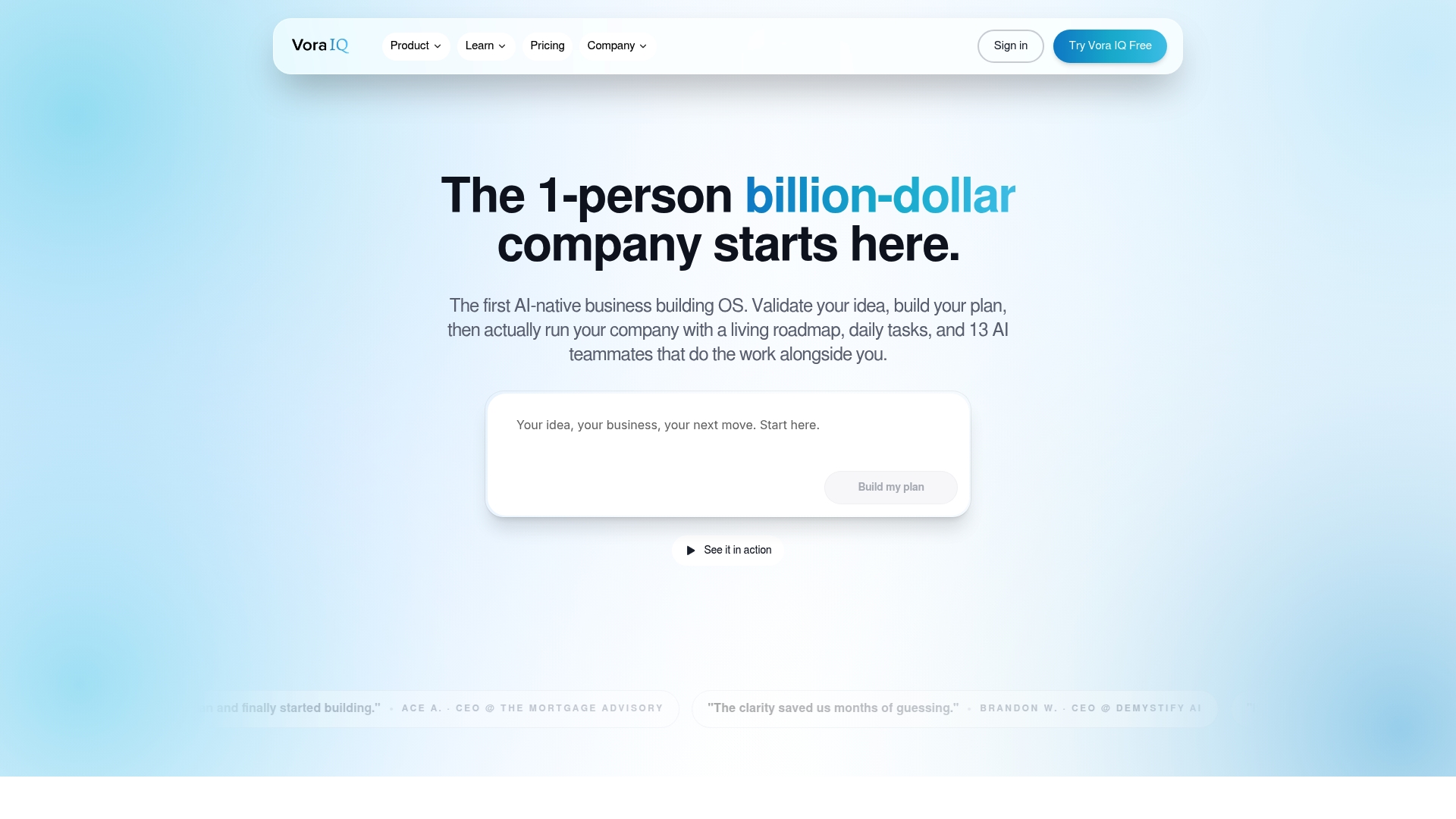
Solo founders and early-stage entrepreneurs use Vora IQ to move from idea to traction without hiring a full team. The platform validates your business idea, builds your plan, generates your roadmap, automates your daily tasks, and keeps your strategy current as your market shifts. Every output is personalized to your context, not pulled from a generic template. That is the difference between AI that sounds like you and AI that sounds like everyone else.
Explore the full range of use cases to see how founders at your stage are using Vora IQ right now, or check out the platform features to understand exactly what you get from day one. Get your free Idea Report Card and put your first AI-powered roadmap in motion today.
Key Takeaways
The most effective AI business advice for small business owners is to start with one specific, revenue-impacting workflow, use existing foundation models via API, and measure outcomes before expanding.
| Point | Details |
|---|---|
| Start with one workflow | Pick the highest-volume, revenue-impacting task first and automate that before adding more tools. |
| Use foundation models via API | OpenAI and Anthropic models save time and cost compared to building proprietary AI from scratch. |
| Apply human-in-the-loop review | For the first 90 days, a human should approve all customer-facing AI output to protect quality and trust. |
| Keep a tooling floor around $125/month | Avoid tool overload; one focused AI subscription compounds efficiency faster than many small ones. |
| Vora IQ as your AI operating system | Vora IQ delivers personalized roadmaps, plans, and automation built for solo founders, with 2,400+ roadmaps delivered. |