
Don't Lose QSBS Time: U.S. Founders' LLC vs C Corp Decision
By Vora IQ Team
U.S. founders: choose an LLC or C Corp with fundraising and QSBS timing in mind. Learn when to form a Delaware C Corp, avoid costly conversions, and...
- llc vs c corp

For most bootstrapped businesses, an LLC is the right call. For founders planning to raise venture capital or hire with stock options, a C-Corp usually wins. The deciding factor is almost never taxes. It’s whether you’ll need institutional money and equity compensation within the next couple of years.
TL;DR:
- Opt for a Delaware C-Corp if you plan to raise venture capital within the next two years, as most investors prefer this structure.
- An LLC can be more straightforward and flexible for small founders but may incur higher self-employment taxes and lacks standard investor-friendly features.
- Converting an LLC to a C-Corp close to a funding round can trigger costly tax and legal complications, potentially costing weeks or thousands of dollars.
- Starting as an LLC and delaying incorporation risks losing QSBS benefits and extending the timeline for qualifying stock exemptions, which can be critical for fundraising.
- The choice ultimately depends on your funding plans, hiring needs for equity compensation, and readiness to handle administrative formalities and legal complexities.
Table of Contents
- LLC vs C Corp: The Quick Comparison
- How C-Corps and LLCs Are Actually Taxed
- Liability Protection and Corporate Formalities
- Why Investors Push Founders Toward a C-Corp
- Three Questions That Tell You Which Entity to Choose
- Converting Between an LLC and a C-Corp Without Getting Burned
- Where to Incorporate and What It Actually Costs
- Your Checklist Once You’ve Made the Decision
- Optionality Costs Nothing Until It Costs Everything
- Let Vora IQ Turn Your Entity Decision Into a Real Plan
- Where to Verify the Filing Details
- Sources
LLC vs C Corp: The Quick Comparison
Every founder eventually asks the same question in different words: build now, fundraise later, or structure for fundraising from day one? The answer hinges on five practical differences.
- Taxes: C-Corps pay a federal corporate tax on profits, then shareholders pay tax again on dividends. LLCs default to pass-through treatment, where profit flows to your personal return once, not twice.
- Administrative burden: C-Corps require a board of directors, bylaws, annual meetings, and formal minutes. LLCs run on an operating agreement with far fewer mandatory rituals.
- Fundraising fit: Venture capital firms almost universally want a Delaware C-Corp before they’ll write a check, because preferred stock and standardized cap tables are built for corporations, not LLC membership units.
- Equity compensation: Stock options and ISOs only exist in the corporate world. If you’re hiring engineers with equity in year two, an LLC can’t offer that instrument.
- QSBS eligibility: Only C-Corp stock qualifies for the Qualified Small Business Stock exclusion under Internal Revenue Code §1202, which can shield a huge chunk of exit gains from federal tax if you hold the stock long enough.
Notice the pattern: LLCs win on simplicity, C-Corps win on scale. Neither structure is objectively “better.” They’re built for different games.
How C-Corps and LLCs Are Actually Taxed
This is where most founders get confused, so let’s clear it up plainly.
A C-Corp pays a federal tax on its profits at the entity level. If the company then distributes any of that after-tax money to shareholders as a dividend, the shareholder pays personal income tax on it too. That’s the “double taxation” everyone warns you about.
Here’s the part that gets glossed over: double taxation is mostly theoretical for early-stage startups. Most venture-backed companies reinvest every dollar into growth. There’s no profit to distribute, so there’s no dividend, so there’s no second tax hit. Double taxation becomes a real cost only once a company is profitable and actually cutting checks to owners, which for most startups is years away, if it happens at all.
An LLC works differently by default. Profits and losses pass straight through to members via Schedule C (single-member) or Form 1065 with a K-1 (multi-member), and you report that income on your personal return. But there’s a catch: LLC members are generally treated as self-employed, meaning that income is subject to self-employment tax on top of ordinary income tax.
Pro Tip: Run the numbers before you assume pass-through is automatically cheaper. Self-employment tax applies to Social Security up to the annual wage base plus Medicare on all net earnings, so a profitable LLC can sometimes owe more than a similarly profitable S-Corp election would.
That’s where elections come in. An LLC can file Form 2553 to be taxed as an S-Corp, letting owners split income between a reasonable salary (subject to payroll tax) and distributions (not subject to self-employment tax). Alternatively, an LLC can file Form 8832 to elect C-Corp tax treatment entirely, though this is rare outside specific tax-planning situations.
Two numbers worth modeling before you file anything:
- The IRS guidance on paying yourself walks through how salary versus distribution decisions affect your tax bill, whether you’re running payroll for a C-Corp or splitting income under an S-election.
- The self-employment tax rate is a fixed percentage of net earnings, so a founder pulling six figures out of an LLC should compare that cost against the combined payroll and dividend tax burden of a C-Corp before assuming pass-through is cheaper.
The tax code doesn’t hand out a universal winner here. It hands out a spreadsheet exercise.
Liability Protection and Corporate Formalities
Both structures do the one thing every founder actually needs: they separate your personal assets from business debts and lawsuits. A creditor suing your company generally can’t come after your house or personal savings, provided you’ve kept the entity and yourself as genuinely separate parties.
That “provided” is where founders get burned. Courts can pierce the corporate veil and hold owners personally liable when a company ignores its own formalities or blends personal and business finances.
C-Corps carry heavier formal requirements: a board of directors, written bylaws, a stock ledger tracking who owns what, and documented board minutes for major decisions. Skip these consistently and a court has more ammunition to argue the corporation is a sham, not a real separate entity, especially when a plaintiff’s attorney goes digging during litigation.
LLCs get more slack. An operating agreement can be as flexible as the members want, and there’s no legal requirement for annual meetings or formal minutes in most states. That flexibility is exactly why LLCs appeal to solo founders and small partnerships who don’t want to run a mini-corporation. But “less required” doesn’t mean “no risk.” An LLC owner who pays personal bills straight from the business bank account is handing a future plaintiff the exact evidence needed to pierce the veil.
A short recordkeeping routine protects you regardless of entity type:
- Open a dedicated business bank account and never move personal expenses through it.
- Keep a registered agent on file in your formation state, and renew it every year without letting it lapse.
- Document major decisions in writing, whether that’s formal board minutes or a simple dated memo for an LLC.
- Sign contracts and invoices in the company’s name, not your own, every single time.
Pro Tip: Set a recurring calendar reminder for your registered agent renewal and annual report deadline the same week you form the entity. Missing either one is the single most common way founders accidentally lose good standing with the state.
Why Investors Push Founders Toward a C-Corp
Ask any startup lawyer why venture capital and C-Corps go together and you’ll hear the same answer: standardization. VC firms deploy NVCA model documents built around preferred stock, liquidation preferences, and a Delaware corporate structure that every institutional investor’s legal team already knows how to underwrite. An LLC’s flexible profit-allocation rules, while great for a small partnership, complicate the standardized equity math investors expect, which is precisely why so few venture deals happen inside an LLC.
Equity compensation tells the same story from the hiring side. Stock options and incentive stock options (ISOs) are corporate instruments by definition. If you’re trying to recruit a senior engineer away from a bigger company with the promise of meaningful equity upside, an LLC simply doesn’t have the tool to make that offer competitive.
Then there’s QSBS, the provision that changes the math on an eventual exit. IRC §1202 lets founders and early investors exclude a substantial portion of capital gains from federal tax when they sell qualifying C-Corp stock held long enough. Only stock in a domestic C-Corp qualifies. LLC membership interests are never eligible, no matter how the company converts later.
That last point is the trap. Some quick math on why timing matters:
- QSBS has a required holding period measured in years, and that clock starts the day you receive qualifying C-Corp stock, not the day your business first made money as an LLC.
- Founders who delay incorporating as a C-Corp until right before a fundraise can shorten or forfeit that holding-period advantage entirely, along with racking up legal cleanup costs converting under deal-timeline pressure.
- Converting an existing LLC into a C-Corp later is legally possible but rarely cheap or fast when a term sheet is already on the table.
If institutional fundraising is even plausible within your planning horizon, that QSBS clock is a real reason to start the C-Corp conversation earlier rather than later.
Three Questions That Tell You Which Entity to Choose
Skip the philosophical debate. Answer these three questions honestly and the choice mostly makes itself.
- Are you planning to raise institutional venture capital within the next 12 to 24 months? If yes, form a Delaware C-Corp now. Retrofitting later costs time and money you’ll need for the raise itself.
- Will you need to hire using equity, ISOs, or a standardized option pool? If yes, you need a corporation. LLCs cannot issue stock options, full stop.
- Do you mainly need pass-through losses, simple administration, and low overhead right now? If yes, an LLC is almost certainly the better starting point, especially if fundraising is speculative rather than planned.
Most founders don’t get three clean “yes” answers to the same question, and that’s normal. If you’re torn between optionality and simplicity, two compromise paths work reasonably well: start as an LLC but put a conversion plan on the calendar tied to a specific fundraising milestone, or incorporate as a Delaware C-Corp early precisely because you want the QSBS clock running and the fundraising door open even if you’re not sure you’ll walk through it.
Converting Between an LLC and a C-Corp Without Getting Burned
Converting isn’t a single process. Depending on your state, it might be a statutory conversion (a direct entity-type swap on file with the secretary of state), a merger into a newly formed corporation, or in narrow cases a tax election alone. Which path applies, and how much paperwork it takes, varies by state.
The tax mechanics usually run through IRC §351, which allows a tax-free transfer of assets into a corporation in exchange for stock, provided you meet control requirements. That “usually” matters: if the LLC carries liabilities exceeding the basis of transferred assets, or members have negative capital accounts, the conversion can trigger taxable gain even though no cash changed hands.
Timing hits your QSBS clock directly, since it only starts running once you’re holding qualifying C-Corp stock. Before converting, line up:
- A startup-focused attorney to handle the statutory filing and equity documentation
- A CPA to model the §351 tax exposure and any gain triggered by liabilities
- Updated cap table and stock ledger documents ready before any investor due diligence begins
Cleaning this up mid-financing, under deadline pressure, always costs more than doing it early.
Where to Incorporate and What It Actually Costs
Delaware remains the default choice for startups planning to raise venture capital, mainly because its corporate law is predictable and every VC’s counsel already knows it cold. If you’re not raising outside money, incorporating in your home state is usually simpler and skips the extra cost of registering as a foreign entity there too.
Expect these recurring line items regardless of structure:
- State formation filing fees, which vary widely by state and entity type
- An annual report or franchise tax payment, again state-dependent, with Delaware charging a franchise tax separate from any home-state obligations if you incorporate there but operate elsewhere
- A registered agent service, typically a modest annual fee if you use a third-party provider rather than yourself
- Legal fees that scale up sharply once you’re preparing actual fundraising documents, versus the relatively low cost of a straightforward formation
The SBA’s guidance on choosing a business structure is a solid starting point for comparing these state-level basics before you file anything.
Your Checklist Once You’ve Made the Decision
Whichever structure you pick, the first two weeks matter more than people expect.
- File your formation paperwork in your chosen state and apply for an EIN using Form SS-4.
- Open a business bank account immediately, and set up bookkeeping before your first transaction, not after.
- Structure payroll correctly from day one, separating salary from distributions so you’re not guessing at self-employment tax exposure later.
- If you formed a C-Corp, prepare your equity pool, get a 409A valuation before issuing options, and start documenting board minutes now.
- If you formed an LLC, finalize your operating agreement and set a routine for issuing K-1s to members each year.
Pro Tip: Book your first CPA consult before you’ve made a single dollar of revenue, not after your first tax season surprises you. The conversation costs less than the mistake it prevents.
Optionality Costs Nothing Until It Costs Everything
Here’s my honest read after walking through the mechanics: the “start simple, convert later” advice sounds reasonable and is often wrong for anyone with a real shot at raising money. The QSBS clock and clean-cap-table requirements punish delay in ways that don’t show up until you’re staring at a term sheet with weeks to close.
One pattern shows up again and again in startup law commentary: founders who wait until right before a raise to convert end up paying rushed legal fees and losing months off their QSBS holding period, both avoidable with six months of foresight.
If fundraising is even plausible, lean toward a Delaware C-Corp early. If it’s genuinely not on your radar, an LLC keeps things lean. Either way, model the decision with real numbers instead of gut feel. Tools like Vora IQ exist for exactly that kind of modeling, alongside your CPA and attorney.
— Khalel
Let Vora IQ Turn Your Entity Decision Into a Real Plan
Choosing between an LLC and a C-Corp is only the first fork in the road. What comes next, cap table structure, payroll setup, equity pool sizing, investor-ready financials, is where most solo founders lose weeks they don’t have. Vora IQ builds that next stretch into an adaptive roadmap instead of a stack of guesswork.
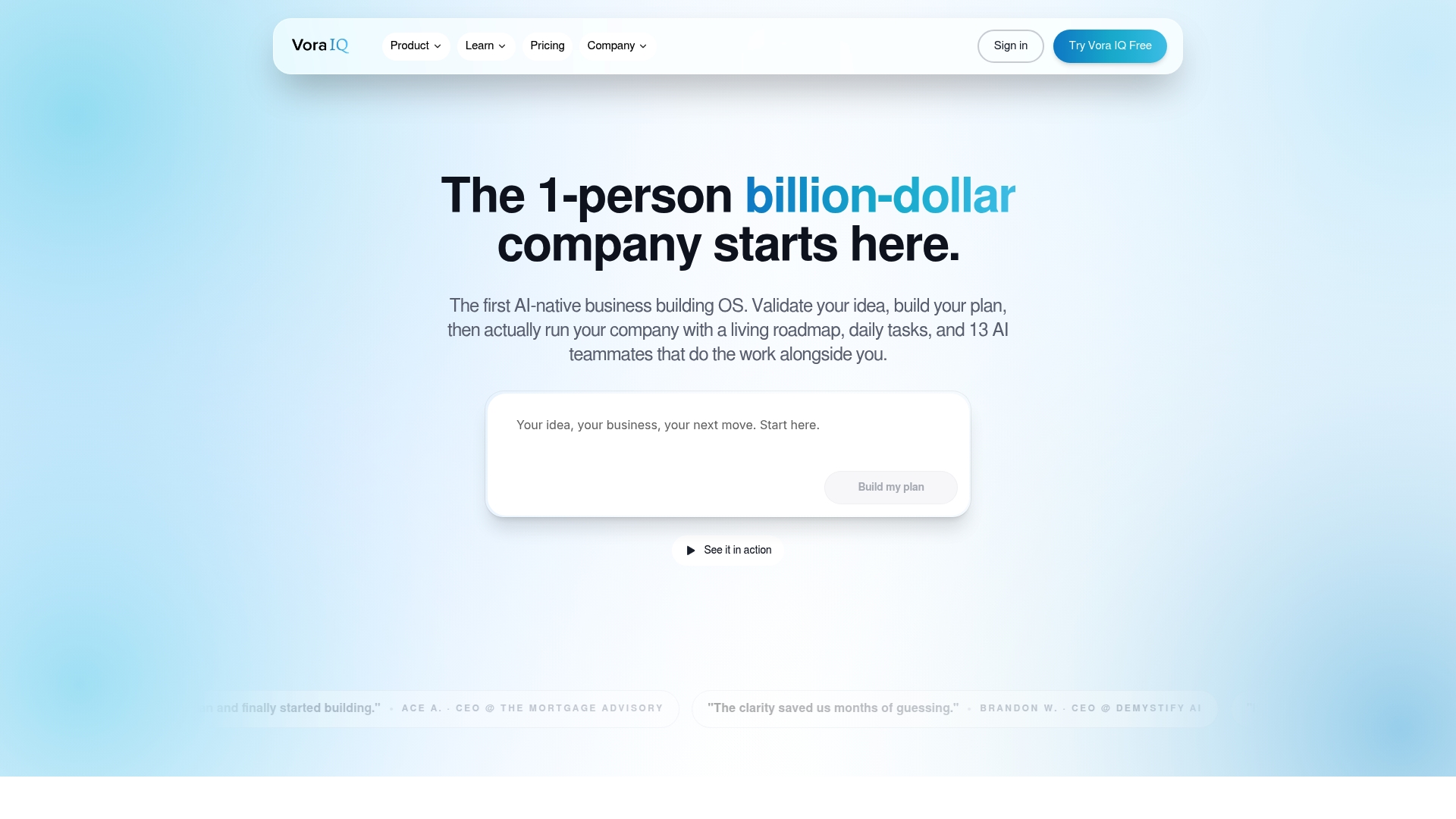
Once you know your structure, Vora IQ’s AI teammates help you model the financial side (down to Stripe-connected projections), draft the documents investors expect to see, and generate a day-by-day execution plan so formation decisions turn into forward motion instead of stalling in a folder of half-finished paperwork. Founders comparing tools for this stage can see exactly who Vora IQ is built for and how the platform handles roadmap generation and financial modeling on the features page.
If you’ve already picked LLC or C-Corp and want the next ninety days mapped out instead of improvised, start with a free Idea Report Card and let Vora IQ generate your formation-to-fundraising roadmap today.
Where to Verify the Filing Details
Don’t take entity mechanics on faith from any single article, including this one. The IRS page on forming a corporation covers EIN applications and Form 8832 elections directly, while its LLC guidance walks through pass-through defaults and Form 2553. The SBA’s structure comparison rounds out the state-filing basics before you commit to a jurisdiction.
Sources
- LLC vs. C-Corp for startups: key differences in taxes, QSBS eligibility, investor expectations
- Choose a business structure (SBA)
- Limited liability company (LLC) (IRS)
- The ABCs of LLCs and C and S corps