
Top 3 AI Business Consulting Services Alternatives 2026
By Vora IQ Team
Compare 3 AI business consulting services alternatives to make informed decisions for enhancing decision-making and operations in your company.
- ai business consulting services

Building a growth-ready company as a solo founder is slowed down by scattered tools and the high cost of human consultants. Traditional AI business consulting services often require expensive retainers and still force founders to handle planning, content, and legal work across different platforms. This comparison covers scope, workflow fit, and pricing for three AI founder operating systems so you can pick one that covers all core business needs without outside consultants.
Table of Contents
Vora IQ
At a Glance
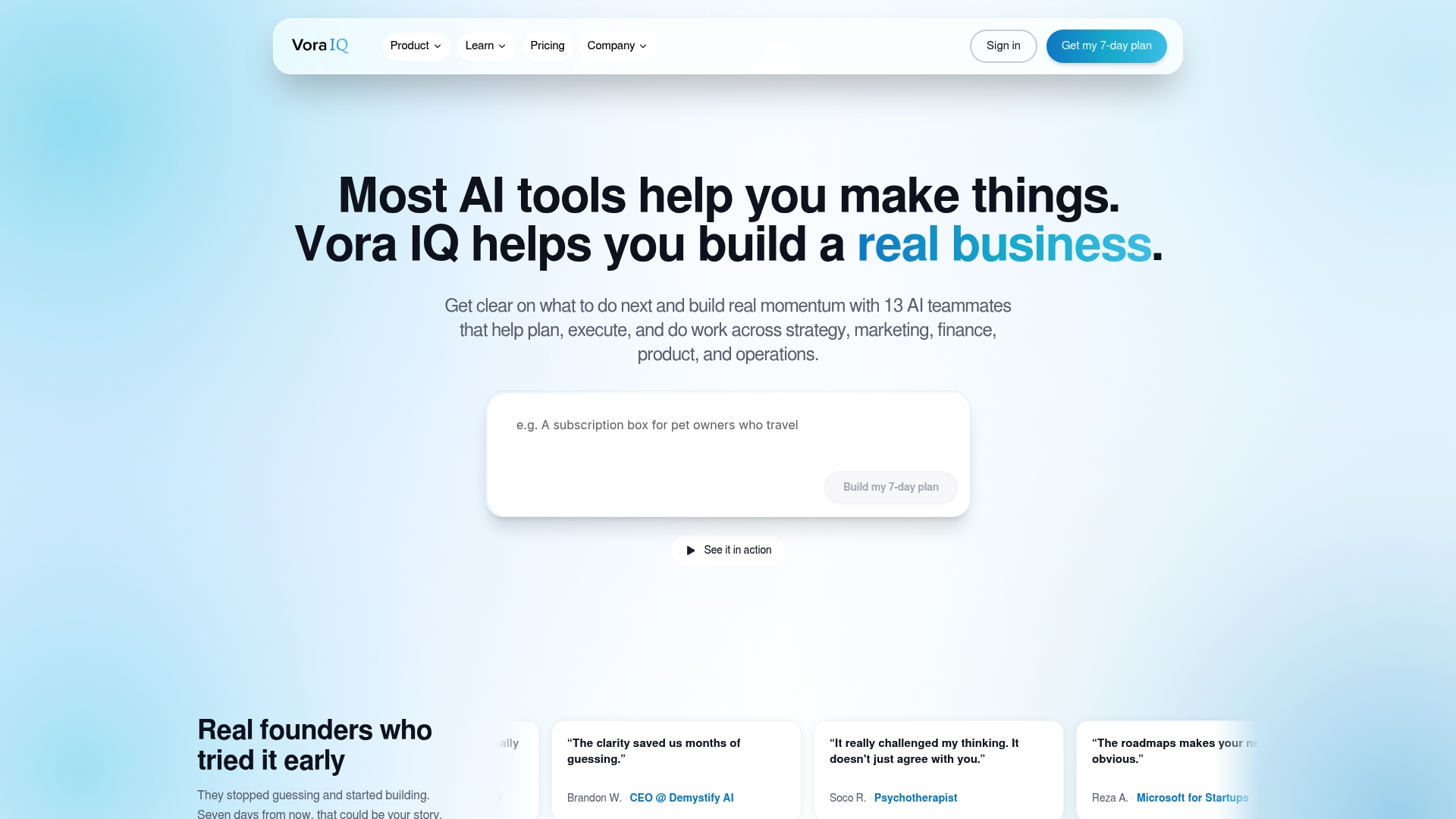
According to the company, Vora IQ has delivered over 2,400 unique roadmaps for founders and early teams. The product presents itself as the first AI-native operating system aimed at solo founders and early-stage entrepreneurs. It starts with a free Idea Report Card and packs planning, execution, and basic legal and finance support into one platform.
Core Features
Vora IQ runs a unified AI business team of 13 specialist agents that cover strategy, marketing, finance, legal, and growth. The platform creates real-time adaptive roadmaps and converts roadmap items into daily task lists while integrating market and competitor signals. It also offers voice-driven social content creation and scheduling, financial dashboards powered by Ledger, and a notes system labeled Notebook Intelligence that ties inputs directly to plans.
Key Differentiator
The platform’s connected AI system both plans and executes work across core startup functions. Agents hand off context to one another so priorities and tasks evolve as the business changes. That continuous handoff keeps the roadmap aligned with new market signals and operational realities rather than leaving plans static.
Pros
Vora IQ embeds multiple functional roles into one platform so you can replace several point tools or external consultants. The AI agents generate tasks and content that follow the current roadmap, which reduces the manual coordination burden for a solo founder. Financial and legal outputs sit alongside marketing and product work, so tracking runway and compliance happens in the same place you plan growth.
Cons
- Relies heavily on AI, which may not replace nuanced human judgment for complex legal or strategic decisions.
Who It’s For
You should consider Vora IQ if you are a solo founder or part of a very small team preparing to validate an idea and move to execution quickly. You will get the most value if you are comfortable with AI-driven workflows and want to avoid hiring multiple specialists. It also fits founders who prefer a single place to track roadmap, content, finance, and basic legal needs.
Unique Value Proposition
A roster of 13 specialist AI agents acts as a connected, on-demand business team. That design replaces the need to assemble separate consultants and tools for each function. With agents sharing context, the platform reduces the coordination load and shortens the time from idea validation to first executions. For a founder on a tight budget or short runway, that workflow can substitute for hiring multiple contractors early on.
Real World Use Case
A solo founder uses Vora IQ to validate demand by pulling market signals and competitor notes into a tailored roadmap. The system produces daily tasks, schedules social posts in the brand voice, and updates the financial dashboard to reflect projected burn. The founder completes legal checklists and initial filings without hiring separate counsel for every item.
Pricing
Pricing starts at $49.99/month or $419.99/year. Your first Idea Report Card is free with no credit card required, so you can pressure-test your idea before paying, and every plan is backed by a 14-day money-back guarantee. The vendor positions the subscription as a lower-cost alternative to hiring a full startup team.
Website: https://voraiq.com
CEOfriend
At a Glance
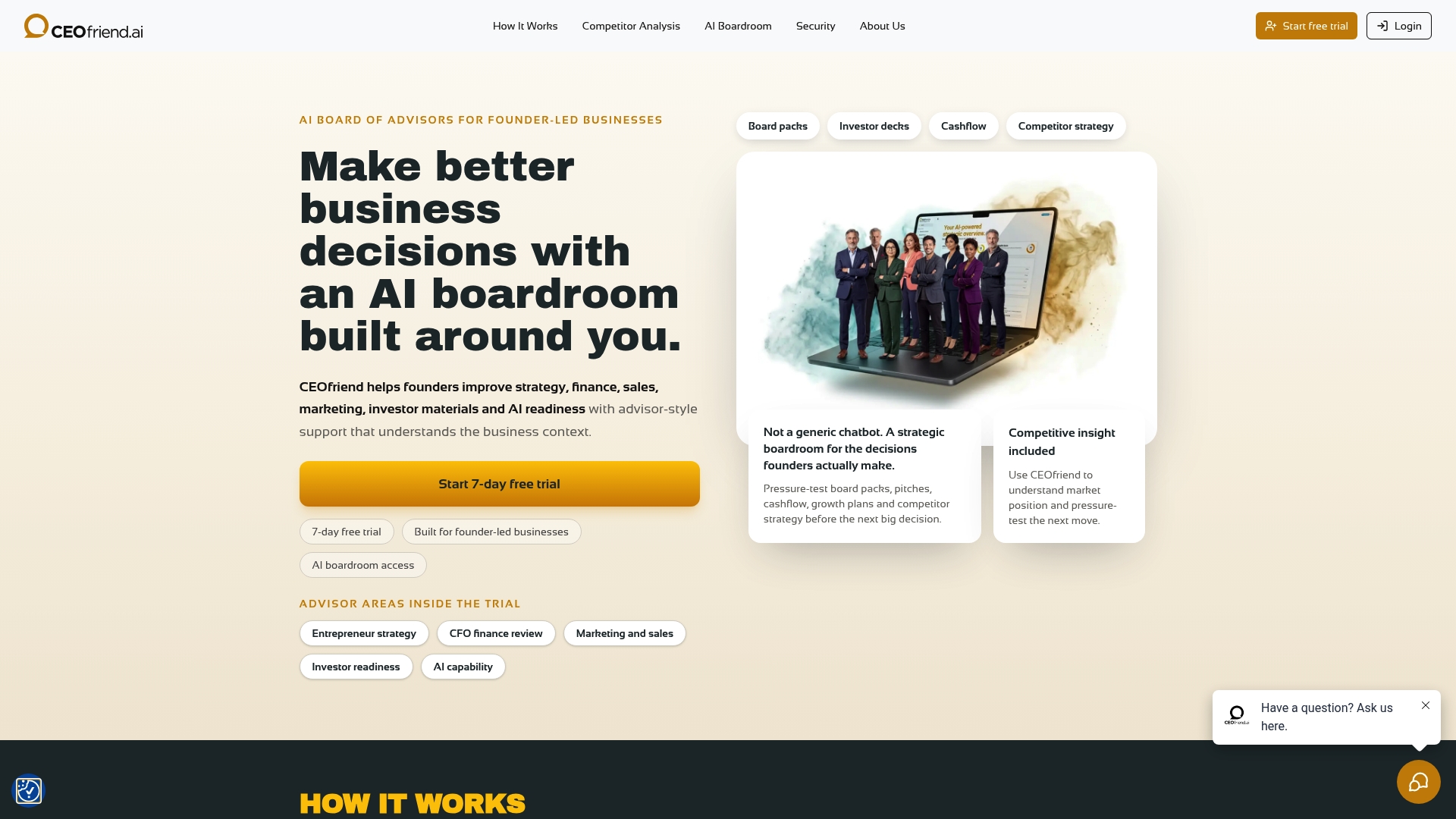
Instant competitor benchmarking without sign-up lets you compare peer domains in seconds. The tool targets founder led SMEs moving from startup to scaleup and focuses on strategic oversight for companies around £1M–£20M revenue. It also offers board pack optimization and a conversational dashboard that brings market and competitor signals into one place.
Core Features
CEOfriend combines domain benchmarking, real-time competitor insights, and a personalized dashboard with conversational AI interfaces to help you make faster calls. It accepts uploaded business documents and returns tailored advice for investor decks, board packs, and AI readiness. The platform groups finance, marketing, and strategy guidance so you can pressure test plans without hiring extra executives.
Key Differentiator
CEOfriend uses AI agents trained specifically on executive roles to analyze and pressure test strategic documents and decisions. Those agents mimic executive thinking patterns and surface questions and gaps that a small advisory board would raise. That focus on board level review distinguishes it from generic business intelligence tools.
Pros
CEOfriend delivers board level insights tailored to founder led businesses in a single place. It helps refine investor materials and board packs and runs competitor benchmarks without a signup barrier. The product claims enterprise grade security and private data handling, which supports use with sensitive investor and financial documents. It also covers multiple business functions so leaders do not juggle several point tools when preparing strategic reviews.
Cons
- Limited independent reviews make it hard to validate long term performance and user satisfaction from third party sources.
- The depth of AI advice may not match a full time executive or an external specialist for complex legal or tax questions.
- Feature set targets founder led and growth stage companies, so very small startups or large enterprises may find the fit less suitable.
When It May Not Fit
If your business requires hands on accounting, legal counsel, or niche technical audits, CEOfriend will not replace that specialized work. Larger companies with established boards and dedicated C suite staff may find overlap with existing processes. Companies seeking a human hourly advisory model rather than an AI assisted review will likely prefer traditional advisors.
Who It’s For
Founders and growth stage leaders who want on demand, board style oversight without hiring full time executives. Teams preparing investor decks, refining 90 day plans, or assessing AI readiness will get the most immediate value. This suits companies moving from seed toward scale with measurable revenue and clear growth targets.
Real World Use Case
A founder drops competitor domains into the benchmark tool, uploads a draft investor pitch, and asks the AI agents to pressure test pricing assumptions. The platform flags comparators, suggests deck rearrangements, and highlights weaknesses in market positioning. The founder leaves with a prioritized set of edits and a clearer 90 day plan.
Website: https://ceofriend.ai
Pythe
At a Glance
Stage-aware across seven tracks, Pythe maps product, growth, revenue, team, fundraising, operations, and customer milestones to your current company stage. It pairs that roadmap with an AI cofounder that will draft outreach, run research, and follow up on tasks you delegate. The platform updates plans as metrics change so your next actions stay aligned with real progress.
Core Features
Pythe builds a personalized, stage-aware roadmap covering seven startup tracks and lets you generate, edit, and regenerate milestones as your company evolves. The AI cofounder handles delegated work such as research, drafting, and outreach, while live metrics feed stage-aware insights back into the plan. Deep market analysis is tailored to your company inputs and adjusts priorities as you hit milestones.
Key Differentiator
Pythe combines a stage-specific operating system, live metrics, and a delegable AI collaborator into one workflow. That integration lets the roadmap adapt automatically when performance data shifts. For solo founders who want planning, execution, and measurement in the same tool, this integrated loop is the core difference.
Pros
The platform creates a highly customized plan that reflects your company context and stage, which keeps weekly priorities specific and measurable. It consolidates research, planning, delegation, and progress tracking so you do not jump between tools. The AI cofounder reduces time spent on routine tasks like follow-up and first-draft outreach, while live metrics and stage retrospectives close the feedback loop and guide plan adjustments.
Cons
- No independent third-party reviews are available, so real-world user satisfaction is unverified. This makes assessing long-term reliability harder.
- Onboarding can feel complex because the roadmap is deeply customizable and requires detailed inputs. New founders may need time to set up effective workflows.
- The platform provides limited transparency on how its AI makes specific decisions, which may concern users who want audit trails or explainability.
When It May Not Fit
If you prefer a very lightweight checklist tool, Pythe will likely feel heavy and configurable. Teams that need strict AI explainability or full audit logs may find the platform lacking. Larger companies that already run dedicated analytics and project operations stacks might find overlap rather than complementarity.
Notable Integrations
Pythe connects to common startup tools to keep work and data in sync. Integrations include Stripe, Slack, Notion, Figma, and n8n. These connections let you pull metrics, send notifications, and store plans where your team already works.
Who It’s For
Solo founders and early-stage teams who want one place for planning, delegated work, and live measurement will get the most from Pythe. Choose it if you need a roadmap that shifts with milestones and a helper that executes routine tasks. Skip it if you want minimal setup or strict AI transparency.
Real World Use Case
A solo founder generates a tailored startup roadmap, then asks the AI cofounder to compile a list of target customers and draft outreach emails. The founder tracks signups in live metrics, and the roadmap reprioritizes next-week tasks based on those signals. Delegation reduces busywork so the founder focuses on customer validation.
Pricing
Pythe offers a free testing tier and two paid plans. The entry tier is £0/forever for testing one founder workflow. Paid plans start at £19/month for Basic and £39/month for Premium.
Website: https://pythe.app
Comparison of alternatives
Choosing the right AI-driven platform involves assessing each product’s alignment with entrepreneurial needs and recognizing unique tradeoffs.
Analysis of alignment and core functionalities
Vora IQ focuses on early-phase startups, offering an integrated AI-based operating system for planning, executing, and managing business operations under a singular platform. This makes it an excellent fit for solo founders keen on streamlining diverse workflows without assembling an extensive team.
CEOfriend specializes in providing data-driven insights and strategic assistance to founder-led organizations with significant revenues. Its focus on executive-level considerations and competitor analysis distinguishes it as particularly effective for later-stage strategic planning.
Pythe’s emphasis lies in stage-specific milestones that inform task delegation and adaptive planning. This product provides deep integration with existing tools, which supports founders with an established trajectory seeking to optimize their organizational roadmap alongside automated task management.
Scalability and specialization differences
While Vora IQ designs its services for those in the initial phases of their businesses, CEOfriend is more suited for those transitioning toward substantial scaling. Pythe strikes a balance between these options, offering a configuration-intensive solution operationally applicable across more detailed milestones and existing tool integration setups.
Best fit
- Founders requiring a cohesive platform that combines strategy, execution, and real-time updates will find Vora IQ’s offerings most pertinent at early stages.
- Leaders who need strategic-level analysis focusing on refinement of materials like pitch decks and business plans will benefit from CEOfriend.
- Teams focused on developing and adhering to effective milestone-oriented planning and execution workflows will find Pythe’s multi-tool integrations and AI-coordinator functionalities advantageous.
Our pick
Voraiq.com creates the environment for small teams and solo founders who seek an integrated and adaptive AI-driven business execution platform, creating advanced, coherent, and consistently updated roadmaps. Yet, larger or more mature companies requiring intensive board-level material preparation or highly specialized insights might gain more value from CEOfriend or Pythe.
Evaluating AI-driven business platforms involves considering factors such as their unique features, target user base, and any limitations. Below is a comparison of three notable platforms.
| Product | Key Features | Target Audience | Pricing | Limitation | |-----------|--------------------------------------------|------------------------------------------------|---------------|---------------------------| **| Vora IQ | Unified platform with 13 AI agents and tools | Solo founders and small early-stage teams | From $49.99/month | Relies heavily on AI for complex decisions | **| CEOfriend | Competitor benchmarking, board pack optimization | Founders of SMEs scaling from £1M–£20M | Price not published | Limited independent reviews | **| Pythe | Stage-aware roadmap, delegable AI collaborator | Solo founders and early-stage teams | From £19/month | Requires input for customization |
How Can Solo Founders Get Clear Business Direction Without Hiring a Team?
Many solo founders and early teams struggle to keep their startup plans aligned with shifting markets and daily tasks. They face the challenge of juggling legal, financial, marketing, and strategy needs all at once. Vora IQ answers that challenge by combining 13 AI specialist agents into one platform that crafts a living roadmap. This unified AI business team updates your plan and daily tasks, so you stay on track without the hassle of managing multiple tools or consultants.
- A connected AI system that hands off context between roles
- Financial and legal tools alongside marketing and growth planning
- Voice-driven content creation and automated scheduling
Find out how Vora IQ delivers clarity and momentum for solo founders at Vora IQ. Take control of your startup roadmap and see your daily tasks evolve with your progress.
FAQ
How does Vora IQ help solo founders manage tasks?
Vora IQ generates daily task lists from its real-time adaptive roadmaps, making it easier for solo founders to stay organized. The platform converts roadmap items directly into actionable tasks, supporting effective execution. Solo founders can expect a streamlined workflow that aligns with their strategic goals.
What is the difference between Vora IQ and CEOfriend?
CEOfriend provides tailored, board-level insights and allows instant competitor benchmarking without a sign-up barrier, making it ideal for strategic oversight. Vora IQ, on the other hand, excels in delivering a unified AI business team that handles planning and execution simultaneously, reducing the burden of coordination for solo founders. Choose CEOfriend if you prioritize high-level strategic comparisons, but opt for Vora IQ for a more hands-on, task-driven approach.
Which platform offers more integrations for workflow?
Vora IQ supports a connected working environment using 13 specialist AI agents across various functions so tasks evolve as the business changes. In contrast, CEOfriend enhances decision-making with its focus on strategic documents and competitor insights. Founders should select Vora IQ if they seek a more dynamic integration of planning and execution with collaborative features.
Can I expect comprehensive financial dashboards with Vora IQ?
Vora IQ offers financial dashboards powered by Ledger, detailing crucial financial data alongside marketing and product work. This feature enables solo founders to track runway and compliance without juggling multiple tools. Expect seamless financial management as part of your overall business strategy with Vora IQ.
Does Vora IQ support basic legal needs for startups?
Yes, Vora IQ provides basic legal support as part of its all-in-one platform for solo founders. Integrating legal essentials reduces the need for multiple consultants, allowing founders to maintain focus on growth and execution. This convenience is particularly beneficial for those looking to minimize outsourcing early on.