
AI Business Help for Small Businesses: 2026 Guide
By Vora IQ Team
Unlock the power of AI business help for small businesses. Boost productivity, enhance customer service, and streamline operations today!
- ai business help

Artificial intelligence gives U.S. small businesses a real competitive edge, and the U.S. Small Business Administration says it clearly: AI helps you do more with less. Whether you’re a solo founder or running a lean team, AI tools now handle tasks that used to eat your whole week. Think automated bookkeeping, customer chatbots, social media scheduling, and demand forecasting, all without hiring a full department.
Here’s where AI delivers the most immediate value for small businesses:
- Productivity: Automate repeat tasks like scheduling, email sorting, and inventory updates
- Customer service: Deploy chatbots that answer questions and route complex issues 24/7
- Marketing: Generate and schedule content, personalize campaigns, and analyze performance
- Finance: Automate invoicing, flag anomalies, and forecast cash flow
- Decision-making: Analyze your own business data to spot gaps and opportunities
- Operations: Predict demand, reduce waste, and coordinate supply chains
What are the real benefits and risks of AI for small businesses?
AI’s biggest gift to small business owners is time. Automating repeat tasks frees you to focus on growth, not admin. The SBA advises that AI can help bridge skilled labor gaps, manage inflation pressure, and sharpen your decision-making through data analysis. Organizations that deeply integrate AI into customer service report 17% higher customer satisfaction than those with minimal AI adoption.
Key benefits:
- Cuts costs by reducing manual labor on routine tasks
- Speeds up customer response times with always-on automation
- Surfaces patterns in your data that human review would miss
- Helps you compete with larger businesses on a fraction of the budget
Risks to prepare for:
- Data privacy: Feeding sensitive customer or financial data into third-party AI tools carries real exposure
- Integration complexity: AI tools rarely plug in without some technical setup
- Bias in outputs: AI trained on skewed data can produce unfair or inaccurate results
- Staff readiness: Your team needs to understand when to trust AI and when to override it
Pro Tip: Start with one free or low-cost AI tool that solves a specific pain point. Test it for 30 days, measure the time saved, then decide whether to scale. Jumping into a full AI overhaul before proving value is the fastest way to waste budget and create confusion.
ROI expectations vary by use case. Automating invoicing or meeting notes delivers fast, measurable returns. More complex deployments, like predictive analytics or custom AI models, take longer to pay off and require stronger data foundations.
AI terms every small business owner should know
You don’t need a computer science degree to use AI well. You do need to know what people mean when they throw around these terms.
- Machine learning (ML): AI that learns from data patterns without being explicitly programmed for each scenario. Your email spam filter uses it.
- Natural language processing (NLP): AI that reads, understands, and generates human language. Powers chatbots, writing tools, and voice assistants.
- Generative AI: AI that creates new content, including text, images, and code, based on prompts. Think ChatGPT or AI writing assistants.
- Predictive analytics: Uses historical data to forecast future outcomes, like which customers are likely to churn or when to reorder inventory.
- Chatbot: A program that simulates conversation, typically used for customer support or lead qualification.
- Virtual assistant: A broader AI tool that handles tasks like scheduling, research, and reminders through voice or text.
- Data governance: The policies and practices that control how your business collects, stores, and uses data. Critical before deploying any AI tool.
- AI platform: A software environment that bundles multiple AI capabilities, like planning, analysis, and automation, into one place.
Understanding these terms helps you ask better questions when evaluating tools and avoid being oversold on features you don’t need.
How AI applies across your core business functions
AI isn’t one thing. It shows up differently depending on where you apply it, and the results are concrete.
Marketing is where most small businesses start. AI tools analyze which messages resonate with which audiences, generate social media posts, and personalize email campaigns based on past behavior. Platforms built for AI content marketing can scale your output without scaling your headcount.
Customer service gets faster and cheaper with AI. Chatbots handle common questions around the clock, route complex issues to the right person, and even detect frustration signals in customer messages before a situation escalates.

Finance benefits from AI through automated invoicing, fraud detection, and cash flow forecasting. Instead of reviewing every transaction manually, AI flags the ones that need your attention.
Operations is where machine learning business assistance pays off quietly. AI tools predict demand spikes, optimize delivery routes, and alert you when inventory is running low, before you run out.
A small U.S. bakery using AI demand forecasting, for example, can reduce ingredient waste by ordering closer to actual need rather than guessing. A solo consultant using Otter.ai gets meeting transcripts turned into searchable notes and automated follow-up tasks, cutting post-meeting admin time significantly.

Advanced AI tools that are transforming small U.S. businesses
The tools available to small businesses in 2026 are genuinely powerful. Here’s how the leading platforms stack up across the capabilities that matter most.
| Tool | Best for | Key capability | Free option |
|---|---|---|---|
| Vora IQ | Solo founders, early-stage startups | Business planning, roadmaps, market analysis, social media automation | Free Idea Report Card |
| Grammarly | Writing and communication | Grammar, tone, clarity, AI text detection | Yes |
| Otter.ai | Meetings and workflows | Transcription, action item capture, CRM integration | Yes |
| Lovable Labs Inc. | Building AI apps | AI development platform with free credits | 10 free credits |
Vora IQ stands out for founders who need more than a single-function tool. It combines business idea validation, AI-generated business plans, adaptive roadmaps, financial modeling with Stripe integration, competitor analysis, and social media content generation into one platform. With over 2,400 unique roadmaps delivered, it’s built specifically for the solo founder who needs a full team’s worth of thinking without the payroll.
Grammarly is trusted by 40 million people and 50,000 organizations including Zoom and Atlassian. It goes beyond spell-check to improve tone, clarity, and even detect AI-generated text in your communications. For small businesses where every customer email matters, that’s a practical edge.
Otter.ai is trusted by organizations including Salesforce, Harvard, and IBM. It transcribes meetings in real time, captures decisions and action items automatically, and integrates sales insights with CRM systems. If your week involves a lot of calls and follow-ups, Otter.ai pays for itself fast.
Lovable Labs Inc. gives small businesses a way to build custom AI applications without heavy upfront cost. Sign up and get 10 free credits to start building. Business and Enterprise plans are available for teams that need more.
Pro Tip: Vora IQ’s 13 specialist AI teammates each focus on a different business function, from legal awareness to pitch deck creation. Instead of hiring consultants for every question, you get structured, context-aware guidance built into your workflow. Check the use cases page to see which roles fit your stage.
Real-world AI adoption: what’s working for U.S. small businesses
Small businesses across the U.S. are putting AI to work in ways that show up directly on the bottom line. A solo e-commerce founder using AI-powered demand forecasting can cut overstock costs and reduce the time spent manually reviewing sales data each week. A freelance consultant using an AI writing assistant like Grammarly produces cleaner proposals faster, which shortens the sales cycle.
The SBA highlights a practical pattern: businesses that start with free or low-cost AI services test value before committing to paid plans, which avoids costly deployments that don’t fit the actual workflow. That phased approach, starting with one function and expanding based on results, is what separates businesses that get traction from those that buy tools and never use them.
AI is also reshaping roles rather than eliminating them. Research from Santa Clara University shows that AI expands professional responsibilities, with new roles like AI project managers and ethics specialists becoming more common even in small business environments. You don’t need to fear replacement. You need to build the skills to direct AI well.
Compliance and ethics: what you need to get right before you scale
Using AI in your business comes with real legal and ethical responsibilities. The SBA recommends having a second person review all AI-generated content before it goes out, especially if you’re using free tools where the provider’s liability is limited.
Key areas to address:
- Intellectual property: AI pulls from public data. Verify that outputs don’t infringe on existing copyrights, patents, or trademarks before publishing or distributing.
- Data privacy: Avoid feeding sensitive customer data or proprietary business information into third-party AI tools. Once it’s in the training pool, you can’t take it back.
- Transparency: No federal law currently requires you to disclose AI use, but it’s becoming standard practice. A brief public statement about how your business uses AI builds customer trust.
- Bias monitoring: Review AI outputs regularly for patterns that could disadvantage specific customer groups or produce inaccurate results.
- Governance: Strong data governance and a phased implementation approach are the two most reliable ways to keep AI working for your business rather than against it.
If your business has an attorney, a short consultation on your AI use policy is worth the investment before you scale any AI-driven customer-facing process.
Key Takeaways
AI gives U.S. small businesses a measurable advantage in productivity, customer service, and decision-making when adopted with a clear plan and the right tools.
| Point | Details |
|---|---|
| Start with one tool | Test a free or low-cost AI tool for 30 days before committing to a full deployment. |
| Customer service ROI | Businesses with deep AI integration report 17% higher customer satisfaction scores. |
| Vora IQ for founders | Delivers over 2,400 unique roadmaps with planning, analysis, and automation in one platform. |
| Compliance comes first | Review AI outputs for IP issues, data privacy, and bias before any customer-facing use. |
| Phased adoption wins | Piloting AI in one function, measuring results, then expanding is the approach that sticks. |
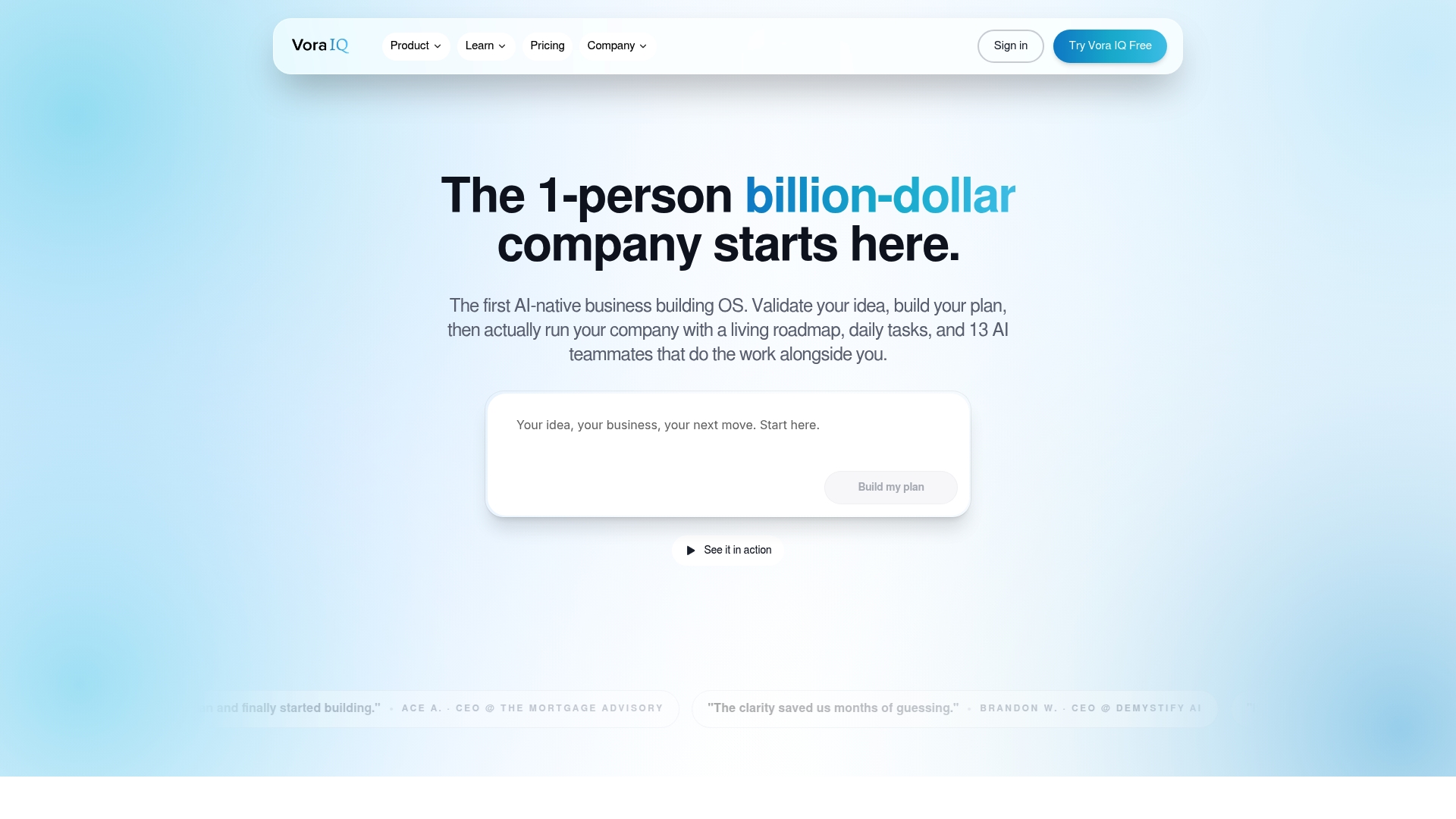
Ready to move from planning to building? Vora IQ gives solo founders and early-stage entrepreneurs a full AI-powered operating system, from idea validation and adaptive roadmaps to social media automation and financial modeling. No big team required. Get your free Idea Report Card and see what clarity actually feels like.