
Best AI for Business Advice: A 2026 Guide for Founders
By Vora IQ Team
Discover the best AI for business advice in 2026. Find out how Vora IQ and other tools can transform your startup with actionable insights.
- best ai for business advice

For founders who need practical, context-aware business advice, an AI-native operating system that combines strategic agents and workflow automation is the best starting point. Vora IQ is the recommended solution: it covers idea validation, living roadmaps, financial modeling, and daily task execution in one platform built specifically for solo founders and early-stage teams. If your immediate priority is drafting a business plan or pitch deck, LivePlan or Jasper can handle that single job well. If you need AI woven into your existing Microsoft stack, Microsoft 365 Copilot is the natural fit. But if you want advice that connects to your actual business data and then acts on it, the integrated OS approach wins.
The three signals that matter most when evaluating any AI for business advice: integration depth (does it connect to your CRM, accounting, and spreadsheets?), agentic capability (can it execute tasks, not just answer questions?), and contextual accuracy (is it grounded in your data, not generic training data?).
Table of Contents
- What category of AI tool do you actually need?
- How do you choose the right AI tool for business advice?
- How to run a 30/60/90 pilot before you commit
- Why agentic, integrated AI delivers better business advice
- Why Vora IQ is the recommended solution for solo founders
- Key Takeaways
- The gap between AI advice and founder accountability
- Vora IQ gives you advice and execution in one place
- Sources and further reading
What category of AI tool do you actually need?
Not every founder needs the same kind of AI. The market now features tools categorized by use case — from data analysis and content creation to customer support and financial management. Matching your immediate job to the right category saves weeks of trial-and-error.
Here is a fast-scan map of the main categories and what they solve:
- Strategic advisors and agentic operating systems (e.g., Vora IQ): Validate a business idea, generate a market-grounded roadmap, run pricing sensitivity models, automate daily founder tasks. Best for founders who need advice and execution in one place.
- Productivity copilots (e.g., Microsoft 365 Copilot): Summarize emails, draft proposals, pull data from SharePoint or Excel, and automate meeting follow-ups inside apps you already use. Best when your team lives in Microsoft 365.
- Business plan and document writers (e.g., LivePlan, Jasper): Produce structured business plans, investor narratives, and marketing copy. Narrow scope, fast output, low learning curve.
- CRM and marketing AI (e.g., HubSpot’s AI features): Score leads, personalize outreach sequences, analyze pipeline health, and generate campaign content. Best when your revenue bottleneck is in sales or marketing.
- Content and brand AI (e.g., Jasper, Grammarly): Draft blog posts, social copy, and brand-consistent communications. Grammarly adds tone and clarity checks across every channel.
- Customer support automation: Deploy AI chat agents to handle tier-1 support tickets, route inquiries, and surface knowledge-base answers without a full support team.
- Analytics and forecasting platforms: Connect to your financial data and model revenue scenarios, churn risk, or unit economics. Useful once you have 6+ months of transaction history.
Pro Tip: Start with the category that matches your biggest bottleneck today. If you are pre-revenue, strategic validation and planning tools deliver the fastest ROI. If you are post-revenue with a sales problem, CRM AI moves the needle faster.
For founders who want to explore which tools actually work in 2026, the short answer is: pick the category first, then the tool. Trying to find one tool that does everything before you know your priority is the most common mistake.
How do you choose the right AI tool for business advice?
Choose on integration depth and context access first, then accuracy and cost. A tool that gives brilliant generic advice but cannot read your QuickBooks data or your HubSpot pipeline is less useful than a simpler tool that can. Analysts consistently recommend choosing tools based on how well they connect to your CRM, accounting software, and spreadsheets, because grounded advice is measurably more relevant than advice built on training data alone.

The evaluation checklist
Run every tool you consider through these six questions:
- Integration: Does it connect natively to your CRM, accounting platform, and spreadsheets, or does it require manual data uploads?
- Data grounding: Does the AI use your business data to generate advice, or does it rely solely on its base model?
- Agentic capability: Can it take actions (send emails, update records, generate documents) or only produce text?
- Transparency: Does it show an evidence chain or reasoning trace, or does it just hand you a conclusion?
- Pricing model: Is it per seat, metered by usage, or a flat subscription? What happens to cost as your team grows?
- Support and onboarding: Is there a guided setup, or are you on your own after signup?
Red flags to watch for
Vendor lock-in with opaque outputs is the biggest risk. If a tool cannot show you why it made a recommendation, you cannot pressure-test it, and you cannot hand it to an investor or advisor for review. Watch for tools that produce high-level strategic language without any quantitative model underneath. That is “vibes-based” advice dressed up as AI consulting.

Weak integrations that force you to manually copy-paste context into a chat window also kill productivity fast. You end up doing the work the AI was supposed to eliminate.
Pricing ballparks
Most small-business-friendly AI tools fall into three pricing shapes. Entry-level single-purpose tools (Grammarly, Jasper) typically run $20–$50 per month per seat. Integrated productivity copilots like Microsoft 365 Copilot are priced per seat on top of existing Microsoft 365 subscriptions. Agentic OS platforms built for founders, like Vora IQ, offer monthly and annual subscription tiers and start you with a free venture report, so you can judge fit before committing. For AI business help tailored to small businesses, that free first deliverable is the most important procurement tool you have.
How to run a 30/60/90 pilot before you commit
Run a focused 30/60/90 pilot that validates accuracy, integration, and ROI before committing to an annual plan. This is the single best way to avoid paying for a tool that sounded great in a demo but does not fit your actual workflow.
The pilot timeline
| Period | Objective | Owner | Success Metric | Deliverable |
|---|---|---|---|---|
| Days 1–30 | Connect data sources; run first advice outputs | Founder | AI outputs match known business facts | Integration checklist complete; first roadmap or plan generated |
| Days 30–60 | Test agentic tasks; measure time saved | Founder + ops | Hours saved per week vs. baseline | Task automation log; forecast accuracy comparison |
| Days 60–90 | Measure revenue influence; evaluate trust | Founder + finance | Decisions influenced; team acceptance rate | Go/no-go report; ROI estimate |
Pilot checklist
Run through these before you start:
- Connect your primary data sources (accounting, CRM, spreadsheets) and confirm the AI can read them.
- Assign clear roles: the founder owns strategy validation, finance owns forecast outputs, ops owns task automation.
- Define your experiment scope: pick 2–3 real business decisions or processes to run through the AI during the pilot.
- Set a security and permissions baseline: confirm what data the tool stores, where, and who can access it.
- Document your pre-pilot baseline: how long do these tasks take today? What is your current forecast error rate?
KPIs to track
Measure both quantitative and qualitative outcomes. On the quantitative side: hours saved per week, reduction in forecast error, and revenue-influenced decisions (deals closed or costs avoided where AI input played a role). On the qualitative side: how often does your team accept AI recommendations without editing them? That acceptance rate is a proxy for trust, and trust is what determines whether the tool gets used six months from now.
Go/no-go criteria: If the tool saves fewer than two hours per week by day 30 and your team is still manually correcting most outputs, that is a clear signal to try a different category or tool. If integration is working and outputs are grounded in your data, expand to additional workflows in month two.
AI tools cannot replace every part of your startup team, but a well-run pilot tells you exactly which parts they can handle, and which still need a human.
Why agentic, integrated AI delivers better business advice
Agentic and deeply integrated AI platforms deliver materially better advisory outcomes than single-thread LLM assistants when context and execution both matter. The reason is structural: a chatbot that answers questions is only as good as the context you manually provide. An agentic platform that connects to your actual business data, chains multi-step tasks, and executes across apps is operating with a fundamentally different information base.
“The move to agentic AI — where AI orchestrates workflows across apps — is the biggest productivity shift in 2026, making integration and agent frameworks key differentiators for enterprise and small-business leaders alike.”
Microsoft, on the shift from text generation to agentic workflow execution across Excel, HubSpot, and Jira
Google’s Gemini Enterprise platform illustrates the same principle: it offers connectors to Drive, OneDrive, SharePoint, HubSpot, and Jira, plus a no-code agent designer that lets teams build custom workflows without engineering resources. The pattern is consistent across enterprise platforms: grounding AI outputs in real company data is what separates useful advice from plausible-sounding noise.
For founders, the most practical version of this is a multi-agent debate structure, where separate AI roles (an analyst, a strategist, a CFO-equivalent) each challenge the same decision from different angles. Platforms that model scenario debates between specialist roles produce data-grounded recommendations that are harder to dismiss as generic. This is the AI equivalent of getting a second opinion, except it happens in seconds and costs a fraction of a consulting engagement.
McKinsey’s QuantumBlack practice makes an important counterpoint: agentic AI introduces non-deterministic behaviors that require validation, governance, and audit trails, especially for high-stakes decisions. That is not an argument against agentic AI. It is an argument for building human-in-the-loop checkpoints into your workflow, which a well-designed pilot (see the 30/60/90 plan above) does automatically.
Strategy experts position multi-agent reasoning as a faster, model-backed substitute for lengthy consultant decks. For a solo founder without a board of advisors, that is a meaningful shift in what is accessible. For a deeper look at how this applies to planning specifically, the AI for strategic planning guide covers the mechanics in detail.
Why Vora IQ is the recommended solution for solo founders
Vora IQ is positioned as the leading AI-native operating system for founders who need integrated advice plus execution support. It is not a chatbot you ask questions. It is an OS that connects to your business context and then moves with you from idea to execution.
Here is how its features map directly to the selection criteria from the evaluation checklist above:
- Multi-agent advisors: Vora IQ includes 13 specialist AI teammates covering strategy, finance, compliance, marketing, and operations. Each agent is grounded in your specific business context, not generic training data.
- Living roadmaps: The roadmap adapts as your business changes. It is not a static document you generate once and forget. When your market shifts, the roadmap updates.
- Integrations: Native Stripe integration for financial modeling, plus connections to spreadsheets and CRMs, so advice is grounded in your actual revenue and pipeline data.
- Business validation tools: Run idea validation, competitor analysis, and market sizing before you commit resources. This is the gut check backed by real analysis that most founders skip.
- Automated execution agents: From social media content scheduling to pitch deck generation and compliance awareness, Vora IQ automates the execution layer so you can focus on decisions.
- Structured document generation: Pitch decks, proposals, product specs, and brand kits, all generated from your business context and ready to share.
Vora IQ offers monthly and annual subscription plans, and your first venture report is free. Annual subscribers get access to optional add-ons including custom landing page creation. Pricing details are listed on the Vora IQ features page. The free venture report is the right entry point: use it to pressure-test your idea before you pay anything, then evaluate whether the outputs match your business reality before you subscribe. Monthly plans can be cancelled anytime, and every plan is backed by a 14-day money-back guarantee.
Getting started in your first week:
- Connect your Stripe account and primary spreadsheet to ground the AI in your financial data.
- Run your first idea or product validation to get a PMF signal and competitive landscape summary.
- Generate your living roadmap and review the 30-day task list the system produces.
- Activate the specialist agents most relevant to your current bottleneck (finance, marketing, or ops).
- Share a generated pitch deck or proposal with one external stakeholder and collect feedback.
Vora IQ has delivered a substantial number of unique roadmaps across industries. That volume reflects a consistent pattern: founders who connect their data and run the validation workflow in the first week get the most out of the platform.
Key Takeaways
The best AI for business advice is an agentic, integrated platform that connects to your real business data, executes tasks across your stack, and adapts as your situation changes.
| Point | Details |
|---|---|
| Integration beats novelty | Choose tools that connect to your CRM, accounting, and spreadsheets before evaluating any other feature. |
| Run a 30/60/90 pilot | Test integration, time saved, and forecast accuracy before committing to an annual plan. |
| Agentic capability matters | AI that executes tasks across apps delivers better advisory outcomes than a chatbot that only answers questions. |
| Require an evidence chain | Reject any tool that gives strategic conclusions without showing the reasoning or quantitative model behind them. |
| Vora IQ for founders | Vora IQ combines 13 specialist AI agents, living roadmaps, and Stripe-connected financial modeling in one OS built for solo founders. |
The gap between AI advice and founder accountability
Most founders adopt AI tools expecting them to make decisions. The better frame is to treat AI as a decision accelerator: it compresses the time between “I have a question” and “I have a structured, data-backed answer.” The decision itself, and the accountability for it, stays with you.
The practical pitfall I see most often is founders who accept AI outputs without pressure-testing them. The output looks authoritative. It uses the right vocabulary. It has bullet points and a summary. But if you did not check whether the AI had access to your actual revenue data, your actual competitive set, and your actual cost structure, you are reading a well-formatted guess.
Pro Tip: Before acting on any AI-generated strategic recommendation, ask one question: “What data did this output use?” If the tool cannot answer that clearly, treat the output as a starting hypothesis, not a conclusion.
The founders who get the most from AI advisory tools are the ones who use them to challenge their own thinking, not confirm it. Run the AI’s recommendation against your own instinct. Where they diverge, dig in. That tension is where the real insight lives.
Vora IQ gives you advice and execution in one place
Most AI tools give you answers. Vora IQ gives you a plan and then helps you execute it. For solo founders and early-stage teams who cannot afford a full advisory bench, that combination is the real differentiator.
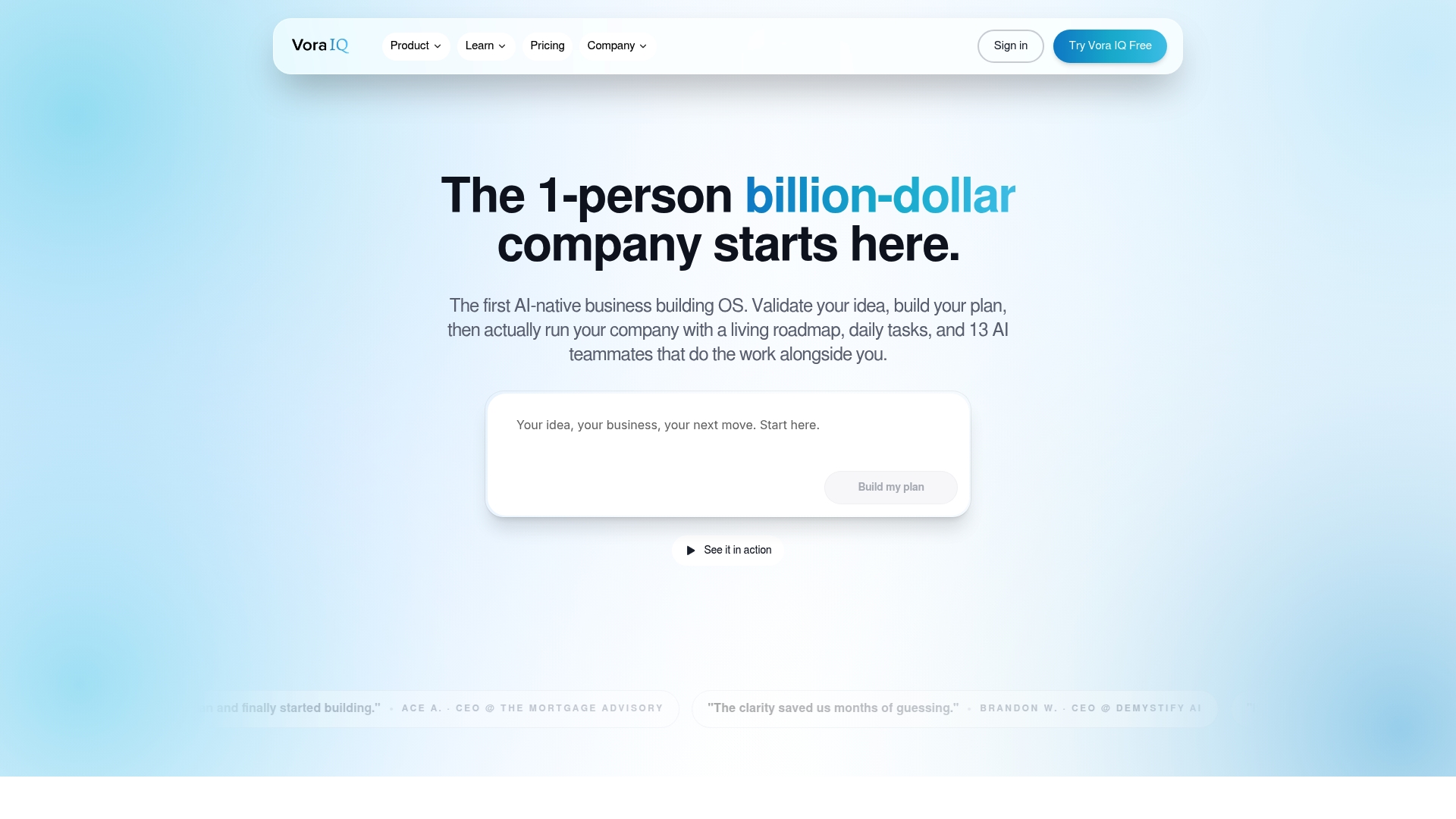
Vora IQ has generated many unique roadmaps for founders across industries, each one grounded in the founder’s specific business context, not a generic template. The platform covers everything from idea validation and market analysis to pitch deck generation, financial modeling with Stripe, and daily task automation through 13 specialist AI agents. You get the strategic layer and the execution layer in one subscription, starting with a free venture report so you can judge fit before you commit.
See who Vora IQ is built for and get your free venture report today.
Sources and further reading
- The 20 Best AI Tools for Business — Intuit Blog: Covers tool categories by use case and the case for prioritizing integration depth when evaluating AI for business.
- Microsoft 365 Copilot: Agentic AI and Productivity: Microsoft’s perspective on the shift from text generation to agentic workflow execution across enterprise apps.
- Microsoft 365 Copilot Business: Product documentation on data grounding via Microsoft Graph and SharePoint connectors.
- Gemini Enterprise — Google Cloud: Details on Google’s no-code agent designer and enterprise data connectors for grounded AI outputs.
- McKinsey QuantumBlack AI Consulting: Governance and validation requirements for agentic AI in high-stakes business decisions.
- McKinsey AI Agents and Consulting Perspectives: Analysis of multi-agent reasoning as a faster alternative to traditional consulting workflows.
- SynthBoard: AI Advisor for Scaleup CEOs: Example of multi-agent debate systems used for scenario modeling and strategic pressure-testing.
- Vora IQ — Business Building Software for Founders: Homepage and primary product overview for the AI-native OS built for solo founders and early-stage teams.