
Best Proposal Software for Sales Teams in 2026
By Vora IQ Team
Discover the best proposal software for sales teams in 2026, tailored to enhance productivity and streamline workflows for every team size.
- best proposal software

For solo founders, consultants, and early-stage sales teams, Vora IQ is the recommended pick. It’s the only platform that generates proposals in your firm’s voice and connects those outputs directly to your business roadmap and execution plan. No other tool on this list does both.
That said, the right choice depends on your team size, sales motion, and whether your bottleneck is presentation, process, or contract lifecycle. Here’s the short version:
- Vora IQ — Best for solo founders, consultants, and startup teams needing AI-native proposals tied to business workflows
- PandaDoc — Best all-around for mid-market sales teams wanting proposal-to-contract workflows
- Proposify — Best for agencies running standardized, template-driven proposal processes
- Qwilr — Best for teams that need visually striking, web-native proposals
- GetAccept — Best for sales teams focused on real-time engagement tracking and e-signature
- Better Proposals — Best for freelancers and small teams that need fast, clean proposals
- Loopio — Best for organizations responding to high volumes of formal RFPs
- Conga / DealHub — Best for large enterprises with complex CPQ and contract needs
Pro Tip: Run a 7–14 day trial with real deal data, not demo content. Test time-to-first-draft, how well the AI or templates match your brand voice, and whether CRM or payment integrations actually sync without manual workarounds.
Key Takeaways
The strongest proposal software for your team is the one that matches your actual bottleneck: speed to first draft, process consistency, engagement tracking, or enterprise CPQ.
| Point | Details |
|---|---|
| Match tool to bottleneck | Identify whether your gap is proposal generation, process control, or CLM before evaluating any vendor. |
| Vora IQ for integrated workflows | Solo founders and consultants get AI-native proposals tied to roadmaps and execution plans, not just document formatting. |
| Test with real deals | Run every trial with live deal data; a demo scenario won’t reveal CRM sync gaps or AI voice accuracy. |
| Budget beyond the license | Total cost of ownership runs 30–50% higher than per-seat pricing when setup, training, and integrations are included. |
| Enterprise needs a different tier | Conga, DealHub, and Loopio serve CPQ and RFP needs that mid-market tools aren’t built to handle. |
Table of Contents
- How does the best proposal software compare at a glance?
- Vora IQ — the recommended pick for founders and consultants
- PandaDoc — the all-around pick for sales teams
- Proposify — built for agencies that run tight proposal processes
- Qwilr — when your proposal needs to be a web experience
- GetAccept — strong for engagement tracking and signed conversions
- Better Proposals — fast, clean proposals for small teams
- Conga, DealHub, and Loopio — the enterprise and RFP tier
- How we evaluated these tools
- How to choose the right proposal software for your sales team
- When does Vora IQ give you a real edge?
- What security and compliance basics should you verify?
- What does proposal software actually cost when you add everything up?
- My take on picking the right shortlist fast
- Vora IQ is a different kind of proposal tool
- Sources
How does the best proposal software compare at a glance?
Pricing signals are based on publicly listed starting rates and may vary by plan tier or seat count. “Trial Available” means a self-serve free trial or free plan exists; “Demo only” means you need to contact sales first.
Vora IQ — the recommended pick for founders and consultants
Most proposal tools help you format a document. Vora IQ does something different: it generates proposals in your firm’s voice and connects those outputs to your living roadmap and execution plan. That integration matters when you’re a solo founder or a small consulting team, because the proposal isn’t the end of the process. It’s the beginning of a client engagement that needs to stay aligned with your strategy.
The AI-native feature set includes structured document generation for proposals and pitch decks, modular AI agents that learn your methodology, and adaptive roadmaps that update as your business context changes. The Pivot agent, for example, links proposal outputs to strategic decision workflows, so when a deal closes or pivots, your execution plan adjusts with it.
Strengths:
- Proposals generated in your firm’s voice without starting from a blank template
- Integrated roadmaps and task automation mean proposals connect to what happens after the deal
- Built for solo founders and consultants, not enterprise sales teams managing hundreds of reps
- Free venture report to start, no card required; Stripe integration for payment workflows
Limitations:
- Not a fit for large enterprise CPQ or complex contract lifecycle management
- Lighter on deep CRM sync than PandaDoc or Proposify for teams running Salesforce at scale
Pro Tip: When you start with Vora IQ, upload a real past proposal and a brief on your firm’s methodology. Then generate a new proposal for a live opportunity. Compare the output’s tone and structure to your manual version. That gap tells you exactly how much time you’ll save per deal.
The use-case pages confirm the target buyer: solo founders, entrepreneurs, consultants, and early-stage startup teams. If that’s you, start here.
PandaDoc — the all-around pick for sales teams
PandaDoc is the most widely deployed proposal platform in mid-market sales stacks, and the reason is straightforward: it covers the full document workflow from proposal creation through e-signature and contract storage without requiring a separate tool for each step.
The content library lets teams lock down approved messaging and pricing blocks, so reps can’t go off-script. Approval workflows route proposals through the right reviewers before they go out. Analytics show when a recipient opened the document, how long they spent on each section, and whether they forwarded it. For a sales manager trying to coach on deal velocity, that data is genuinely useful.
PandaDoc connects to Salesforce, HubSpot, and Stripe out of the box, and CPQ connectors are available for teams that need dynamic pricing. A free plan exists for basic use; paid plans start around $19 per user per month and scale up with advanced analytics and workflow features.
The tradeoff versus Vora IQ: PandaDoc is built for sales teams managing volume, not for founders who need proposals tied to a business roadmap. If you’re running a 10-rep sales team and need one source of truth for all proposal content, PandaDoc is a strong fit. If you’re a consultant who needs the proposal to connect to your delivery plan, Vora IQ is the better starting point.
Proposify — built for agencies that run tight proposal processes
Agencies live and die by proposal consistency. A rogue rep who edits the pricing section or swaps in an off-brand template can cost a pitch. Proposify’s core value is template governance: admins control which sections reps can edit, which are locked, and which require approval before sending.
Why agencies choose it:
- Template locking and brand controls prevent off-script proposals
- Approval workflows route proposals through account leads before client delivery
- Metrics on proposal open rates and section engagement help teams refine pitch decks over time
- HubSpot and Salesforce integrations keep CRM records current without manual updates
Where it falls short:
- Less AI-driven than Vora IQ; templates require more upfront manual configuration
- Not ideal for solo operators or founders who need proposals tied to broader business planning
- Pricing starts around $49 per user per month, and for a mid-market team, total ownership cost runs 30–50% higher than per-seat pricing when setup, training, and integrations are included.
When to choose Proposify over an AI-native option: if your bottleneck is process consistency rather than speed to first draft, and you have a team that needs guardrails more than generation, Proposify earns its place. As third-party roundups note, design-forward platforms trade off process automation for presentation quality. Proposify sits firmly on the process side of that spectrum.
Qwilr — when your proposal needs to be a web experience
Qwilr turns proposals into interactive web pages instead of PDFs. That distinction changes how buyers experience your pitch. Instead of scrolling a static document, they interact with pricing toggles, embedded videos, and clickable ROI calculators. For sales teams selling to design-conscious buyers or in competitive markets where presentation is a differentiator, that format can move the needle.
The analytics are a genuine strength: Qwilr tracks time spent on each section, which pricing option a buyer hovered over, and whether they shared the link internally. That behavioral data helps reps prioritize follow-up.
The tradeoff is real, though. Web proposals require more design attention upfront, and some enterprise procurement teams still require PDF submissions. Mobile rendering is solid but worth testing in your trial. Pricing starts around $35 per user per month. Check whether your CRM integration syncs proposal status back to deal records automatically, because that’s where Qwilr’s setup can require extra configuration.
GetAccept — strong for engagement tracking and signed conversions
GetAccept is built around one core insight: knowing when and how a buyer engages with your proposal is as valuable as the proposal itself. The platform sends real-time notifications when a recipient opens a document, tracks time on each section, and lets reps send in-document chat messages or video introductions to keep momentum alive.
What sales teams value most:
- Live engagement notifications that trigger timely follow-up
- Recipient analytics showing section-level attention and drop-off points
- Built-in e-signature with audit trails
- Salesforce and HubSpot sync for deal-stage updates
Where it’s less compelling:
- Template library is narrower than PandaDoc’s for teams that need heavy content governance
- Pricing starts around $25 per user per month, but for mid-market teams, total ownership cost may run 30–50% higher than the per-seat license alone once you include setup, training, and integrations; advanced analytics sit in higher tiers.
- Less suited for founders or consultants who need proposal-to-roadmap integration
In a demo, ask GetAccept to show you a live notification flow and a sample analytics report from a real proposal. That’s the feature that either sells you or doesn’t.
Better Proposals — fast, clean proposals for small teams
Better Proposals does one thing well: it gets a polished proposal out the door fast. The template library covers common service categories, the editor is clean and requires no design skill, and built-in e-signature and Stripe payment integration mean a client can sign and pay in the same session.
For a freelancer or a two-person sales team, that simplicity is the point. You’re not managing a content library or routing approvals through three stakeholders. You need a professional-looking document in under an hour, and Better Proposals delivers that reliably.
Pricing starts around $19 per user per month. The honest limitation: as your team grows and you need CRM sync, approval workflows, or analytics beyond basic open tracking, you’ll outgrow it. Think of Better Proposals as a strong first step before migrating to a more integrated platform like PandaDoc or Vora IQ.
Conga, DealHub, and Loopio — the enterprise and RFP tier
These three platforms serve a fundamentally different buyer than the tools above. If you’re evaluating them, you’re probably running complex deals with multi-stakeholder approval chains, formal RFP responses, or CPQ requirements that touch your ERP.
Conga (Conga CPQ) handles enterprise contract lifecycle management and configure-price-quote workflows at scale. It’s built for organizations where pricing is dynamic, contracts require legal review, and the proposal is one step in a long revenue process. Implementation typically requires a dedicated project and Salesforce expertise. Pricing is custom and negotiated.
DealHub sits at the intersection of CPQ and revenue operations. Sales ops teams use it to manage quoting, proposal generation, and contract workflows inside a single platform that feeds back into Salesforce or HubSpot. The strength is revenue data integrity across the deal cycle. Like Conga, it’s a demo-and-negotiate purchase.
Loopio is purpose-built for RFP response management. Organizations that respond to dozens of formal RFPs per year use Loopio to maintain a centralized content library, assign response sections to subject-matter experts, and automate the assembly of compliant responses. The content reuse engine is its standout feature.
For enterprise buyers, the key questions:
- What’s the implementation timeline, and who owns it internally?
- Does the platform require a Salesforce admin to configure integrations?
- What are the onboarding and professional services fees beyond the license?
- How does the platform handle security certifications (SOC 2, encryption at rest and in transit)?
Analysts consistently recommend categorizing your need as e-signature, proposal generation, or CLM before evaluating any of these platforms. Buying a CLM when you need a proposal tool is a common and expensive mistake.
How we evaluated these tools
Every tool on this list was assessed against a consistent set of criteria. Here’s exactly what we measured and how we weighted it.
Testing criteria (in priority order):
- Time-to-first-draft: How quickly can a new user produce a complete, send-ready proposal using the platform’s templates and AI features?
- Template flexibility and content library: Can teams lock approved content while giving reps enough flexibility to personalize?
- Approval workflows: Does the platform support multi-step review and approval before sending?
- CRM and CPQ integrations: Does the platform sync bidirectionally with Salesforce and HubSpot without manual workarounds?
- Analytics and engagement tracking: Can you see recipient behavior at the section level, not just open/close timestamps?
- Security and compliance: Does the vendor publish SOC 2 Type II certification, encryption standards, and access control documentation?
- Onboarding and support: What does the vendor provide beyond a help center? Is there a customer success manager, live onboarding, or professional services?
- Total cost of ownership: What are the real costs beyond the per-seat license (setup fees, training, integration work, support tiers)?
Data sources: vendor documentation and published feature pages, hands-on trial testing with real proposal scenarios, published user reviews on G2 and Capterra, and third-party analyst commentary. Vendor-sourced claims are treated as vendor claims and noted as such.
What we did not test: deep enterprise scaling beyond 50-seat deployments, custom integration projects requiring professional services, and ERP-level CPQ configurations. Those scenarios require a dedicated proof-of-concept with the vendor’s implementation team.
A note on AI-generated proposals: AI tools can reduce time-to-first-draft significantly, but they still require subject-matter expert review before client delivery. Vora IQ’s guidance on AI adoption sets realistic expectations for what to automate and what still needs human judgment. No tool replaces the SME; the best ones reduce the time that SME spends on formatting and structure.
How to choose the right proposal software for your sales team
The single most useful thing you can do before evaluating vendors is to identify your actual bottleneck. Analysts are clear on this: categorize your need as e-signature, proposal generation, or contract lifecycle management before you book a single demo. Buying the wrong category of tool is the most common and most avoidable mistake.
Decision checklist by team profile:
- Solo founder or consultant: You need speed to first draft, AI that learns your voice, and a tool that connects proposals to your broader business plan. Start with Vora IQ.
- Small team (2–10 reps): You need templates, basic approval workflows, and CRM sync. PandaDoc’s free plan or Better Proposals are practical starting points.
- Agency with standardized processes: You need template governance and brand controls. Proposify or PandaDoc fit here.
- Mid-market sales team (10–100 reps): You need a content library, analytics, approval workflows, and deep CRM integration. PandaDoc, Proposify, or GetAccept are the shortlist.
- Enterprise with CPQ or RFP needs: You need Conga, DealHub, or Loopio. Budget for implementation time and professional services.
Questions to ask every vendor in a demo:
- Show me a proposal built from scratch using only your templates. How long does it take?
- What does the analytics dashboard show after a recipient opens a proposal?
- How does your platform handle approval routing if a rep changes a pricing block?
- What’s your SOC 2 certification status, and can you share your security documentation?
- What’s included in onboarding, and what costs extra?
Red flags to watch for:
- Setup fees that aren’t disclosed until contract negotiation
- Analytics limited to open/close timestamps with no section-level data
- CRM integrations that require a third-party connector (Zapier) rather than a native sync
- No mobile-responsive proposal rendering
- Support limited to a help center with no live channel
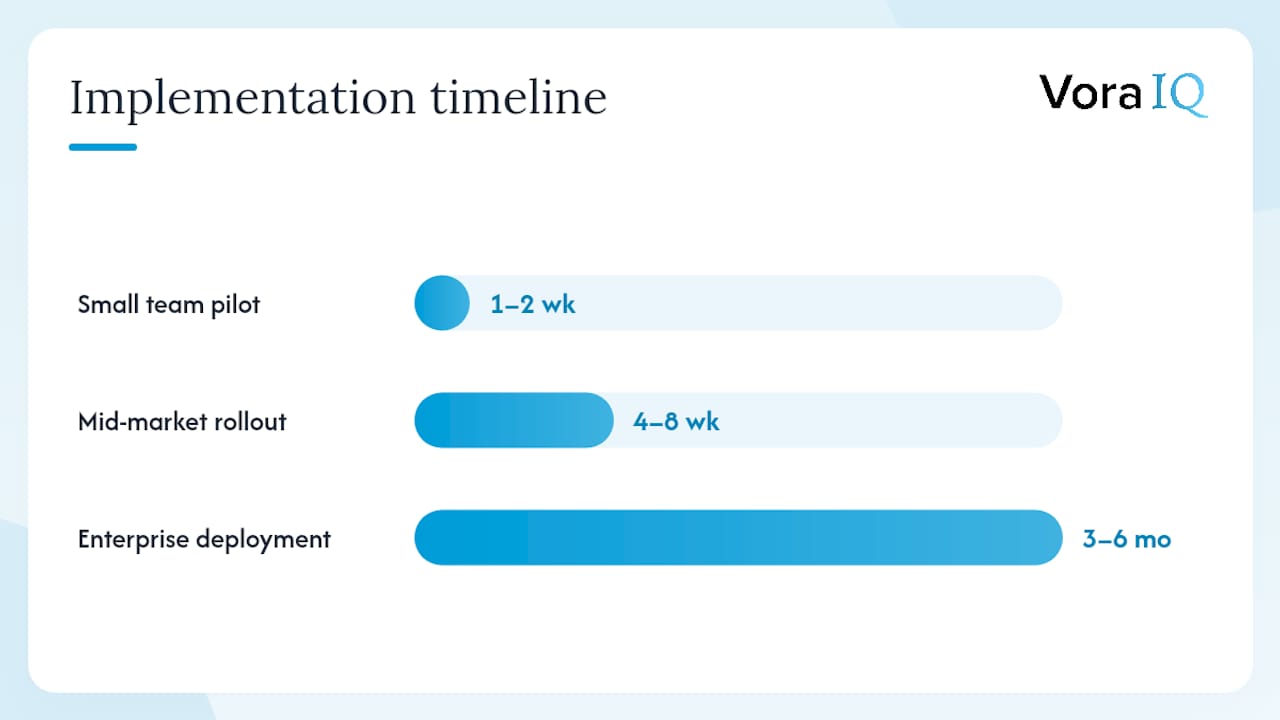
Implementation timeline (realistic):
- Small team pilot (1–5 users): 1–2 weeks to configure templates and connect CRM
- Mid-market rollout (10–50 users): 4–8 weeks including training and content migration
- Enterprise deployment (50+ users, CPQ/ERP integration): 3–6 months with professional services
For adoption, pick two or three early adopters who are motivated to test the tool on live deals. Their feedback in the first two weeks shapes whether the broader team buys in.
When does Vora IQ give you a real edge?
Vora IQ’s advantage is specific: it’s built for the buyer who needs proposals to connect to a broader business system, not just a document workflow. That’s a solo founder pitching investors and clients simultaneously, a consultant who needs proposals to reflect their firm’s methodology, or an early-stage startup team that can’t afford a separate tool for every function.
The AI operating system and modular agents generate structured documents, including proposals and pitch decks, that adapt to your business context. The Pivot agent connects proposal outputs to strategic decision workflows, reducing the handoff between sales and strategy. Over 2,400 unique roadmaps have been delivered through the platform, which means the AI has been trained on a wide range of business contexts and can surface relevant structure quickly.
Use cases where Vora IQ delivers a clear outcome:
- A consultant pitching a new engagement generates a methodology-driven proposal in hours instead of days, with the firm’s IP embedded in the structure
- A solo founder sends a client proposal and immediately sees it reflected in their execution roadmap, with next steps auto-populated
- An early-stage startup team uses the same platform for market analysis, financial modeling, and proposal generation, cutting tool sprawl
Where Vora IQ is not the right fit:
- Large enterprise sales teams that need deep Salesforce CPQ integration and multi-level contract approval chains
- Organizations responding to formal government or procurement RFPs that require strict compliance templates
- Teams that need a dedicated CLM for legal review and contract storage
Running a 30-day Vora IQ pilot:
- Week 1: Generate proposals for two or three live opportunities using your firm’s methodology as input
- Week 2: Test the roadmap integration. Does the proposal output connect to your execution plan?
- Week 3: Measure time-to-first-draft versus your previous manual process
- Week 4: Evaluate AI voice match. Does the output sound like your firm, or does it need heavy editing?
Pro Tip: Track editing time per proposal during the pilot. If you’re spending more than 20 minutes editing an AI-generated draft, the tool isn’t learning your voice correctly. Adjust your methodology inputs and run another draft before concluding the tool doesn’t fit.
What security and compliance basics should you verify?
Every proposal tool handles sensitive commercial information: pricing, client data, deal terms. Before you sign a contract, verify these four things with every vendor.
SOC 2 Type II certification is widely regarded as the baseline standard for SaaS data security in the US. Type II means the vendor’s controls have been audited over a period of time, not just at a single point. Ask for the report or a summary letter. If a vendor can’t produce one, that’s a meaningful gap.
Encryption at rest and in transit should be standard. Confirm that proposal data is encrypted using AES-256 (or equivalent) at rest and TLS 1.2 or higher in transit. Most reputable platforms publish this in their security documentation.
Access controls and permissions matter for teams. Can you restrict which reps see which proposals? Can you set role-based permissions so only admins can edit pricing blocks? For enterprise buyers, SSO (single sign-on) and SCIM provisioning are non-negotiable.
Data residency and retention is increasingly relevant for teams with international clients or regulated industries. Ask where proposal data is stored, how long it’s retained after contract termination, and whether you can export all data on exit.
What does proposal software actually cost when you add everything up?
The per-seat price on the pricing page is rarely the real number. Here’s what to budget for beyond the license.
Setup and onboarding fees are common at the mid-market and enterprise tier. Some platforms charge $500–$2,000 for initial configuration and template migration. Ask explicitly whether onboarding is included or billed separately.
Integration costs add up when native connectors don’t exist. If your CRM integration requires a Zapier workflow or a custom API build, factor in the developer time or the Zapier subscription cost.
Training is often underestimated. A self-serve help center is not the same as live onboarding. For teams of 10 or more, budget for at least two to four hours of structured training per cohort, either from the vendor or internally.
Support tier upgrades are a real cost for teams that need SLA-backed response times. Most platforms offer priority support only on higher-tier plans. If your sales team depends on the tool for live deals, a 48-hour support response window is a business risk.
Content migration from your current proposal system (Word docs, Google Docs, a previous platform) takes time. Budget one to two weeks of internal effort for a mid-market team to migrate and reformat existing templates.
The total cost of ownership for a 10-person sales team on a mid-tier platform typically runs 30–50% higher than the per-seat license alone when you include setup, training, and integration work.
My take on picking the right shortlist fast
The biggest mistake sales leaders make when evaluating proposal software is running a feature comparison instead of a workflow test. A feature list tells you what a tool can do. A workflow test tells you what it will do for your specific team, with your specific deals, in your specific CRM environment.
Here’s how to run a tight evaluation in 7–14 days:
Three speed-testing tips:
- Give every vendor the same real deal scenario: a live opportunity with a real client brief, your actual pricing, and your brand assets. The output quality gap between platforms becomes obvious immediately.
- Assign one skeptic and one enthusiast from your team to test independently. Their disagreement will surface the tradeoffs that matter most for your context.
- Build a one-page scoring rubric before you start: time-to-first-draft, CRM sync accuracy, analytics depth, and support responsiveness. Score each vendor on the same rubric the day after the trial ends.
Trial action list:
- Upload your existing proposal template and brand assets on day one
- Generate a proposal for a live deal by day three
- Check CRM sync accuracy by day five
- Review analytics on a sent proposal by day seven
- Escalate one support question and measure response time
For internal alignment, brief your CRM admin and one sales rep before the trial starts. Their buy-in during the pilot determines whether the broader team adopts the tool or ignores it.
Vora IQ is a different kind of proposal tool
PandaDoc, Proposify, and GetAccept are all solid platforms for sales teams managing document workflows at volume. They’re built for that job, and they do it well.
Vora IQ is built for a different job. If you’re a solo founder, a consultant, or an early-stage team, you don’t just need a proposal. You need the proposal to connect to your roadmap, your market analysis, and your execution plan. That’s what Vora IQ delivers.
The AI-native operating system generates proposals in your firm’s voice, ties outputs to your living roadmap, and gives you 13 specialist AI agents that support everything from financial modeling to compliance awareness. It’s not a document tool with AI bolted on. It’s a business operating system that includes proposal generation as one of its core outputs.
If you’re a solo founder, consultant, or startup team who’s been stitching together Google Docs, a CRM, and a separate proposal tool, Vora IQ replaces that stack with one system that keeps everything connected. Start with your free venture report and generate your first AI-native proposal in under an hour.
Sources
A note on source types: vendor documentation describes features as the vendor intends them; third-party analyst pieces and roundups reflect independent evaluation. Weight them accordingly when making your final decision.
- PandaDoc Alternatives Ranked by What They Do Best
- 13 PandaDoc Alternatives That Bring More to the Table