
Business Plan for Your Online Business: 2026 Guide
By Vora IQ Team
Discover why a strong business plan for your online business is essential. Secure funding, clarify strategy, and identify market opportunities.
- business plan online business

Why your online business needs a solid business plan
A business plan for an online business is your strategic foundation. It maps out your mission, market opportunity, financial projections, and operational approach before you spend a dollar. Skip it, and you’re guessing. Build it right, and you have a document that guides every decision from launch through scale.
According to the SBA, a business plan forms the foundation for structuring and growing a business, and it’s the primary tool for convincing investors and partners that your venture is worth their time. That’s not a formality. That’s leverage.
Here’s what a strong plan actually does for you:
- Secures funding from banks, SBA lenders, and angel investors who require it
- Clarifies your strategy so you stop pivoting on gut instinct alone
- Identifies market gaps before competitors do
- Catches weak assumptions in your financials before they become expensive mistakes
- Guides each growth phase from pre-launch through scaling
Two formats dominate: the traditional plan (detail-heavy, required for SBA loans) and the lean startup format (one page, fast to produce, built for iteration). If you’re seeking outside funding, go traditional. If you’re validating fast, start lean and expand.
How to write an effective business plan for your online business
Structure matters. SCORE’s business plan template covers nine core sections, each with fillable worksheets and expert guidance. Use it as your scaffold.
The key sections every online business plan needs:
- Executive summary: Write this last. It’s the first thing investors read and the only section many finish. Keep it under two pages.
- Market analysis: Use TAM, SAM, and SOM. More importantly, validate your SOM with bottom-up sizing from real traffic and conversion estimates, not just industry reports. Investors dismiss top-down-only projections.
- Business model: Explain exactly how you make money. Subscriptions, direct sales, marketplace commissions, or a mix. Be specific.
- Marketing plan: For online businesses, this means channel-level customer acquisition cost estimates, your 90-day launch plan, and your SEO and paid traffic approach.
- Operations: Cover your tech stack, fulfillment, and key tools. For e-commerce, your platform choice (Shopify, BigCommerce, or headless) directly affects your cost floor.
- Financial projections: Build three scenarios: conservative, base, and optimistic. Include unit economics like customer acquisition cost and lifetime value. SaaS investors require this.
- Funding request: State the amount, what you’ll use it for, and what milestone it unlocks.
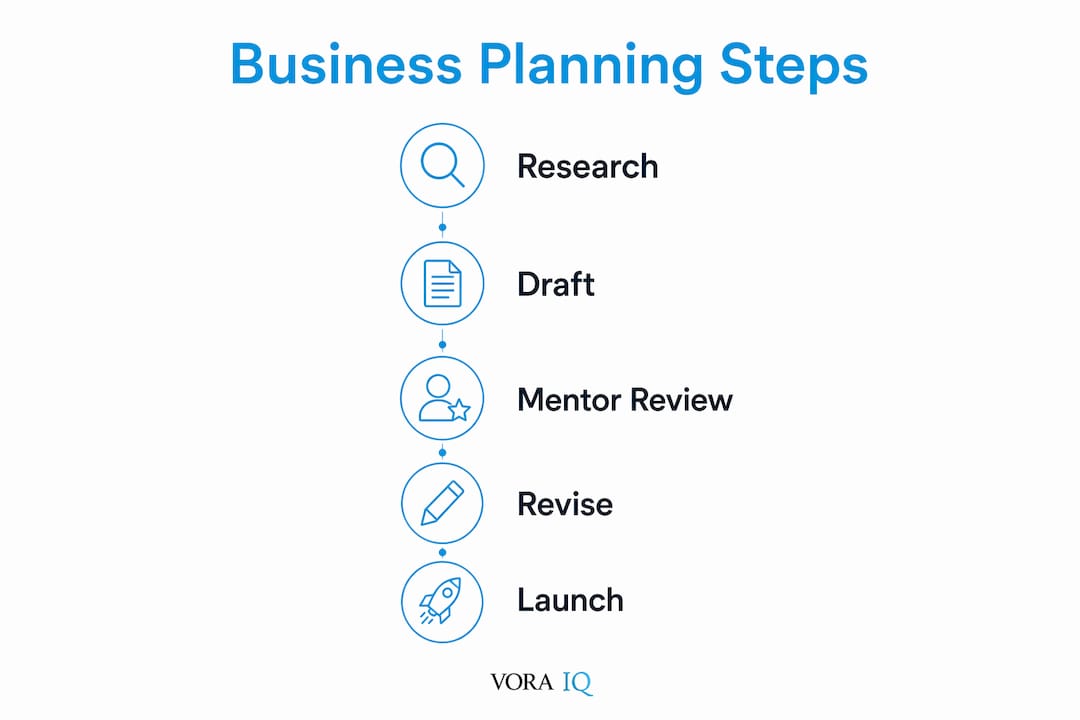
Pro Tip: After drafting, get an experienced mentor to review your financial assumptions. SCORE mentors do this for free, and external review catches the blind spots you’re too close to see.
Treat the plan as a living document. Markets shift. Your assumptions will too. Build in a review cycle so the plan stays useful rather than becoming a file you never open again.

Steps to launch your online business after the plan is done
Your plan is finished. Now execute in sequence. Skipping steps here is where most founders lose momentum.
- Register your business legally. Choose your entity type (LLC is most common for US online founders), register with your state, and get your EIN from the IRS.
- Build your web presence. Launch a clean, mobile-first website. Pick the social platforms where your specific buyer already lives, not all of them.
- Set up your product or service. Load your catalog, write clear product descriptions, and price based on your unit economics model.
- Integrate payments. Connect Stripe, PayPal, or your platform’s native checkout. Test every flow before you drive traffic.
- Launch your minimum viable system. Get operational fast. A simple landing page with a working checkout beats a perfect site that ships in six months.
- Drive initial traffic. Personal outreach, a small paid campaign, or a targeted SEO push. The goal is your first sale, not perfection.
- Capture emails from day one. A subscriber you can reach directly is worth far more than a social follower you can’t. Set up your email tool and a simple opt-in before you launch.
For paid traffic, AI-powered Google Ads management can help online stores get traction faster without wasting budget on underperforming campaigns.
Which business plan writing services are best for US online entrepreneurs?
Five providers stand out for US founders who need professional help. Their specializations differ significantly, so the right choice depends on your specific situation.
| Provider | Specializations | Services Offered | Best For | Rating |
|---|---|---|---|---|
| Visa Business Plans | USCIS-compliant immigration plans, E-2, EB-5, L-1, EB-2 NIW, 120+ industries | Immigration visa plans, RFE responses, multilingual documents, investor plans | Entrepreneurs needing immigration-ready or investor-ready plans | 4.9★ |
| Business Plans USA | US market plan writing, funding and growth consulting | Business plan writing, consulting | US founders seeking reliable plan writing | 4.8★ |
| BusinessPlans.com | Custom plan creation for entrepreneurs | Personalized business plans | New entrepreneurs needing tailored plans | 5★ |
| The Business Plan Store | Investor-ready plans, SBA and bank loan documents | Plan writing, market research, financial projections, business valuations | Founders seeking funding-ready documents | — |
| Vora IQ | AI-native planning, market analysis, financial modeling, social content | Business plan generation, adaptive roadmaps, competitor analysis, pitch decks | Solo founders who want a full planning and execution system | — |
Visa Business Plans is the clearest specialist in the group. With 8,000+ projects completed and over 1,000 attorneys served across 120 industries, they handle the complexity of USCIS-compliant documentation that generalist writers simply can’t match. If immigration is part of your path, they’re the only logical choice.
The Business Plan Store focuses on investor-ready documents and SBA loan support, with decades of experience in financial projections and financing strategy. Founders who need a bank-ready plan with rigorous market research will find a strong fit here.
Business Plans USA offers solid consulting-backed plan writing for US entrepreneurs across a range of industries. Straightforward, reliable, and well-reviewed.
BusinessPlans.com is a verified US consultant with a perfect rating but limited public profile. Best for founders who want personalized attention on a custom plan.
Vora IQ operates differently from the others. Rather than delivering a static document, it gives you an AI-native system that generates your plan, builds an adaptive roadmap, runs market and competitor analysis, and automates social content. For solo founders who need more than a PDF, it’s a different category of tool entirely.
How to choose the right business plan writing service
The wrong service costs you time, money, and credibility with investors. Evaluate every provider on these criteria before you commit:
- Specialization match: A service that writes immigration visa plans operates very differently from one focused on SaaS startups. Match their specialty to your actual need.
- Turnaround time: Ask for a specific timeline in writing. Vague answers are a red flag.
- Revision policy: How many rounds are included? What triggers additional charges?
- Pricing transparency: If a provider won’t quote a price range upfront, move on.
- Customer support: Can you reach a real person during the process? Will you have a dedicated writer?
- Industry experience: Choosing a service specialized in your business type increases the odds your plan gets accepted by lenders and investors.
Questions to ask before hiring:
- Can you show me a sample plan from a business similar to mine?
- Who specifically will write my plan, and what’s their background?
- Have you written plans that successfully secured SBA loans or investor funding?
- What happens if my plan needs changes after delivery?
Red flags to avoid: generic templates with your name swapped in, no verifiable client reviews, promises of guaranteed funding, and providers who can’t explain how they’ll research your specific market.
Pro Tip: Ask for a sample plan before signing anything. A provider confident in their work will share one without hesitation. If they won’t, that tells you everything.
How AI is changing business planning for online founders
AI has moved from novelty to practical advantage for solo founders. Platforms like Vora IQ integrate market research, financial modeling, competitor analysis, and content generation into a single system, replacing what used to require a team of consultants.
The shift is concrete. Instead of spending weeks on a static document, founders can generate a structured plan, get AI-driven market sizing, and receive an adaptive roadmap that updates as their business evolves. Vora IQ has delivered over 2,400 roadmaps across industries, with 13 specialist AI teammates covering everything from financial forecasting to social media scheduling.
For e-commerce founders specifically, AI tools now handle the unit economics modeling that investors require, including customer acquisition cost, lifetime value, and contribution margin, without needing a CFO on retainer.
Pro Tip: Use AI for the first draft and the data layer, then bring in a human reviewer for the narrative and assumptions. The combination is faster and more credible than either approach alone. For AI tools that actually work for founders in 2026, the gap between platforms is significant.
How business plans support funding and immigration goals
A business plan is the required document for most US funding paths. SBA lenders expect a full traditional plan covering every major section. Angel investors focus on the executive summary, market opportunity, and unit economics. Venture capital firms want a clear path to profitability and a defensible market position.
Immigration adds a separate layer of complexity. Visa categories like E-2, EB-5, L-1, and EB-2 NIW each carry specific USCIS requirements for what a business plan must demonstrate, including investment amounts, job creation projections, and operational viability. A generalist writer typically lacks the expertise to meet these standards. Visa Business Plans exists specifically for this use case, with multilingual plan capabilities and experience responding to immigration requests.
What does it cost to write a business plan?
Professional business plan writing services in the US vary widely based on complexity and purpose. A basic plan for internal use or a simple loan application typically costs less than one built for USCIS immigration review or Series A fundraising. Immigration-specific plans and investor-ready documents command higher fees because they require specialized research, legal awareness, and precise financial modeling.
DIY options exist at every price point. SCORE offers free templates and free mentor reviews. Tools like Vora IQ offer subscription-based access to AI-generated plans and roadmaps. The tradeoff is time versus money: a free template takes weeks to complete well, while a professional service delivers a polished document faster but at a cost.
For SBA loan applications, the plan must meet lender-specific requirements that go beyond a standard template, often requiring personal financial statements and detailed financial schedules alongside the core document.
DIY vs. professional business plan writing: what actually happens
The honest comparison comes down to stakes and speed. Founders who write their own plans often produce documents that are accurate about their business but weak on financial modeling and market sizing. The assumptions feel right but don’t hold up under investor scrutiny.
Professional services solve the credibility gap. A writer who has produced hundreds of SBA-approved plans knows exactly what a loan officer looks for. An immigration specialist knows which USCIS criteria a plan must address to avoid an RFE.
The DIY path works best when you’re self-funding, moving fast, and using the plan primarily as an internal roadmap. The professional path pays off when the stakes are high: outside funding, immigration approval, or a formal investor pitch. Many founders do both: draft the plan themselves to force clarity, then hire a specialist to refine the financials and presentation before submission.
Vora IQ gives solo founders a planning system, not just a document
If you’ve been comparing static plan-writing services and wondering whether there’s a faster path, Vora IQ offers a different approach entirely.
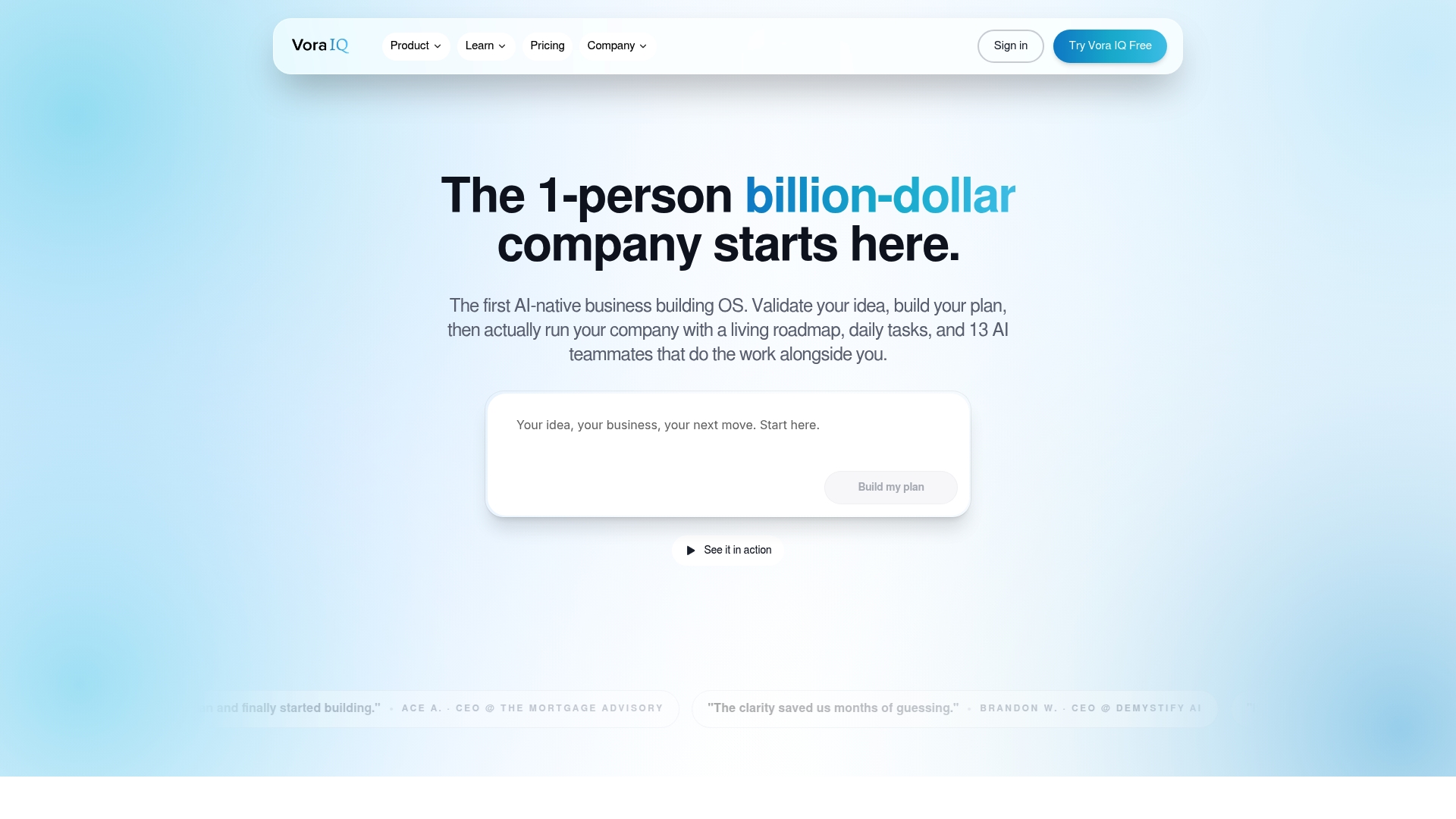
Vora IQ is built for solo founders who need more than a PDF. It generates your business plan, builds a living roadmap that adapts as your business grows, runs market and competitor analysis, models your financials, and automates your social content. All of it is personalized to your specific business context, not a generic template. For founders who want to move from idea to execution without hiring a full team, see how Vora IQ works and what it can do for your specific stage.
The compared providers above are excellent at what they do. If you need an immigration-compliant plan or a bank-ready document, hire a specialist. But if you want a system that keeps working after the plan is written, Vora IQ is worth a serious look. Explore the use cases for solo founders to see where it fits your situation.
Key Takeaways
A strong business plan for an online business is the difference between a funded, focused startup and an expensive guess.
| Point | Details |
|---|---|
| Plan format depends on purpose | Use a traditional plan for SBA loans and investors; use a lean format for fast validation and iteration. |
| Bottom-up market sizing wins | Investors dismiss top-down projections; build your SOM from real traffic, conversion, and order data. |
| Specialist services outperform generalists | Match the provider’s specialty to your need: immigration, SBA funding, or investor pitches each require different expertise. |
| AI accelerates the planning process | Platforms like Vora IQ deliver adaptive roadmaps, financial modeling, and market analysis without a full team. |
| Vora IQ suits founders who need more than a plan | Its AI-native system covers planning, execution, and content generation for solo founders at every stage. |