
Cold Email Frameworks That Actually Get Replies in 2026
By Vora IQ Team
Discover effective cold email frameworks for 2026 that boost reply rates and secure meetings. Maximize your outreach success today!
- cold email framework

Start with a signal-anchored, single-ask framework. That one decision alone separates the emails that get deleted in three seconds from the ones that book meetings. Practitioners confirm this structure is the lever, not clever wording.
Quick decision map:
- Founder/CEO prospect: Trigger/one-liner framework. Short, direct, one question.
- Head of Sales or CRO: PAS (Problem-Agitate-Solution). Lead with a pipeline metric they care about.
- CMO or marketing lead: BAB (Before-After-Bridge). Show the gap between where they are and where they could be.
- RevOps or ops-heavy buyer: Straight-to-business. No story, just the offer and the ask.
- Cold list with no trigger: AIDA. Classic structure, still works when you have no live signal.
Pick your ICP, match the framework, and build from there.
Key Takeaways
The single most effective cold email framework pairs a real, verifiable signal in the opener with one proof point and one low-friction question as the ask — everything else is a variation on that core shape.
| Point | Details |
|---|---|
| Match framework to ICP | Use trigger/one-liner for CEOs, PAS for sales leaders, BAB for CMOs, straight-to-business for RevOps buyers. |
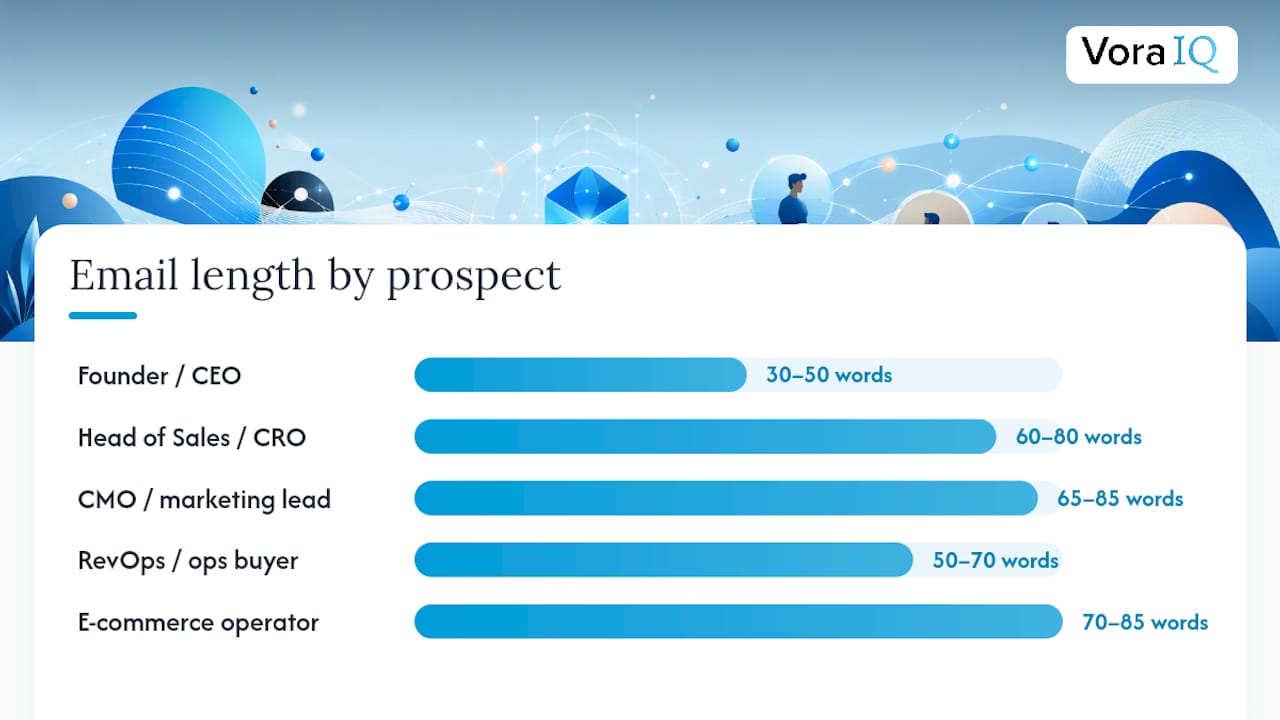
| Keep bodies to 50–125 words | Shorter emails outperform longer ones in B2B; aim for the lower end for founder and CEO prospects. |
| One signal, one ask | Generic personalization kills reply rates; one verifiable signal and one question-style CTA are the two highest-impact levers. |
| Plan sequences before sending | Multi-touch sequences of 4–7 touches consistently outperform single sends; follow-ups capture replies the first email never would. |
| Fix deliverability before copy | Open rates below 25% signal a deliverability problem; authenticate your domain and clean your list before testing new templates. |
Table of Contents
- What a cold email framework is and why it changes your reply rate
- The 9 core cold email frameworks, with templates and examples
- Best practices that apply to every framework you use
- How to build a follow-up sequence that actually converts
- How to A/B test cold emails and actually learn something
- Common cold email mistakes and how to fix them fast
- Ready-to-use templates by use case
- Which framework fits your prospect? A quick decision matrix
- Legal and ethical considerations for cold email outreach
- What I actually do when reply rates drop
- Vora IQ helps you build the outreach engine behind the framework
- Sources
What a cold email framework is and why it changes your reply rate
A cold email framework is a reusable structure, not a script. Think of it as a container with four slots: opener, problem, proof, and ask. You swap in prospect-specific signals for each send, but the architecture stays the same. That distinction matters because it lets you scale personalization without starting from scratch every time.
The reason frameworks work is cognitive, not stylistic. When you sit down to write a cold email without a structure, you face a blank page and tend to over-explain, over-sell, or write about yourself. A framework forces the right order: lead with something relevant to the prospect, connect it to a problem they recognize, show you’ve solved it before, and make one easy ask. That sequence mirrors how decisions actually get made.
On the metrics side, the connection is direct. Salesforce reports that personalized cold emails see roughly 29% higher open rates than generic ones. Open rate is a function of subject line and sender reputation. Reply rate is a function of the body structure. Both are improvable with the right framework applied consistently.
Length is the other variable frameworks control. Mobile email clients show roughly 75–100 characters of preview text before truncating. If your opener is a pleasantry (“I hope this finds you well”), you’ve burned your preview on noise. A framework disciplines you to put the signal in line one, which is exactly where the prospect decides whether to keep reading.
Statistic to hold onto: Astra GTM’s playbook recommends keeping bodies to 50–90 words and using a four-part hook-problem-proof-ask structure to force clarity. Emails in that range consistently outperform longer ones in B2B reply rate tests.
The 9 core cold email frameworks, with templates and examples
Every framework below follows the same evaluation format: what it is, when to use it, a short template you can adapt, a concrete example, and one pro tip. The template is the container. Your signal, offer, and ask are the levers.
1. AIDA (Attention, Interest, Desire, Action)
What it is: The oldest direct-response structure in existence, adapted for cold email. Attention grabs with a relevant hook. Interest builds with context. Desire shows the outcome. Action makes the ask.
Best for: Cold lists where you have no live trigger signal. Works well for founders reaching investors or marketers reaching new verticals.
Template (70–85 words):
Subject: [Specific result] for [their company type]
Hi [Name],
[Attention: one sentence about something specific to their role or company.]
[Interest: the problem that creates friction for people in their position.]
[Desire: one proof point — a result you got for a similar company.]
Would it make sense to spend 15 minutes seeing if we could do the same for [Company]?
[Your name]
Example:
Subject: Reducing churn for B2B SaaS under 50 seats
Hi Jordan,
SaaS teams at your stage often lose 8–12% of their user base in the first 90 days before onboarding is fully dialed in.
We helped Finova cut that number by half in one quarter by fixing three onboarding gaps.
Worth a 15-minute call to see if the same gaps exist for you?
Pro Tip: AIDA works best when the “Attention” line references something verifiable, like a funding round, a product launch, or a hiring spike. Generic attention lines (“I noticed you’re in SaaS”) kill the structure before it starts.
2. PAS (Problem, Agitate, Solution)
What it is: Lead with the problem, make it feel real by agitating the consequence, then offer the solution. This framework works because it mirrors how buyers think when they’re already aware of a pain.
Best for: Sales leaders, CROs, and revenue-focused buyers who respond to pipeline and quota language.
Template (60–80 words):
Subject: [Problem] at [their company stage]
Hi [Name],
[Problem: one sentence naming the specific friction they face.]
[Agitate: what happens when that problem goes unsolved — lost revenue, wasted time, missed quota.]
[Solution: how you fix it, in one sentence.]
Open to a quick call this week?
[Your name]
Example:
Subject: SDR ramp time eating your Q3 pipeline?
Hi Marcus,
Most SDR teams at Series A take 60–90 days to ramp, which means your Q3 pipeline is being built by people who aren’t fully effective yet.
That gap compounds every quarter you don’t fix it.
We cut ramp time to 30 days for three teams this year using a structured call framework.
Worth 20 minutes?
Pro Tip: The agitate step is where most people go soft. Name a real consequence (“that’s $200K in delayed pipeline”) rather than a vague one (“this can slow growth”). Specificity is what makes the reader feel the problem.
3. BAB (Before, After, Bridge)
What it is: Paint the “before” state (their current reality), show the “after” state (the outcome they want), then bridge the gap with your offer. It’s aspirational rather than pain-focused, which makes it effective for CMOs and marketing buyers.
Best for: Marketing leaders, brand-focused buyers, and anyone who responds to vision over problem-framing.
Template (65–85 words):
Subject: What [Company] could look like with [outcome]
Hi [Name],
Right now, [Before: their current situation in one line].
[After: what that same situation looks like when the problem is solved.]
[Bridge: how you get them from before to after, in one sentence.]
Would it be worth a quick call to map out what that could look like for [Company]?
[Your name]
Example:
Subject: What Meridian’s content pipeline could look like
Hi Priya,
Right now, your content team is producing 8 pieces a month with a 3-week turnaround per piece.
With a structured AI-assisted workflow, that same team could ship 20 pieces at the same quality in the same window.
We built that system for two SaaS marketing teams this quarter.
Worth 15 minutes to see if it fits?
4. 3Ps: Praise, Picture, Push
What it is: Open with a genuine, specific compliment about the prospect’s work or company. Paint a picture of an improved outcome. Push with a soft ask. The praise must be real, not flattery.
Best for: Warm-ish prospects, founder-to-founder outreach, and situations where you’ve done real research on the person’s work.
Template (55–75 words):
Subject: [Specific thing you admired] — quick thought
Hi [Name],
[Praise: one specific, verifiable thing they’ve done or built — not generic.]
[Picture: what that work could look like with one specific improvement or addition.]
[Push: one soft question that invites a conversation, not a commitment.]
[Your name]
Example:
Subject: Your Series A announcement — quick thought
Hi Dana,
Congrats on the Series A — the positioning around async-first workflows is genuinely differentiated in a crowded market.
Teams at your stage often hit a content distribution wall right after funding. We’ve helped three post-Series A companies build the distribution engine to match their product story.
Would it be useful to share what worked?
5. Trigger/one-liner framework
What it is: The shortest framework on this list. One sentence of context tied to a live trigger event (funding, hiring, product launch, press mention), followed by one question. No pitch, no proof, no story.
Best for: Founder and CEO prospects who get flooded with long emails. Also effective when you have a strong trigger and a tight offer.
Template (30–50 words):
Subject: [Trigger event] — one question
Hi [Name],
Saw [Company] just [trigger: raised, launched, hired, expanded] — congrats.
Teams at that stage often [one-line problem].
Is that something you’re working through right now?
[Your name]
Example:
Subject: Nexio’s product launch — one question
Hi Sam,
Saw Nexio launched the enterprise tier last week — nice move.
Teams scaling into enterprise often find their outbound motion doesn’t match the new buyer profile.
Is that something on your radar?
Pro Tip: Tools like Lavender can score this type of email in real time, flagging whether your opener reads as personalized or generic before you hit send. SalesHandy and Instantly both support trigger-based sequencing so you can fire this template automatically when a prospect hits a defined signal.
6. Asset-share / value-first framework
What it is: Lead with something genuinely useful — a relevant resource, a benchmark report, a teardown, a template — before making any ask. The value comes first; the ask is secondary and soft.
Best for: Prospects who are skeptical of cold outreach, content-heavy industries, and situations where you want to build trust before a meeting request.
Template (60–80 words):
Subject: [Asset name] for [their role/industry]
Hi [Name],
I put together [asset: a short guide, a benchmark, a teardown] specifically for [their role or company type].
[One sentence on why it’s relevant to them right now.]
Happy to send it over — no strings. If it’s useful, we can talk about [offer] after.
Worth sending?
[Your name]
7. Straight-to-business framework
What it is: No story, no praise, no warm-up. State who you are, what you do, who you’ve done it for, and what you’re offering. Respect the prospect’s time by getting to the point in line one.
Best for: RevOps buyers, ops-heavy decision-makers, and any prospect who explicitly values directness. Also works well for second or third touches when earlier emails used a softer approach.
Template (50–70 words):
Subject: [Specific offer] for [Company]
Hi [Name],
[Your company] helps [their type of company] [specific outcome] in [timeframe].
We did it for [named client or vertical] — [one-line result].
If that’s relevant to what you’re working on at [Company], I’d like to show you how.
20 minutes this week?
[Your name]
8. Breakup email
What it is: The final touch in a sequence. Acknowledge you haven’t connected, give them an easy out, and make one last soft ask. The tone is respectful, not passive-aggressive.
Best for: The last email in a 3–5 touch sequence. Also effective as a re-engagement email for prospects who went cold after a demo.
Template (35–55 words):
Subject: Closing the loop, [Name]
Hi [Name],
I’ve reached out a few times and haven’t heard back — totally understand if the timing isn’t right.
I’ll stop following up after this. But if [specific problem] ever becomes a priority, I’m happy to reconnect.
Worth one quick reply either way?
[Your name]
9. Multi-channel follow-up framework
What it is: Not a single email but a sequenced shape that pairs email with LinkedIn touches and, where appropriate, a phone call. The email is the anchor; the other channels reinforce it.
Best for: High-value accounts where a single email won’t cut through. Works well when you have a strong ICP and a clear trigger.
Multi-touch sequences of 4–7 touches consistently outperform single sends. Follow-ups often capture a large share of replies that the first email never would have generated on its own.
Sequence shape:
- Day 1: Email (AIDA, PAS, or trigger framework)
- Day 2: LinkedIn connection request (no pitch)
- Day 4: Email follow-up (bump or new angle)
- Day 6: LinkedIn message (one-line reference to the email)
- Day 9: Final email (breakup)
Best practices that apply to every framework you use
The framework is the structure. These rules are the quality controls that determine whether the structure actually performs.
Subject lines
Keep them 4–7 words. Make them specific and continuous with the first line of the body. “Quick question about [Company]'s pipeline” outperforms “Thought you’d find this interesting” every time. Sendspark’s research confirms that short, specific subject lines consistently perform better than overly clever or long ones. Never write a subject line that could apply to any email in your database.
The opener rule
One signal. One. Not “I noticed you’re in SaaS and recently raised funding and are hiring SDRs.” Pick the strongest signal and build the opener around it. Reachly’s playbook is direct on this: one real signal in the opener, a specific offer, and a single defined ask. That combination raised reply rates in their live campaigns. Generic personalization (“I loved your LinkedIn post!”) is worse than no personalization because it signals to the reader that you didn’t actually do the work.
Length
Stay in the 50–125 word range for the body. For founder and CEO prospects, aim for the lower end. For technical buyers or complex offers, the upper end is acceptable. Mobile email clients truncate previews aggressively, so your signal needs to appear in the first 75–100 characters of the body, not buried in paragraph three.
Pro Tip: Paste your draft into a mobile email preview tool before sending. If your signal doesn’t appear early on a phone screen, rewrite the opener. Most replies are decided quickly during preview.
CTA design
One ask per email. Always. A question-style CTA (“Is this worth 15 minutes?”) outperforms a directive (“Book a call here”) because it lowers the commitment threshold. Never ask for a meeting in the first touch to a cold prospect who has never heard of you. A soft question is the right first ask.
Deliverability checklist
Before you spend time on copy, confirm these are in place:
- SPF, DKIM, and DMARC records are configured on your sending domain.
- You’re sending from a warmed domain (not a brand-new one).
- Your list has been validated with a tool like Clearout to remove invalid addresses before sending.
- Daily send volume stays within safe limits for your domain age (typically under 100 sends/day for a new domain).
- Unsubscribe links are present and functional (required under CAN-SPAM).
Using AI in outreach
AI tools are useful for signal research, draft generation, and merge field suggestions. Lavender scores emails in real time and flags weak openers before you send. SalesHandy and Instantly both support sequenced sending with personalization at scale. The rule: use AI to generate the draft, then edit it yourself before sending. An AI-generated email that hasn’t been reviewed reads like one. For a broader look at which AI tools actually help founders scale outreach, this guide to AI tools for startup founders covers the practical options worth considering.
Statistic to hold: Salesforce data shows personalized cold emails see approximately 29% higher open rates. That uplift comes from the subject line and opener working together, not from personalization tokens dropped into a generic template.
How to build a follow-up sequence that actually converts
Most replies don’t come from the first email. That’s not a reason to send more emails faster. It’s a reason to plan your sequence before you send the first one.
The 3-email rule and when to extend it
The 3-email rule is a practical minimum: first touch, one follow-up, one breakup. For most cold outreach, that’s the floor. For high-value accounts or complex sales cycles, extending to 5–7 touches across multiple channels is worth the effort.
Here’s a five-touch sequence that works:
- Day 1 — First touch: Your primary framework email (AIDA, PAS, trigger, or BAB depending on ICP). Full structure: signal, problem, proof, ask.
- Day 3 — Bump: One or two lines. Reference the first email. Add one new piece of value or a different angle. Subject: “Re: [original subject]” keeps the thread intact.
- Day 5 — New angle: Try a different hook. If the first email led with a problem, this one leads with a result. Keep it under 50 words.
- Day 8 — Social proof touch: One sentence about a result you got for a company in their vertical. One question.
- Day 12 — Breakup: Respectful, short, gives them an easy out. Leaves the door open.
Short templates for each follow-up stage
Bump (Day 3):
Wanted to make sure this didn’t get buried. Still think [one-line reason it’s relevant]. Worth a quick reply?
New angle (Day 5):
Different angle: [Company in their vertical] used [your approach] to [specific result]. Relevant to what you’re working on?
Breakup (Day 12):
Closing the loop here. If [problem] becomes a priority later, happy to reconnect. No pressure either way.
When to add LinkedIn and calls
Pair LinkedIn with email when the prospect’s profile shows recent activity (posts, comments, job changes). Send the connection request on Day 2 with no message. If they accept, send a one-line message on Day 6 referencing the email thread. Add a call to the sequence only when the deal size justifies it and you have a direct number. Cold calls without a prior email touch have a lower connection rate than calls that follow an email the prospect has already seen.
For teams building a multichannel outreach motion, a marketing automation checklist helps map which steps to automate and which to keep manual to preserve the personal feel.
How to A/B test cold emails and actually learn something
Testing cold emails without a plan produces noise, not insight. The goal is to isolate one variable, run it against a real sample, and make one decision based on the result.
Step-by-step test plan
- Choose one variable. Subject line, opener signal type, CTA wording, or body length. Never test two variables at once.
- Split your list. 50/50 split between variant A and variant B. Both lists should come from the same ICP segment.
- Set a minimum sample size. For meaningful results in cold outreach, aim for at least 100 sends per variant (200 total). Below that, the variance in open and reply rates is too wide to trust.
- Define the measurement window. Measure open rate at 48 hours. Measure reply rate at 5 business days. Replies that come in after Day 5 are usually from the follow-up sequence, not the first email.
- Make one decision. Keep the winner. Archive the loser. Run the next test on a different variable.
What to test first
Metrics to track
- Open rate: Measures subject line and sender reputation. A healthy B2B open rate sits in the 30–50% range for well-targeted lists.
- Reply rate: The most important metric. Sendspark reports that well-targeted templates paired with a tight ICP can drive 8–15% reply rates in B2B.
- Positive reply rate: Replies that express interest, not just “remove me.” Track this separately from total replies.
- Meeting conversion rate: Of positive replies, how many convert to a booked call? This is where framework quality shows up in pipeline.
- Downstream pipeline impact: The metric that actually matters to your business. Tie reply rate to revenue, not just activity.
When results are statistically meaningful
For cold outreach, you don’t need a p-value. You need a practical rule of thumb: if one variant produces a reply rate that’s at least 2 percentage points higher than the other across 100+ sends per variant, treat it as the winner and move on. Waiting for statistical significance in small outreach campaigns wastes more time than it saves.
Common cold email mistakes and how to fix them fast
Generic personalization
“I loved your recent LinkedIn post” is not personalization. It’s a signal that you didn’t actually read the post. Fix: use a verifiable, specific signal — a funding announcement, a product launch, a job posting, a press mention. If you can’t find a real signal, use a vertical-level observation instead of a fake personal one.
Long bodies
Emails over 150 words in a cold outreach context almost always hurt reply rates. The reader sees a wall of text and moves on. Fix: cut to 50–90 words. If you can’t make your case in that range, your offer isn’t clear enough yet.
Multiple CTAs
“Book a call, reply to this email, or check out our website” is three asks. The prospect chooses none. Fix: one ask, one action, one question. Make it easy to say yes to a small thing.
Asking for a meeting in the first touch
A cold prospect who has never heard of you is not ready to commit 30 minutes. Fix: ask a question that requires a one-word or one-sentence answer. “Is this relevant to what you’re working on?” is a better first ask than “Can we schedule a demo?”
Ignoring deliverability
Deliverability and list quality are often the silent cause of low reply rates. You can have the best framework in the world and still land in spam if your domain isn’t authenticated or your list is full of invalid addresses. Fix: run your list through Clearout before sending, confirm SPF/DKIM/DMARC are set, and warm your domain before scaling volume.
Legal compliance
Under CAN-SPAM, every commercial email must include a physical mailing address and a working unsubscribe mechanism. If you’re reaching EU-based prospects, GDPR applies and you need a legitimate interest basis for the outreach. Build both into your sequence template from day one, not as an afterthought. Consent and tracking requirements also affect how you handle personalization data across channels — keep your practices transparent and compliant.
Ready-to-use templates by use case
These templates are copy-ready. Swap the bracketed fields for real signals before sending. Each template includes a suggested subject line, body, CTA, and a one-sentence personalization instruction.
1. Cold first touch (trigger event)
Subject: [Company]'s [trigger] — one question Body (55 words):
Hi [Name],
Saw [Company] just [trigger: raised, launched, hired for X role] — congrats on the momentum.
Teams at that stage often find [specific friction that follows the trigger].
We helped [similar company type] solve that in [timeframe].
Is that something you’re navigating right now?
[Your name]
CTA: Soft question (yes/no answer) Personalization: Replace [trigger] with a verifiable event from the last 30 days. Target: 55–65 words.
2. Mutual connection intro
Subject: [Mutual contact] suggested I reach out Body (60 words):
Hi [Name],
[Mutual contact] mentioned you’re working on [specific challenge or initiative] and thought it was worth connecting.
We’ve helped [similar company type] with [specific outcome] — [Mutual contact] saw it firsthand.
Happy to share what we did if it’s relevant to what you’re building.
Worth a quick call?
[Your name]
CTA: Soft question Personalization: Confirm the mutual contact’s name and the specific challenge they mentioned. Target: 60–70 words.
3. Value-first / asset share
Subject: [Asset name] for [their role] Body (65 words):
Hi [Name],
I put together a [short guide / benchmark / teardown] for [their role or company stage] that covers [specific topic].
Given [one-line reason it’s relevant to them right now], thought it might be useful.
Happy to send it over — no strings. If it’s helpful, we can talk about [offer] after.
Worth sending?
[Your name]
CTA: Permission ask (yes/no) Personalization: Name the asset specifically and tie it to a recent event or challenge in their vertical. Target: 60–75 words.
4. Video outreach
Subject: 90-second video for [Name] at [Company] Body (50 words):
Hi [Name],
I recorded a short video specifically for [Company] — it covers [one specific thing relevant to their situation].
[Video thumbnail or link]
No pitch, just a thought I think is worth 90 seconds of your time.
Let me know what you think?
[Your name]
CTA: Open-ended reply invitation Personalization: Record a genuine 60–90 second video referencing something specific to their company. Tools like Sendspark support personalized video at scale. Target: 45–55 words plus video link.
5. Breakup / final touch
Subject: Closing the loop, [Name] Body (45 words):
Hi [Name],
I’ve reached out a few times and haven’t heard back — totally understand if the timing isn’t right.
I’ll stop following up after this. But if [specific problem] ever becomes a priority, I’m happy to reconnect.
Either way, best of luck with [Company].
[Your name]
CTA: No ask — just an open door Personalization: Name the specific problem you’ve been referencing throughout the sequence. Target: 40–50 words.
Which framework fits your prospect? A quick decision matrix
| Prospect profile | Best framework | Body length | Primary hook | Typical CTA | When to skip |
|---|---|---|---|---|---|
| Founder / CEO | Trigger / one-liner | 30–50 words | Live trigger event | Soft yes/no question | No verifiable trigger available |
| Head of Sales / CRO | PAS | 60–80 words | Pipeline or quota metric | Open to a call this week? | Prospect is not quota-carrying |
| CMO / marketing lead | BAB | 65–85 words | Vision gap (before vs. after) | Map out what this looks like? | Offer is purely operational |
| RevOps / ops buyer | Straight-to-business | 50–70 words | Specific outcome + timeframe | 20 minutes this week? | Relationship requires trust-building first |
| HR / talent leader | Value-first / asset share | 60–75 words | Relevant benchmark or resource | Worth sending? | No relevant asset to share |
| E-commerce operator | AIDA | 70–85 words | Revenue or conversion metric | Worth a 15-minute call? | Offer has no e-commerce proof point |
Legal and ethical considerations for cold email outreach
Cold email in the United States is governed primarily by the CAN-SPAM Act. The rules are straightforward: every commercial email must identify itself as an advertisement (or be clearly commercial in nature), include your physical mailing address, provide a working opt-out mechanism, and honor unsubscribe requests within 10 business days. Misleading subject lines and deceptive “from” fields are prohibited. The Federal Trade Commission enforces CAN-SPAM, and violations carry penalties per email.
If you’re reaching prospects in the European Union, GDPR applies regardless of where your company is based. Under GDPR, cold email to individuals requires either explicit consent or a documented legitimate interest basis. B2B outreach to business email addresses can qualify under legitimate interest, but you must be able to demonstrate that the outreach is relevant to the recipient’s professional role and that their privacy interests don’t override yours. Document your basis before sending.
Canada’s CASL is stricter than CAN-SPAM. It requires express or implied consent before sending commercial electronic messages to Canadian recipients. Implied consent exists when you have an existing business relationship, but it expires after two years.
The practical baseline for any outreach program: include a physical address, make unsubscribing easy, don’t use deceptive headers, and keep your list clean. For personalization data, be transparent about how you sourced contact information. Consent and tracking frameworks like the IAB TCF define permissible data uses across channels — understanding those boundaries keeps your outreach compliant as you scale.
This is general information, not legal advice. Confirm current requirements with a qualified attorney before launching large-scale outreach campaigns.
What I actually do when reply rates drop
When a campaign’s reply rate falls below what I’d expect for the ICP and offer, I run through the same audit every time. The problem is almost never the framework itself. It’s usually one of five things.

First, I check the signal quality. Are the openers referencing real, recent, verifiable events? Or have they drifted into generic “I noticed you’re in [industry]” territory? Generic signals kill reply rates faster than any other variable. I pull five emails from the sequence and read them as if I were the prospect. If I wouldn’t reply, the signal isn’t good enough.
Second, I check deliverability. I run the sending domain through a mail tester, confirm DMARC is set to at least “quarantine,” and check whether recent sends have triggered spam filters. Fixing deliverability before touching copy is non-negotiable.
Third, I shorten the body. If emails are running over 100 words, I cut to 70. If they’re already at 70, I try 50. Length is the easiest variable to test and one of the highest-impact ones.
Fourth, I change the CTA. If the ask is “book a 30-minute call,” I switch to a yes/no question. If it’s already a question, I make it more specific to the prospect’s situation.
Fifth, I re-sequence. If the first touch isn’t working, I move the strongest proof point to the Day 3 follow-up and use a completely different hook for the first email.
Campaign audit checklist:
- Signal quality: is the opener tied to a verifiable, recent event?
- Deliverability: open rate above 25%? SPF/DKIM/DMARC configured?
- List hygiene: validated with Clearout or equivalent before sending?
- Body length: under 100 words? Under 75 for founder/CEO prospects?
- CTA: single ask, question format, low commitment?
- Follow-up sequence: at least 3 touches planned before closing the loop?
- Subject line: 4–7 words, specific, continuous with the opener?
Vora IQ helps you build the outreach engine behind the framework
A cold email framework is only as good as the signals feeding it. Finding those signals — funding rounds, hiring spikes, product launches, press mentions — takes research time that most solo founders and small teams don’t have.
Vora IQ’s AI teammates handle the research, competitive analysis, and market context that make your openers specific instead of generic. Apollo, Vora IQ’s outreach and partnerships agent, helps you map your ICP, identify the right signals, and build the outreach strategy around them. You write better emails when you have better intelligence behind them.
If you’re building your outreach motion from scratch or want to tighten an existing one, explore how Vora IQ’s use cases map to your stage and goals. Solo founders, early-stage teams, and consultants all use the platform to move faster without adding headcount.
Sources
- Cold Email Template: 12 Frameworks That Get 30%+ Reply Rates
- Cold email templates: 12 that book meetings in 2026
- How to Write Cold Emails That Get Replies | Astra GTM
- Cold email templates (Salesforce blog)
- Cold Email Templates That Get Replies in 2026, Tested