
Best Productboard Alternatives for Solo Founders in 2026
By Vora IQ Team
Discover the best productboard alternatives for solo founders in 2026. Explore AI-native platforms that streamline customer discovery and roadmapping.
- productboard alternatives

For solo founders, the best productboard alternatives are AI-native unified platforms that combine validated customer discovery, living roadmaps, and execution in one place. If you need a quick shortlist:
- Vora IQ — AI-native operating system built specifically for solo founders; covers discovery, roadmapping, execution, and financial modeling in one subscription
- Aha! — deep strategy and portfolio management; best for founders scaling toward a product team
- Airfocus — modular prioritization engine with flexible scoring frameworks
- Notion or Coda — flexible doc-based workspaces; low cost, high adaptability for early-stage teams
- Roadmunk — visual timeline roadmaps for stakeholder communication
- ProdPad — outcome-based roadmapping with strong idea-management workflows
- ProductPlan — clean timeline roadmaps for founders who mostly need to communicate “what ships when”
The core reason to prioritize AI-native unified platforms: they reduce admin overhead, speed up validated decisions, and tie your plan directly to daily execution. No tool-switching, no double entry.
Pro Tip: Before you evaluate any tool, write down your single biggest bottleneck. Discovery? Prioritization? Execution? That answer should determine which category you trial first.

Table of Contents
- What do the best Productboard alternatives actually cover?
- Why do founders leave Productboard?
- How we evaluated these alternatives for solo founders
- Detailed profiles: which alternative fits your situation?
- How do you choose the right alternative?
- Your 30-day trial playbook
- Key Takeaways
- The tool you pick should match the stage you’re actually at
- Vora IQ gives solo founders discovery, roadmap, and execution in one place
- Useful sources
What do the best Productboard alternatives actually cover?
| Category | Best For | Core Capabilities | AI / Automation | Key Integrations | Pricing Shape | Onboarding Time | Trial Available |
|---|---|---|---|---|---|---|---|
| AI discovery + OS (e.g., Vora IQ) | Solo founders, bootstrapped teams | Validation, roadmap, execution, financial modeling | High — AI teammates, automated tasks, market analysis | Stripe, Slack, and more | Paid subscription, free venture report to start | 1–2 days | Yes |
| Prioritization-first (e.g., Airfocus) | Small PM teams | Scoring frameworks, modular roadmaps | Moderate | Jira, Slack, Azure DevOps | Free tier; paid from ~$59/mo | 2–4 days | Yes |
| Visual roadmap tools (e.g., Roadmunk) | Stakeholder-facing PMs | Timeline, swimlane views | Low | Jira, Trello, CSV | Entry paid tier | 1–2 days | Yes |
| Docs-as-roadmap (e.g., Notion, Coda) | Teams under 10 | Flexible docs, templates, databases | Low–moderate | Slack, GitHub, Zapier | Free tier available | Hours | Yes |
| Strategy + portfolio OS (e.g., Aha!) | Growing product orgs | Goals, initiatives, releases, portfolio | Moderate | Jira, Salesforce, Slack | Paid from ~$59/user/mo | 1–2 weeks | Yes |
| Outcome-based roadmapping (e.g., ProdPad) | Discovery-focused PMs | Idea management, outcome roadmaps | Low–moderate | Jira, Slack, Trello | Free tier; paid tiers | 2–3 days | Yes |
| Classic timeline roadmaps (e.g., ProductPlan) | PMs communicating timelines | Swimlanes, milestones, sharing | Low | Jira, Pivotal Tracker | Paid from ~$39/user/mo | 1–2 days | Yes |
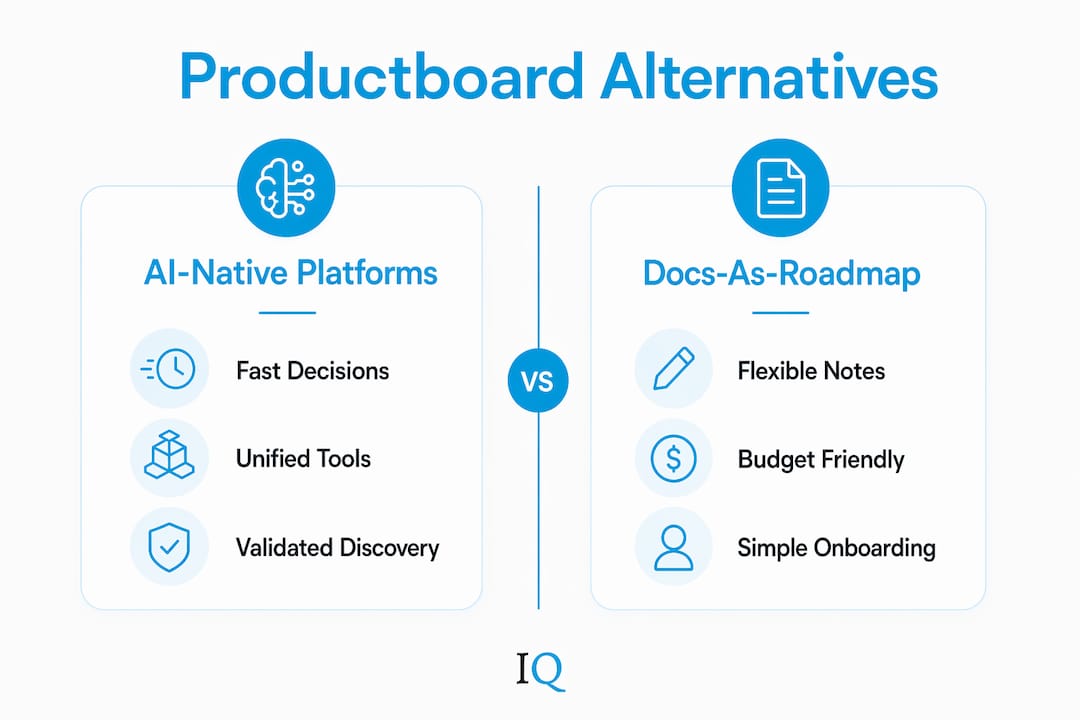
Pricing notes: Docs-as-roadmap tools (Notion, Coda) are typically the cheapest entry point, often free. AI-native operating systems like Vora IQ offer the most capability per dollar for solo founders. Enterprise strategy suites like Aha! carry the highest per-user cost and tend to scale quickly with per-maker pricing — a real pain point for teams under 10.
Why do founders leave Productboard?
Most teams move on because the tool doesn’t solve the upstream problem, costs too much, or creates workflow silos. Productboard organizes feedback elegantly, but organizing biased, volunteered inputs more elegantly doesn’t remove the bias. Discovery still requires qualitative research to surface real user intent.
Roughly 80% of shipped software features are rarely or never used, according to a Pendo analysis — indicating roadmaps built on volunteered feedback may miss real customer intent.
The most common gaps solo founders cite:
- Price scaling — per-maker or per-user pricing grows fast as you add collaborators
- Setup complexity — long rollout times divert focus from execution for early-stage teams
- No validated discovery — feedback votes are not the same as confirmed customer intent
- Execution silos — a separate roadmap tool alongside Jira or Linear creates double entry and disconnected workflows
- Limited AI automation — most dedicated roadmap tools offer minimal AI beyond basic suggestions
How we evaluated these alternatives for solo founders
The priority was tools that deliver validated discovery, low onboarding cost, and integrated execution for one-person or very small teams. Feature count didn’t drive the ranking. Speed to a validated decision did.
Evaluation criteria:
- Validated insights (high weight) — does the tool help you confirm customer intent, not just collect votes?
- Roadmap clarity (high weight) — can you build a living roadmap that updates as signals change?
- Execution integration (high weight) — does the tool connect plan to daily tasks without a separate app?
- Onboarding time (high weight) — can a solo founder get value in days, not weeks?
- Pricing shape (medium weight) — is the entry tier affordable, and does cost scale reasonably?
- Integrations (medium weight) — does it connect to tools you already use (Jira, Slack, Stripe)?
Practical transparency signals checked:
- Public pricing pages (no “contact sales” for basic tiers)
- Free trial or demo availability without a sales call
- Documented integrations list
- Onboarding documentation quality
Detailed profiles: which alternative fits your situation?
Vora IQ — AI-native operating system for solo founders
Vora IQ is the only tool in this list built from the ground up for solo founders rather than adapted from a team PM tool. It covers idea validation, AI-generated business plans, living roadmaps, daily task automation, market and competitor analysis, financial modeling with Stripe integration, and social media content scheduling.
- Strengths: All-in-one (no tool-switching), 13 specialist AI teammates, context-aware outputs tailored to your business
- Limitations: Not designed for large product teams managing multi-squad delivery; less suited to enterprise portfolio management
- Pricing: Subscription-based, starting with a free venture report; monthly and annual plans, backed by a 14-day money-back guarantee
- Best for: Solo founders who need discovery, plan, and execution in one place
Aha! — enterprise strategy suite
Aha! goes deep on goals, initiatives, and cross-portfolio alignment. It’s closer to a full product operating system than a roadmap app. The trade-off: complexity and cost that most solo founders won’t need until they have a product team. Gartner Peer Insights consistently ranks Aha! among the top Productboard alternatives for enterprise product organizations.
- Strengths: Deep strategy tools, strong portfolio management, mature integrations
- Limitations: High per-user cost, steep learning curve, overkill for teams under five
- Best for: Founders scaling toward a dedicated product org
Airfocus — prioritization engine
Airfocus lets you score initiatives using custom frameworks, then translates scores into roadmaps. Modular by design, so you can add or remove components as your process matures.
- Strengths: Flexible scoring, clean roadmap views, good Jira integration
- Limitations: Discovery is limited; you still need a separate source of validated customer insight
- Best for: Founders who have clear inputs but struggle to prioritize them
Roadmunk — visual roadmaps for stakeholder communication
Roadmunk is purpose-built for timeline and swimlane presentations. If your primary need is communicating “what ships when” to investors or advisors, it delivers fast.
- Strengths: Strong visual output, easy sharing, quick setup
- Limitations: Minimal discovery or execution features; essentially a presentation layer
- Best for: Founders who already have a prioritized backlog and need a clean way to show it
Notion and Coda — docs-as-roadmap workspaces
Lightweight template-first approaches work well for teams under 10 that haven’t hit a clear scaling bottleneck yet. Both tools are free to start and highly flexible.
- Strengths: Near-zero cost, maximum flexibility, fast setup
- Limitations: No native discovery or validation; requires discipline to maintain structure
- Best for: Very early-stage founders who need a scratchpad before committing to a dedicated PM tool
ProdPad — outcome-based roadmapping
ProdPad emphasizes idea management and outcome-driven roadmaps. It’s built for teams that care about learning, not just shipping features.
- Strengths: Strong idea-to-outcome flow, good discovery support, clean roadmap views
- Limitations: Less execution integration than a unified OS; lighter AI features
- Best for: Founders focused on discovery and outcome clarity
ProductPlan — classic timeline roadmaps
ProductPlan handles timelines, swimlanes, and simple strategy-linked roadmaps. Clean and fast to set up.
- Strengths: Easy to use, good sharing controls, clear visual output
- Limitations: Minimal discovery or AI; per-user pricing scales quickly
- Best for: Founders who need a polished roadmap for investor or board communication
Pro Tip: If you’re a solo founder running on a tight runway, start with a free venture report from an AI-native platform before committing to a dedicated roadmap tool. You may find you don’t need the separate layer at all.
How do you choose the right alternative?
Pick the tool that fixes your single biggest bottleneck first. A tool with 50 features you don’t need won’t help you move faster.
Decision checklist:
- What is your primary bottleneck right now — discovery, prioritization, roadmapping, or execution?
- Are you a team of one, or do you have collaborators who need access?
- Which tools do you already use daily (Jira, Slack, Stripe)?
- What’s your monthly budget ceiling for tooling?
- Do you need AI automation, or is manual workflow fine for now?
- How much time can you spend on onboarding — hours or weeks?
Red flags to watch during demos:
- No public pricing (forces a sales call before you can evaluate fit)
- Maker-based pricing that doubles your cost the moment you add a contractor
- No free trial or sandbox environment
- Integrations listed as “coming soon” for tools you use today
- Separate discovery and execution tools with no native connection between them
Your 30-day trial playbook
Run a 30-day, outcome-driven pilot that proves discovery leads to prioritized work and shipped outcomes. Don’t evaluate features. Evaluate decisions.
Week-by-week milestones:
- Week 1 — Intake and integrations: Connect your existing tools (Jira, Slack, Stripe). Import any existing feedback or backlog items. Confirm the integration works before you invest more time.
- Week 2 — Discovery: Run at least three customer conversations or feed existing interview notes into the platform. Does the tool help you identify validated intent, or just store notes?
- Week 3 — Prioritize and roadmap: Build your first living roadmap from the validated inputs. Can you update it in under 30 minutes when a signal changes?
- Week 4 — Execute and measure: Assign tasks from the roadmap and track completion. Measure: time to decision, number of unvalidated features in the backlog, and task handoff speed.
Migration tips:
- Export your existing Productboard features as CSV before switching
- Avoid double entry by designating one tool as the source of truth on day one
- Archive old roadmaps rather than migrating them wholesale; start fresh with validated inputs
Success signals: fewer unvalidated features queued, faster time from customer signal to roadmap update, and daily tasks that trace back to a validated initiative.
Key Takeaways
For solo founders, the best productboard alternatives are AI-native unified platforms that combine validated discovery, living roadmaps, and execution — not just cheaper versions of the same feedback-aggregation workflow.
| Point | Details |
|---|---|
| Validate first, roadmap second | Approximately 80% of shipped software features are rarely or never used; prioritize validated discovery before choosing your roadmap tool. |
| Prefer unified platforms | Running separate discovery and execution tools creates friction and double entry for small teams. |
| Watch pricing traps | Per-maker pricing scales fast; confirm the cost at your likely team size before committing. |
| Run a 30-day pilot | Measure time-to-decision and validated backlog size, not feature coverage, during any trial. |
| Vora IQ for solo founders | Vora IQ covers discovery, living roadmaps, and execution in one AI-native OS, starting with a free venture report. |
The tool you pick should match the stage you’re actually at
Most founder tool advice skips the uncomfortable truth: the majority of product management platforms were built for product teams, not solo founders. They assume you have a discovery researcher, a PM, and an engineering lead. You don’t. So when you evaluate productboard alternatives, the question isn’t “which tool has the most features?” It’s “which tool produces a validated decision the fastest, with the least overhead?”
The 30-day pilot framework matters here. Founders who commit to measuring time-to-decision during a trial almost always land on a cleaner, more integrated tool than founders who evaluate by clicking through feature demos. The demo looks impressive. The trial tells the truth.
Vora IQ’s approach — 13 AI teammates, living roadmaps, and execution automation in one subscription — reflects exactly that founder-first logic. Over 2,400 roadmaps delivered across industries is a proof point worth taking seriously when you’re deciding where to put your limited time.
Vora IQ gives solo founders discovery, roadmap, and execution in one place
Every alternative in this list solves part of the problem. Vora IQ solves the whole thing. You get validated discovery, living roadmaps, and daily execution in one AI-native operating system built specifically for solo founders — no stitching together three separate tools, no per-seat pricing surprises, and no six-week onboarding.
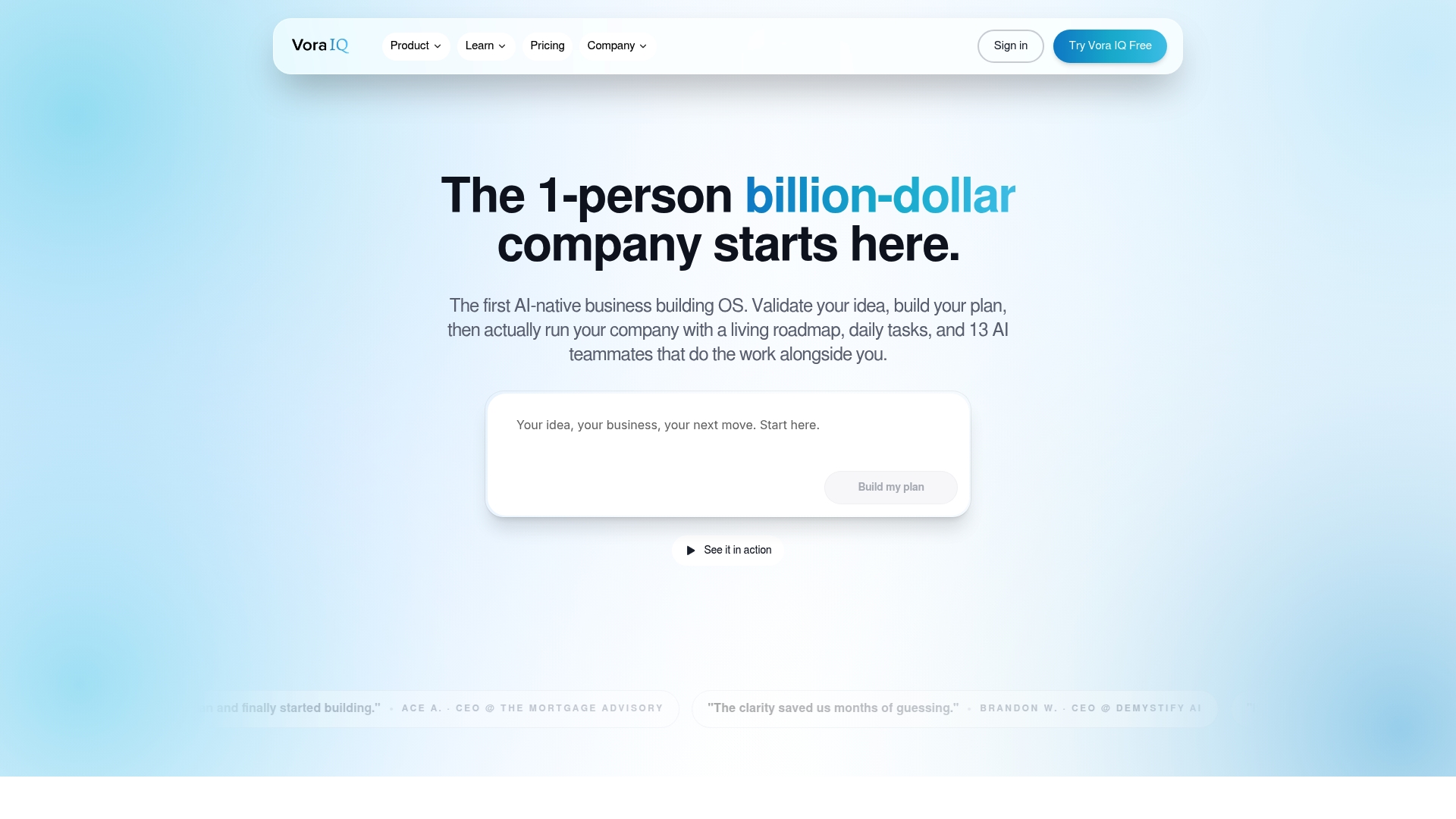
The numbers back it up: over 2,400 unique roadmaps delivered across industries, Stripe integration for financial modeling, and 13 specialist AI teammates that adapt to your business context. Whether you need a PMF signal, a pitch deck, or a daily task list tied to a validated initiative, it’s all in one place.
Get your free venture report at Vora IQ and run the 30-day pilot from this article. You’ll know within a week whether it fits.
Useful sources
- Pendo analysis: ~80% of shipped features rarely or never used — backs the discovery-first argument and the 80% statistic
- Rework: unified platforms reduce friction for small teams — supports the evaluation criteria on execution integration and silo risk
- IdeaPlan: lightweight tools for teams under 10 — supports the docs-as-roadmap and template-first recommendation
- Subrupt: per-maker pricing as a pain point — backs the pricing trap red flags
- Gartner Peer Insights: top Productboard alternatives — independent ranking of alternatives including Aha!, Airfocus, Roadmunk, and ProductPlan
- Vora IQ: idea validation for solo founders — explains why validated customer intent matters more than vote counts
- Vora IQ: best AI tools for startup founders — broader context on AI-native tools for founders evaluating their stack