
Startup Planner Made Easy for Solo Founders
By Vora IQ Team
Transform your ideas into actionable steps with a startup planner. Validate your business concept and streamline your planning process today!
- startup planner

A startup planner is a structured roadmap that turns idea-stage thinking into accountable tasks and financial logic. The fastest way to use one: start with a lean one-page planner to validate your core assumptions, then build a traditional plan only when you need investor-ready detail. The U.S. Small Business Administration frames a business plan as the foundation of a business and a roadmap to structure, run, and grow it. That framing matters. A plan isn’t a document you write once. It’s a thinking tool you return to.
Your first three moves:
- Validate the problem and customer. Talk to at least five potential users before you write a single section. Confirm the pain is real and that people would pay to solve it.
- Sketch startup costs and a 12-month cash flow. Even rough numbers reveal whether your idea has a viable runway before you spend weeks drafting.
- Pick a template and fill it out today. A blank page is the enemy of momentum. Choose a format (lean or traditional) and start writing.
Table of Contents
- Which planner format fits your stage?
- What sections does every startup plan need?
- A fast, repeatable workflow to draft your plan
- Startup costs and the financial checklist every plan needs
- Where to find templates, worksheets, and planners
- How to choose the right planner for your stage
- How Vora IQ helps solo founders plan and execute
- Key Takeaways
- The plan is the least important part of planning
- Vora IQ: an AI-native planner built for founders like you
- Authoritative sources and templates
Which planner format fits your stage?
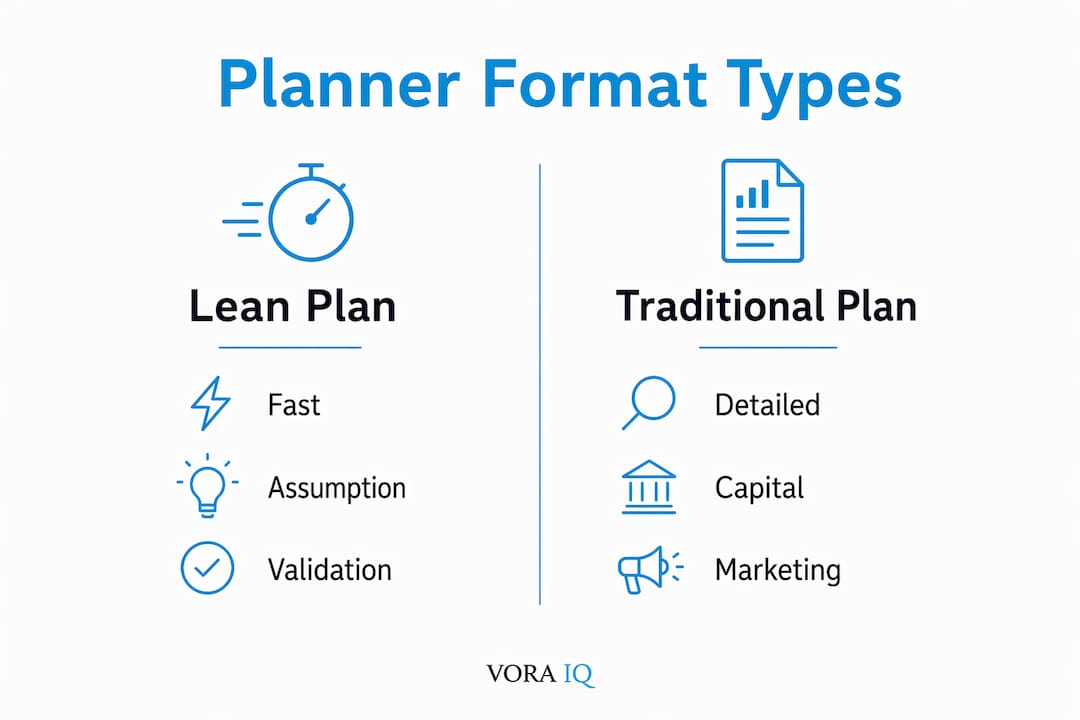
The format question comes first because the wrong choice wastes weeks. The SBA identifies two common plan types: traditional and lean startup. Each serves a different purpose.

Lean (one-page) format is built for speed and iteration. It maps your value proposition, customer segments, key activities, revenue streams, and cost structure onto a single page. You can complete a solid lean plan in one hour to one day. Use it when you’re still validating assumptions, when your audience is yourself or a co-founder, and when you expect to revise it weekly.
Traditional format goes deep. It covers nine standard sections (detailed below) and typically takes three to seven days for a focused first draft. An investor-ready version with polished financials and appendices can take two to six weeks or more. Use it when you’re approaching lenders, applying for an SBA loan, or pitching institutional investors who need the full picture.
The SBA notes that a lean plan can be created very quickly and often fits on a single page — making it the right starting point for most founders who are still testing the market.
The decision comes down to three questions: What’s the purpose (validate vs. raise capital)? Who’s the audience (yourself vs. lenders or investors)? How often will you revise it (weekly vs. quarterly)? If you answered “validate,” “myself,” and “weekly,” start lean. You can always expand.
What sections does every startup plan need?
The SBA lists nine standard sections for a traditional business plan. Not every business needs all nine, but knowing what each section demands helps you budget your writing time and effort.
- Executive summary (300–500 words, written last): A snapshot of the entire plan. Answer: What does your business do, who does it serve, and why will it win? Per NYU Stern’s guidance, this is often the only section investors read. Keep it to two pages maximum and write it after everything else is done.
- Company description (200–400 words): What problem you solve, who you solve it for, and what makes your approach different. This is your “why us” section.
- Market analysis (600–1,200 words): Total addressable market, target segment, competitive landscape, and key trends. Research industry codes (NAICS), market reports, and competitor positioning here.
- Organization and management (300–600 words): Who’s on the team, what roles exist, and what gaps you need to fill. Investors want to know the people behind the plan.
- Product or service line (400–800 words): What you’re selling, how it works, your pricing model, and your product development roadmap. Include IP or proprietary advantages if relevant.
- Marketing and sales (400–800 words): How you’ll reach customers, your go-to-market strategy, and your sales process. Be specific about channels and conversion assumptions.
- Funding request (200–400 words, if applicable): How much you need, what you’ll use it for, and your preferred funding structure. Only include this section if you’re seeking outside capital.
- Financial projections (600–1,000 words + tables): Three-year projections covering revenue, expenses, cash flow, and break-even. This section carries the most weight with lenders.
- Appendix (as needed): Supporting documents — resumes, permits, contracts, market research data, product images. Keep it lean; include only what a reader would actually want to verify.
A fast, repeatable workflow to draft your plan
The sequence you follow matters as much as the sections you write. Most founders make the mistake of starting with the executive summary. That’s backwards.
The high-leverage order, grounded in NYU Stern’s planning framework:
- Finish your market and solution thinking first. Talk to customers, map the competitive landscape, and confirm your value proposition before you write anything formal.
- Build the financial logic. Work through startup expenses, cash flow, break-even, and three-year projections. Numbers force clarity that prose can hide.
- Write the executive summary last. Once your market analysis and financials are solid, the summary writes itself as a coherent stand-alone story.
For a lean plan, this sequence takes one to three days. For a full traditional plan, budget one to two weeks for the market and financial work, then two to three days for drafting the narrative sections.
NYU Stern also recommends a two-tier deliverable approach: a two-page venture concept for initial screeners or judges, then the full plan for detailed review. This structure stops you from over-writing early and keeps your pitch tight.
Pro Tip: Complete your market analysis and financial model before you write a single word of the executive summary. Investors read the summary first but it only holds up when the numbers behind it are real. Writing it last means you’re summarizing facts, not making promises.
For customer discovery, get out of the building. Run five to ten structured interviews before you finalize your market analysis. The artifacts you want at the end of week one: a one-page concept, a validated MVP hypothesis, and a 12-month cash flow draft. Those three documents give you enough to move forward without over-planning.
Startup costs and the financial checklist every plan needs
Financial planning is where most early-stage founders underestimate. The gap between projected and actual costs kills more startups than bad products do.
| Cost Category | What to Research |
|---|---|
| One-time setup | Equipment, software licenses, deposits, website build, branding |
| Recurring operating | Rent, utilities, SaaS subscriptions, insurance premiums |
| Legal and compliance | Entity formation, trademarks, contracts, permits, accounting fees |
| Payroll and contractors | Founder draws, part-time hires, freelancers, benefits |
| Marketing and sales | Paid ads, content production, CRM tools, event costs |
SCORE’s startup-expense worksheet warns founders not to underestimate costs and recommends building a contingency reserve of 10–20% on top of your total projected expenses. That buffer covers the surprises that always show up in the first six months.
The five financial worksheets your plan must include:
- Startup expenses worksheet: Every cost you’ll incur before your first dollar of revenue.
- Working capital estimate: How much cash you need on hand to cover operations for 60–90 days.
- 12-month cash flow projection: Monthly revenue assumptions, payment timing, and expense outflows.
- Break-even analysis: The revenue level at which total costs equal total income.
- Profit and loss projections: Three-year view of revenue, cost of goods, gross margin, and net income.
SCORE’s financial projections template bundles all five of these into a single downloadable package, including a sales forecast and balance sheet for the first three years.
Your 12-month cash flow checklist:
- Set monthly revenue assumptions based on realistic conversion rates, not best-case scenarios.
- Model payment timing separately from revenue recognition (when does cash actually hit your account?).
- Calculate your runway: total cash on hand divided by monthly burn rate.
- Build in the 10–20% contingency reserve at the expense level, not just as a line item.
- Set a monthly review cadence to compare actuals against projections and adjust.
Where to find templates, worksheets, and planners
You have three categories to choose from, and each fits a different stage and working style.

Downloadable PDFs and free templates are the fastest starting point. The SBA’s business plan guidance walks you through both lean and traditional formats with section-by-section explanations. SCORE’s startup business plan template includes fillable worksheets for every major section and is useful even if you’re not seeking outside financing. Both are free and authoritative. The trade-off: they’re static. You fill them in, save a PDF, and then manage version control yourself.
Planner workbooks (physical or digital) add structure and prompts. They’re better than blank templates for founders who need guided questions to think through each section. The downside is that they don’t connect your narrative to your financial model. You’re still managing two separate documents.
Integrated digital planners solve that problem. They combine templates, financial modeling, collaboration, and task management in one place. Some tools now use AI to generate plan drafts, adapt roadmaps as your assumptions change, and connect planning to execution. The AI business plan creation category has grown fast, with tools that can generate a structured concept in minutes rather than days.
Vora IQ sits in this third category. It’s an AI-native operating system built specifically for solo founders and early-stage teams. It generates business plans, builds adaptive roadmaps, models financials, and connects planning to daily execution tasks. One platform instead of four separate tools.
How to choose the right planner for your stage
Not every tool fits every founder. Here’s what to evaluate before you commit to any planner, template, or platform:
- Stage fit: Does it support idea validation, or does it assume you already have a product? Early-stage founders need validation workflows, not just plan templates.
- Output types: Does it produce a living roadmap you can update, or just a static document? A plan you can’t iterate is a plan you’ll abandon.
- Financial modeling: Can you build a 12-month cash flow inside the tool, or do you need a separate spreadsheet? Disconnected financials create version-control problems fast.
- Collaboration: Can a co-founder, advisor, or accountant access and comment on the plan? Even solo founders need outside input at some point.
- Export formats: Does it produce investor-ready PDFs, pitch decks, or both? Know what format your audience expects before you build.
- Integrations: Does it connect to tools you already use? Stripe integration, for example, lets you tie revenue projections to real transaction data.
- Price model: Free templates cost nothing but require more manual work. One-time planner workbooks run $10–$100. SaaS platforms typically run $10–$100+ per month depending on features. Know what you’re trading: time vs. money vs. capability.
Two questions worth asking about any tool: How are financials modeled — are they formula-driven or just text fields? And can you iterate the plan without rebuilding it from scratch each time?
For a deeper look at AI-powered planning tools and what rapid generation actually looks like in practice, the category has matured significantly in the past two years.
How Vora IQ helps solo founders plan and execute
Vora IQ maps directly to the planning needs this guide covers. Here’s how the features connect:
- AI-generated business plans: Vora IQ produces a structured plan draft based on your idea and context, not a generic template. You get a starting point that’s already shaped around your market.
- Adaptive living roadmaps: The roadmap updates as your assumptions change. When your market analysis shifts, your task list shifts with it.
- Startup financial modeling: Built-in financial tools cover startup expenses, cash flow, and projections. Stripe integration ties revenue modeling to real transaction data.
- Task automation: Daily tasks are generated from your plan, so execution follows directly from planning rather than living in a separate system.
- Exportable pitch artifacts: Pitch decks, proposals, and structured documents are generated from your plan data, not built separately.
- 13 specialist AI teammates: Each one covers a different domain, from market analysis to compliance awareness to social media content, all personalized through your Business Memory.
Vora IQ has delivered over 2,400 unique roadmaps across industries. That’s not a feature claim. It’s a signal that the system has been tested against real founder problems at scale.
Use cases where Vora IQ delivers the most traction: a solo founder validating a SaaS idea who needs a PMF signal before building; a consultant packaging a client’s concept into a fundable plan; a small team turning a validated plan into weekly sprints with clear ownership. For a full picture of how the platform maps to different founder types, the Vora IQ use cases page breaks it down by role and stage.
Key Takeaways
A startup planner works best when you start lean to validate assumptions, build your financial logic before writing narrative, and treat the plan as a living document you update weekly rather than a one-time deliverable.
| Point | Details |
|---|---|
| Start lean, expand later | Use a one-page lean plan to validate assumptions fast; build the traditional plan only for investors or lenders. |
| Follow the right sequence | Complete market analysis and financial modeling before writing the executive summary. |
| Build in a contingency reserve | SCORE recommends 10–20% above projected startup costs to protect your runway. |
| Executive summary goes last | Per NYU Stern, write it after all other sections are complete; keep it to two pages maximum. |
| Vora IQ automates the scaffolding | Vora IQ generates AI-driven plans, adaptive roadmaps, and financial models so you focus on decisions, not document structure. |
The plan is the least important part of planning
Most solo founders spend too long on the document and not enough time on the thinking behind it. The plan is just the artifact. The real work is the market conversation you had before you wrote it, the financial model that forced you to confront your assumptions, and the weekly review that keeps you honest about what’s actually happening versus what you projected.
When you’re planning alone, decision fatigue is the real constraint. You’re the analyst, the writer, the financial modeler, and the customer interviewer all at once. Keeping the plan lean in the early weeks isn’t laziness. It’s resource management. A one-page concept that you revisit every Monday is worth more than a 40-page plan that sits in a folder after you write it.
Treat the plan as a living document. Set a weekly checkpoint, even if it’s 20 minutes. Ask one question: what did I learn this week that changes an assumption in the plan? If the answer is nothing, you probably didn’t talk to enough customers. The founders who move fastest aren’t the ones with the best plans. They’re the ones who update their plans most often.
Vora IQ: an AI-native planner built for founders like you
Solo founders don’t need a 40-page business plan on day one. They need clarity on the problem, a financial model that holds up, and a roadmap that connects planning to execution. Vora IQ delivers all three in one place, without the overhead of a full team or the manual work of stitching together five separate tools.
From AI-generated business plans to adaptive roadmaps and built-in financial modeling, Vora IQ is built specifically for the way solo founders and early-stage teams actually work. Over 2,400 roadmaps delivered. Real traction, real founders, real results. See how it fits your stage and use case at Vora IQ’s use cases page, or compare it directly against the DIY founder stack to find the right fit. Get your free Idea Report Card and have a working plan draft by end of day.
Authoritative sources and templates
These are the primary references worth bookmarking as you build your plan:
- SBA — Write Your Business Plan: The official U.S. government guide covering both lean and traditional formats, section-by-section explanations, and guidance on when to use each. Free and authoritative.
- SCORE — Startup Business Plan Template: Fillable worksheets for every major plan section, useful for founders at any stage, including those not seeking outside financing.
- SCORE — Startup Expenses Worksheet: Dedicated worksheet for estimating startup costs, with the contingency reserve recommendation built in.
- SCORE — Financial Projections Template: Bundles startup expenses, cash flow, income statements, balance sheet, and break-even analysis into one downloadable package for the first three years.
- NYU Stern — Writing Your Startup Plan: Guidance on executive summary best practices, the two-page maximum rule, and why the summary should be written last.
- NYU Stern — New Venture Concept Guidelines: Framework for the two-tier deliverable approach (two-page concept plus full plan), useful for founders preparing for pitch competitions or investor screeners.