
Strategic Planning AI: A 2026 Guide for Leaders
By Vora IQ Team
Discover how strategic planning AI enhances decision-making for leaders. Explore use cases, limitations, and future insights in this essential guide.
- strategic planning ai

Strategic planning AI is the use of artificial intelligence to augment decision-making across research, scenario modeling, resource allocation, and execution monitoring. The industry term for this practice is “AI-assisted strategic management,” and it covers everything from automated competitive scanning to real-time performance dashboards. AI does not replace leadership judgment, ethics, or accountability. It accelerates the evidence-gathering and analysis work that used to consume weeks of a leadership team’s time. This guide covers the core use cases, the real limitations, a practical integration framework, and what the future of AI-driven decision making looks like for entrepreneurs and business leaders.
What are the key AI use cases in strategic planning?
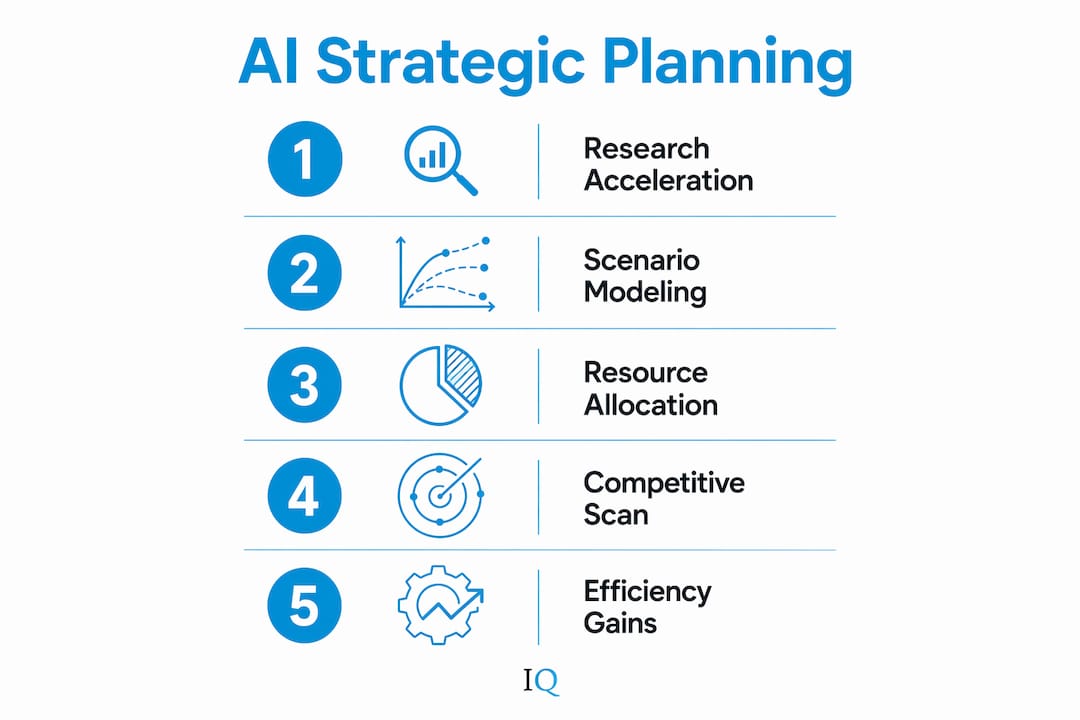
AI for strategic planning delivers the most value in five distinct areas. Each one replaces a slow, manual process with a faster, more consistent output.
- Rapid competitive scanning. AI accelerates research from a two-week process down to a few hours. You get signal maps covering competitor moves, customer sentiment shifts, and macro trends before your next leadership meeting.
- Automated narrative generation. Analysis of over 30,000 strategic plans shows AI eliminates hours of manual data movement annually by converting raw KPI data into contextual narratives. This is the single largest time saver for leadership teams.
- Scenario modeling. AI builds downside, base, and upside cases simultaneously. You stress-test your assumptions in hours instead of weeks, and you walk into board conversations with validated numbers.
- Resource allocation support. AI compares initiatives by cost, capacity, risk, and expected impact. The output is a ranked allocation table your team can debate and refine, not a blank spreadsheet to fill in.
- Continuous execution monitoring. Instead of waiting for quarterly reviews, AI tracks KPIs in real time and flags deviations as they happen. This shifts strategy from a calendar event to a living process.
The output artifacts from these use cases are concrete: signal maps, scenario comparison charts, resource allocation tables, and narrative summaries. These are not abstract reports. They are working documents your leadership team uses to make faster, better-informed calls.
Pro Tip: When you run a competitive scan with AI, ask it to produce a signal map that separates confirmed facts from weak signals. Weak signals are where the real strategic opportunities hide.

AI also supports efficiency gains across functions beyond planning, which means the speed advantage compounds as you scale your operations.
Where does AI fall short in strategic planning?
AI cannot create a final strategy. That is the most important limitation to understand before you build any AI-assisted planning workflow.
AI is prone to failure when generating final strategy documents without human trade-off consideration. The reason is structural. AI optimizes for pattern recognition and data consistency. It does not understand your organization’s risk appetite, political dynamics, or cultural values. Those factors shape every real strategic decision.
“AI helps leaders see options and trade-offs faster, but leaders still make the key decisions about priorities and ethics. The strategist is always human. AI is the co-pilot, not the captain.”
The most common failure modes in AI-assisted strategic management are:
- Poor data integration. Algorithmic planning requires consistent real-time data across all functions. Without clean, connected data, AI outputs are unreliable and can mislead rather than inform.
- Treating AI as the decision-maker. Leaders who hand off a strategic question to AI and accept the output without review are outsourcing accountability. That creates blind spots and weakens the team’s own strategic thinking.
- Using AI only for validation. The best teams use AI to challenge their favored options, not confirm them. Prompting AI to argue against your preferred strategy surfaces flaws and builds stronger commitment to the final decision.
AI excels at pattern recognition and continuous data monitoring but struggles with complex human factors like regulatory nuance and cultural dynamics. The distinction matters. Analytical AI handles repeatable, data-rich decisions well. Judgment AI, the kind that weighs values and social context, still requires a human in the loop.
Human leadership remains non-negotiable for accountability, values-based choices, and team alignment. AI gives you better information faster. You still decide what to do with it.
How to effectively integrate AI into your strategic planning process
The biggest mistake leaders make is trying to integrate AI everywhere at once. Start with one strategic question and one decision meeting.
Here is a practical framework for building AI into your planning workflow without losing leadership accountability:
-
Clean your data first. Transitioning to continuous AI-enabled strategy monitoring depends on clean data and a culture of accountability. Before you run a single AI analysis, audit your data sources for gaps, inconsistencies, and silos.
-
Use AI in the “Think” phase. Apply AI to research and scenario modeling before your planning sessions. Feed it your market data, customer feedback, and financial assumptions. Ask for three scenarios: downside, base, and upside. Require that each scenario include explicit assumptions, risks, and failure metrics.
-
Use AI in the “Plan” phase for narrative drafting. Once your leadership team has aligned on direction, use AI to draft the strategic narrative from your KPI data. Human leaders review, edit, and own the final document.
-
Keep execution human-led. AI monitors performance and flags deviations. Humans decide how to respond. Never automate a strategic response without a human review step.
-
Maintain a cascade log. A cascade log tracks the evolution of your strategic hypotheses and assumptions over time. Every time an external signal changes or a decision shifts, you log it. This institutional memory makes your AI outputs more accurate and your team more aligned.
-
Require multi-scenario outputs. Never accept a single-scenario AI recommendation. Always ask for the full range of outcomes with the assumptions behind each one.
-
Build leadership AI literacy. Successful AI-driven planning requires transparency, source checking, and governance over AI recommendations. Every leader on your team needs to understand what AI can and cannot do.
Pro Tip: Run a 90-minute pilot session where you give AI a real strategic question your team is wrestling with. Compare its output to your team’s current thinking. The gaps and overlaps will show you exactly where AI adds value in your specific context.
You can also explore AI tools for founders that are purpose-built for the planning and execution phases most entrepreneurs face.
The cultural change is as important as the technical setup. Leaders who are transparent about how AI informs their decisions build more trust with their teams than those who treat AI outputs as black-box authority.
What are the future trends in AI for strategic planning?
The shift from quarterly static planning to continuous real-time strategy adjustment is already underway. AI shifts strategic planning from reactive annual events to continuous adaptive strategy that dynamically reallocates resources. This is not a future possibility. It is happening now in organizations that have clean data and committed leadership.
The trends shaping the next three years of AI in strategic management include:
- Cross-organization benchmarking datasets. As more organizations feed anonymized planning data into shared AI systems, the contextual accuracy of AI recommendations will improve significantly. You will be able to benchmark your assumptions against real industry patterns, not just internal history.
- End-to-end planning and execution integration. The next generation of AI tools connects strategy creation directly to task execution. Your roadmap updates automatically when a key assumption changes, and your team’s priorities shift in real time.
- AI literacy as a core leadership skill. The leaders who build AI fluency now will have a compounding advantage. Understanding how to prompt AI, evaluate its outputs, and govern its use is becoming as fundamental as financial literacy.
- Richer scenario generation. As AI models improve, scenario outputs will include more granular risk factors, regulatory considerations, and competitive dynamics. The gap between AI analysis and human judgment will narrow, but it will not close.
- Governance and ethical AI use. The organizations that build clear governance frameworks for AI in strategy will outperform those that do not. Ethical AI use, including transparency about data sources and decision logic, is a competitive differentiator.
The AI competitive analysis capabilities available to entrepreneurs today are already more powerful than what enterprise teams had five years ago. The barrier is not access. It is knowing how to use these tools with discipline and clear leadership accountability.
Key Takeaways
The most effective approach to AI in strategic planning combines fast AI-driven research and scenario modeling with firm human accountability for every final decision.
| Point | Details |
|---|---|
| AI accelerates research dramatically | AI reduces competitive scanning from two weeks to a few hours, freeing leadership for higher-order decisions. |
| Narrative generation saves the most time | Analysis of over 30,000 strategic plans shows AI eliminates hours of manual data work by converting KPIs into contextual narratives. |
| Human judgment is non-negotiable | AI cannot account for risk appetite, culture, or political dynamics; leaders must own every final strategic call. |
| Clean data is the prerequisite | Continuous AI-enabled strategy monitoring fails without integrated, consistent data across all business functions. |
| Start small, then scale | Pilot AI on one strategic question before expanding; build leadership AI literacy and governance in parallel. |
Why I think most leaders are using AI in strategy backwards
Most leaders I see adopt AI in strategic planning use it at the end of the process, not the beginning. They draft their strategy, then ask AI to validate it. That is the wrong order, and it is the reason so many AI-assisted plans look polished but feel hollow.
AI is most valuable before you have formed your opinion. Use it to scan the competitive landscape before your first planning session. Use it to build scenarios before you have anchored on a direction. Use it to argue against your instincts before you commit. When you bring AI in after the decision is made, you are just buying expensive confirmation bias.
The second mistake I see is treating AI outputs as finished work. A leader who reads an AI-generated strategic narrative and sends it to the board without editing it has not done strategy. They have done formatting. The thinking has to be yours. The AI speeds up the research and drafts the structure. You supply the judgment, the values, and the accountability.
The leaders who get this right share one trait. They are genuinely curious about what AI gets wrong, not just what it gets right. They prompt AI to challenge their assumptions. They read the failure scenarios as carefully as the upside cases. That intellectual honesty is what separates AI-assisted strategy from AI-dependent strategy.
Build the habit of asking AI one question before every planning session: “What is the strongest argument against our current direction?” The answer will be more useful than any summary report.
— Khalel
Vora IQ brings AI-assisted strategy to solo founders and entrepreneurs
Building a clear, adaptive strategy without a full team used to mean choosing between speed and depth. Vora IQ changes that equation.
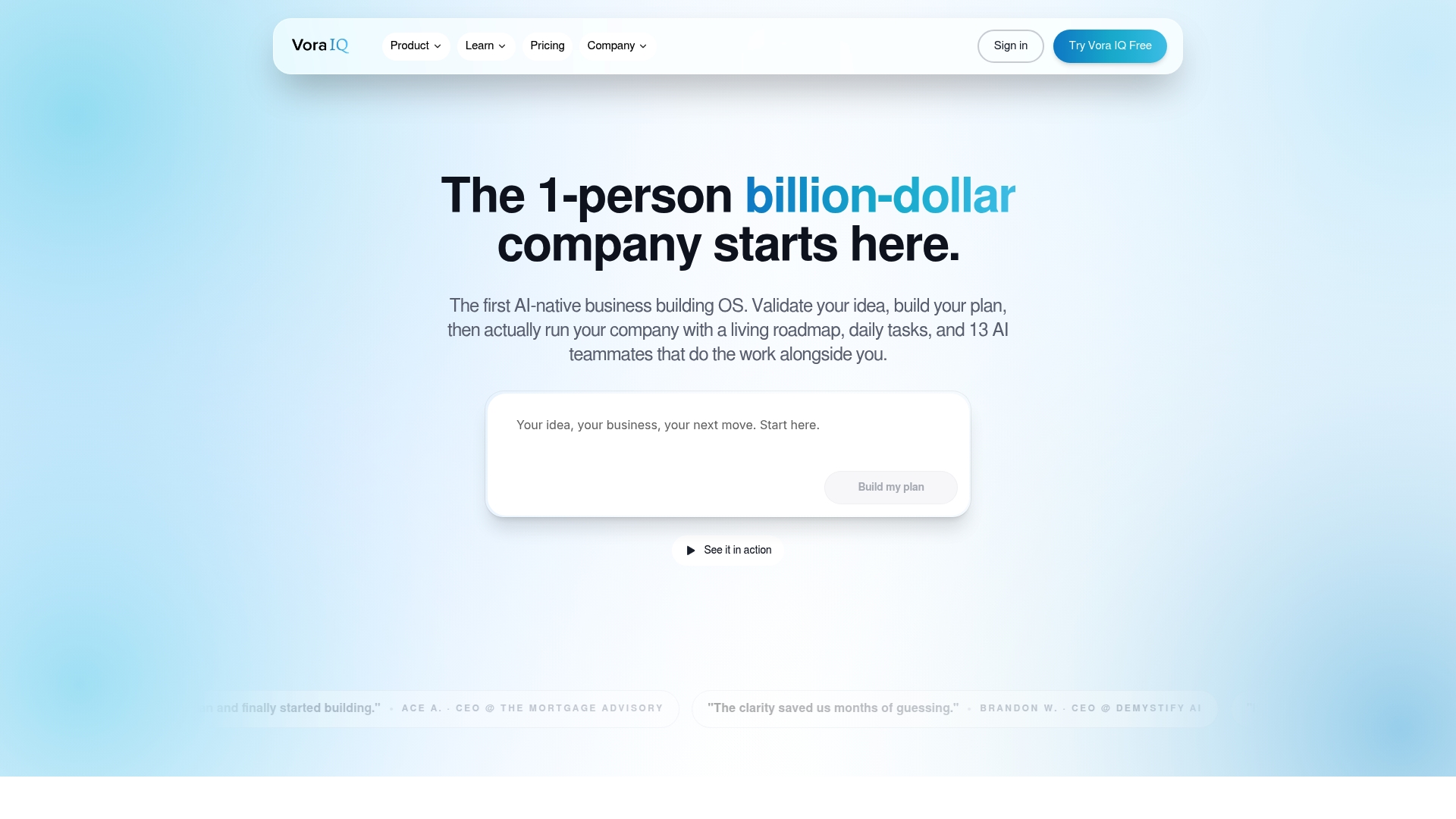
Vora IQ is an AI-native operating system built specifically for solo founders and early-stage entrepreneurs. It has delivered over 2,400 unique roadmaps across industries, each one tailored to the founder’s specific context. The Reflect agent gives you clarity when decisions get hard, walking you through trade-offs with the kind of structured thinking that usually requires a senior advisor. The Echo agent handles strategic communications so your positioning stays sharp while you focus on execution. Explore the full range of AI solutions for founders and see which tools fit your current planning stage.
FAQ
What is strategic planning AI?
Strategic planning AI is the use of artificial intelligence to support research, scenario modeling, resource allocation, and execution monitoring in business strategy. It augments leadership decision-making rather than replacing it.
How much time can AI save in the strategic planning research phase?
AI can reduce the competitive research phase from two weeks to a few hours by scanning market trends, competitor moves, and customer sentiment automatically.
What is the biggest risk of using AI in strategic planning?
The biggest risk is treating AI as the decision-maker. AI cannot account for organizational culture, risk appetite, or ethical trade-offs, so human leaders must review and own every final strategic call.
What is a cascade log and why does it matter?
A cascade log tracks the evolution of your strategic assumptions and decisions over time. It preserves institutional memory and makes AI outputs more accurate as your strategy adapts to new information.
Do I need clean data before using AI for strategy?
Yes. Continuous AI-enabled strategy monitoring depends on integrated, consistent data across all business functions. Without clean data, AI outputs are unreliable and can mislead your planning process.