
OKRs for Startups: A Lean Founder's Playbook
By Vora IQ Team
Discover how to effectively implement OKRs for startups with a simple three-step plan that drives measurable results and enhances team alignment.
- okrs for startups

OKRs work for fast-moving startups when you right-size them. One company objective, two or three measurable Key Results, and a weekly check-in. That’s the whole system for your first quarter. Before you write a single goal, confirm you have at least one metric you can track weekly. No trackable metric means no scorable OKR.
Your three-step starter plan for this week:
- Write one company Objective (what you want to achieve and why it matters right now).
- Draft two or three Key Results that measure whether you hit it.
- Schedule a 15-minute weekly check-in with your team or yourself.
When to delay OKRs:
- You’re in pure discovery mode with no repeatable product yet.
- Your team is two or three people and informal alignment still holds.
- You have no metrics to track, not even a proxy.
If any of those apply, stop validating and start operating first. OKRs reward execution, not exploration.
Key Takeaways
OKRs work for early-stage startups when you run one company Objective, score honestly on the 0.6–0.7 stretch range, and protect the weekly check-in habit above everything else.
| Point | Details |
|---|---|
| Start with one Objective | Write one company Objective with two or three KRs before adding team-level goals. |
| KRs must be outcome-based | Rewrite any KR that starts with a task verb; it needs a measurable metric from X to Y. |
| Score on 0.6–0.7 stretch range | Google’s re:Work guidance sets 0.6–0.7 as the healthy stretch target; 1.0 every cycle means targets are too easy. |
| Weekly updates beat quarterly reviews | Frequent check-ins correlate with better goal attainment; treat the weekly habit as the core product. |
| Never tie OKRs to compensation | Linking OKRs to pay causes sandbagging; keep them as learning tools, separate from performance reviews. |
| Vora IQ accelerates the cycle | Vora IQ’s adaptive roadmaps and Pulse agent automate weekly check-ins and keep OKRs connected to execution. |
Table of Contents
- What OKRs actually are (and how they differ from KPIs)
- Why OKRs help startups and when to adopt them
- How to write startup-safe OKRs that survive pivots
- The right cadence for a startup OKR cycle
- The most common OKR mistakes startups make
- An 8-week starter playbook for early-stage teams
- How to fit OKRs into your existing workflow without adding overhead
- Keeping your team motivated when the plan changes mid-quarter
- What actually makes OKRs stick in small startups
- Vora IQ gives you the OKR infrastructure without the setup cost
- Sources
What OKRs actually are (and how they differ from KPIs)
An Objective is a qualitative, inspiring statement of what you want to achieve. A Key Result is a numeric, time-bound measure that tells you whether you got there. Initiatives are the tasks and projects you run to move those numbers. Objectives set direction; Key Results prove progress; Initiatives are the work.
Writing formulas:
- Objective: Verb + outcome + reason → “Establish product-market fit in the SMB segment so we can raise our seed round with confidence.”
- Key Result: Metric from X to Y by [date] → “Increase weekly active users from 120 to 400 by end of quarter.”
The difference between a task and a Key Result trips up most first-time founders. Here are three quick rewrites:
| Task (wrong) | Key Result (right) |
|---|---|
| Launch onboarding email sequence | Lift 7-day activation rate significantly |
| Run five customer interviews | Achieve a high NPS from initial users |
| Fix checkout bug | Reduce checkout drop-off from 60% to 30% |
OKRs and KPIs are not the same thing. KPIs are always-on health metrics you monitor continuously, like monthly burn rate or churn percentage. OKRs are time-boxed directional bets on where you want to move. Treating a KPI as a Key Result is one of the most common OKR mistakes startups make, and it usually produces a list of metrics that nobody actually tries to change.
Pro Tip: Write your Key Result, then ask: “Can I score this right now, even if the answer is 0.0?” If you can’t assign a starting number, rewrite the KR until you can.
Why OKRs help startups and when to adopt them
The specific value OKRs add to a startup isn’t goal-setting. It’s trade-off clarity. When your team debates whether to prioritize a new feature or a retention fix, the company Objective settles the argument. That’s the real payoff.
Core benefits for early-stage teams:
- Alignment without meetings. Everyone knows the one thing that matters this quarter.
- Visible ownership. Each KR has a single named owner, so nothing drifts.
- Faster learning cycles. Weekly updates surface what’s stalling before it becomes a crisis.
- Trade-off clarity. Competing priorities get resolved by asking which option moves the KR.
The tipping-point checklist. Adopt OKRs when:
- You’ve validated enough to shift from learning to scaling.
- Cross-functional friction is slowing decisions.
- Leadership bandwidth is stretched and priorities feel unclear.
- You have more than one team or workstream running in parallel.
Many startups that adopted a disciplined, outcome-focused OKR rhythm reported reaching ARR milestones faster than teams running on informal priorities, according to The OKR Hub’s startup playbook. The mechanism is straightforward: when everyone can see the same scoreboard, effort concentrates.
Frequent check-ins also correlate with better goal attainment. Teams that treat OKRs as a quarterly event rather than a weekly habit tend to abandon the system within a few quarters. The habit is the product.
How to write startup-safe OKRs that survive pivots
The rules are short. Limit yourself to three to five objectives per level. Keep Key Results outcome-based and scorable. Assign a single owner per KR. Use plain language that names the actual business problem, not corporate-speak.
Stage-specific startup OKR examples:
Early-stage (validation and learning):
| Objective | Key Result |
|---|---|
| Prove the core value proposition resonates with SMB buyers | Achieve a low “very disappointed” score on Sean Ellis PMF survey |
| Build a repeatable sales motion before hiring | Close 10 paid pilots at $500+/month with no discounting |
| Reduce time-to-value so users activate faster | Cut median time-to-first-value substantially |
Growth-stage (acquisition and retention):
| Objective | Key Result |
|---|---|
| Scale paid acquisition to a positive unit-economics channel | Reduce blended CAC substantially while maintaining 90-day LTV |
| Make retention the growth engine | Improve 90-day retention |
| Build a referral loop that compounds | Generate 30% of new signups from referral by end of quarter |
Apply a necessity and sufficiency check before finalizing any set of KRs: ask “Is each KR necessary?” and “Are all KRs together sufficient to confirm the Objective was reached?” If a KR could be green while the Objective clearly failed, cut or replace it. This check is the fastest way to tighten a weak OKR set.
Pro Tip: Draft your KR, then try to score it today. If you genuinely cannot assign a number between 0.0 and 1.0 right now, the KR is not measurable enough. Rewrite it until you can.
The right cadence for a startup OKR cycle
Most enterprise OKR guides assume quarterly cycles. For early-stage startups, six-week or eight-week cycles often fit better because priorities shift faster. The cadence that works is the one you actually run.
A lean startup OKR cycle:
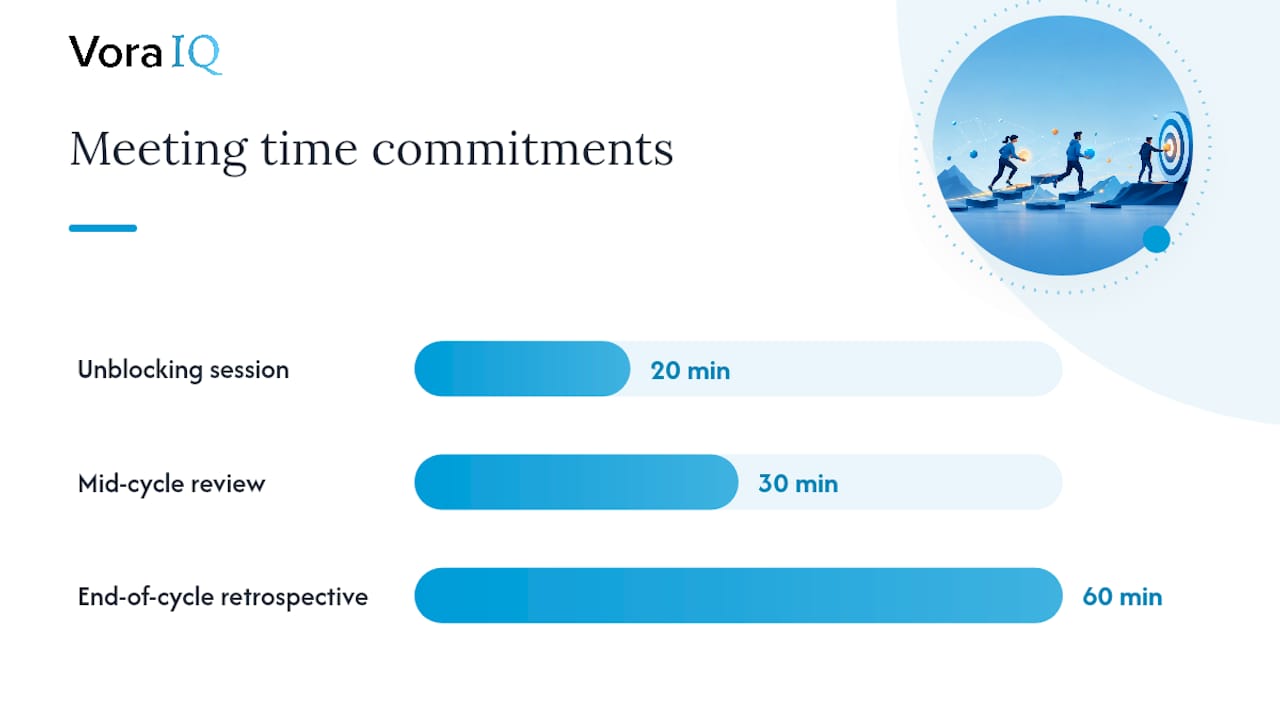
- Planning session (Week 1, 60–90 minutes). Leadership writes one company Objective and two or three KRs. Assign owners. Record baselines.
- Drafting window (Days 3–5). Team members review and flag conflicts or missing coverage.
- Alignment check (Day 7, 30 minutes). Confirm every KR has an owner and a baseline number.
- Weekly check-ins (ongoing, 10–15 minutes). Each owner updates their KR score async before the meeting. The meeting covers only blockers and decisions.
- Mid-cycle review (Week 4 or 5, 30 minutes). Assess whether any KR needs to be killed, pivoted, or accelerated.
- End-of-cycle scoring and retrospective (final week, 60 minutes). Score every KR, discuss what the scores reveal, and decide what carries forward.
Scoring guidance:
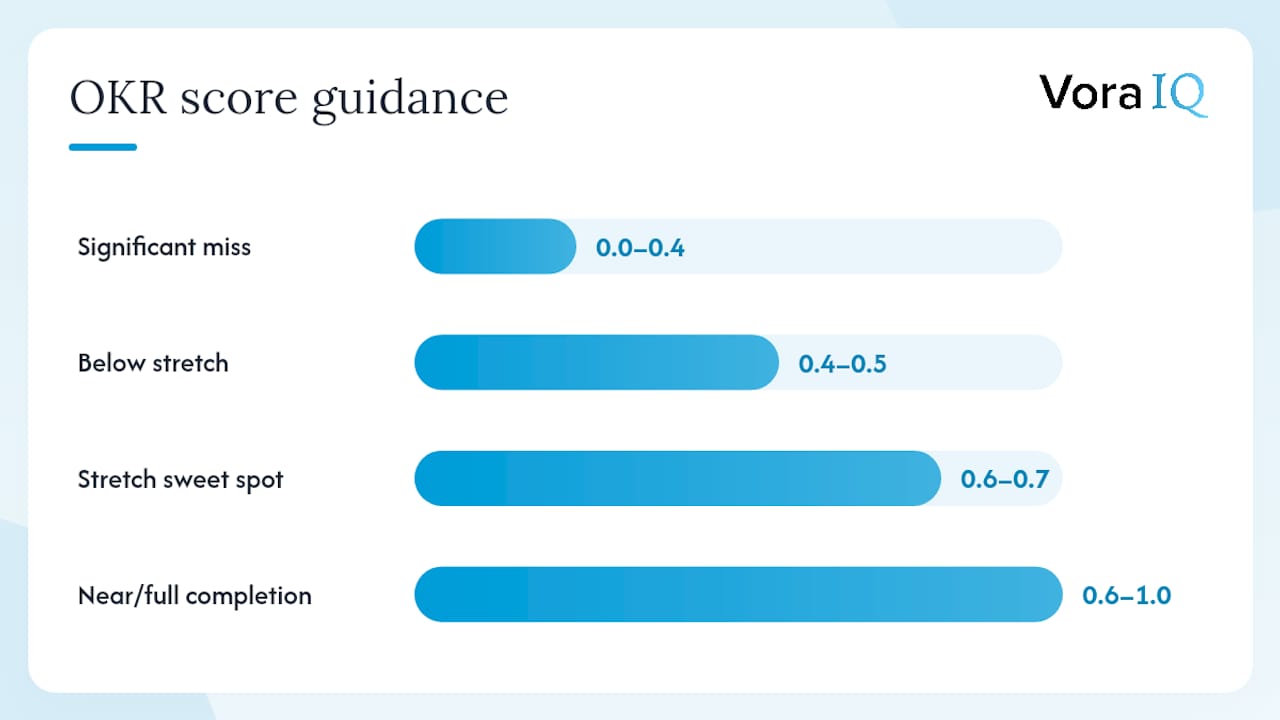
Google’s re:Work framework recommends a 0.0–1.0 scale where 0.6–0.7 is the sweet spot for ambitious stretch goals. Consistently scoring 1.0 means your targets were too easy. Scoring below 0.4 is a signal to investigate, not a reason to panic.
| Score | Interpretation | Action |
|---|---|---|
| 0.0–0.4 | Significant miss | Diagnose root cause; consider killing or pivoting the KR |
| 0.4–0.5 | Below stretch | Review blockers; adjust tactics mid-cycle |
| 0.6–0.7 | Stretch sweet spot | Healthy ambition; continue |
| 0.6–1.0 | Near or full completion | Raise the target next cycle |
Minimum tooling: Start with a shared Google Doc or Notion page. A simple table with Objective, KR, Owner, Baseline, Current Score, and Target is enough for a team of ten or fewer. Add purpose-built software only after the weekly habit is solid, typically after two or three cycles.
Pro Tip: Before every weekly check-in, each KR owner posts a one-line async update: current score, biggest blocker, and one decision needed. The meeting then spends zero time on status and all time on unblocking.
The most common OKR mistakes startups make
Most OKR failures aren’t framework failures. They’re habit failures dressed up as framework problems.
Top mistakes and their fixes:
Writing KRs as tasks. Diagnosis: Your KR starts with a verb like “launch,” “build,” or “send.” Fix: Rewrite it as a measurable outcome the task is supposed to produce.
Too many objectives. Diagnosis: You have six or more objectives and the team can’t name the top priority. Fix: Cut to one or two company objectives for the first cycle. More is not more.
Tying OKRs to compensation. Diagnosis: Teams sandbag targets to protect bonuses. Fix: Keep OKRs and performance reviews completely separate. OKRs are learning tools, not scorecards for pay.
Mixing KPIs and OKRs. Diagnosis: Your KRs are metrics you already track and don’t intend to move. Fix: A KR must represent a deliberate stretch from the current baseline, not a health metric you monitor passively.
Buying software before the habit exists. Diagnosis: You spent a week evaluating tools before writing your first OKR. Fix: Use a spreadsheet for the first two cycles. Tooling solves a scale problem, not a habit problem.
Red flags mid-quarter that signal a course correction:
- No one has updated their KR score in two weeks.
- Scores are consistently 0.9–1.0 every week (sandbagging or targets are too easy).
- A KR has two or more owners and nobody feels accountable.
Pro Tip: If a KR hasn’t moved in three consecutive weeks, treat it as stalled. Either remove the blocker in the next 48 hours or kill the KR and redirect the effort.
An 8-week starter playbook for early-stage teams
Follow this week by week. Don’t skip ahead.
- Week 1. Write one company Objective with two or three KRs. Record baselines for every KR. Schedule the weekly check-in series.
- Week 2. Run your first weekly check-in. Each KR owner posts an async update before the meeting. Spend the meeting only on blockers.
- Week 3. Update KR scores. Flag any KR where the baseline was wrong and correct it now, before the number matters.
- Week 4. Run a 30-minute mid-cycle review. Ask: Is the Objective still the right one? Is any KR stalled? Kill or pivot anything that no longer reflects reality.
- Week 5. Continue weekly updates. Introduce the scoring template to the team so end-of-cycle scoring isn’t a surprise.
- Week 6. Final push. Each KR owner identifies the single highest-leverage action remaining.
- Week 7. Score every KR on the 0.0–1.0 scale. Write one sentence per KR explaining the score.
- Week 8. Run the end-of-cycle retrospective (60 minutes). Cover: What did the scores reveal? What would we do differently? What carries forward? Then decide whether to add team-level OKRs in the next cycle.
Weekly update format (copy this):
- KR: [name]
- Current score: [0.0–1.0]
- Biggest blocker: [one sentence]
- Decision needed from team: [yes/no, and what]
When to add team OKRs: After the weekly habit is solid, typically in your second cycle. Let teams draft their own OKRs bottom-up, then align them to the company Objective. Don’t cascade top-down. The lean rollout approach keeps admin low and ownership high.
Troubleshooting:
- Progress stalled: Run a 20-minute unblocking session. Identify the single constraint and assign one owner to remove it by Friday.
- Objective no longer relevant after a pivot: Kill it cleanly. Write a replacement Objective that reflects the new direction. Don’t carry a dead OKR to protect the appearance of consistency.
- Team disengaged: Shorten the cycle. A four-week sprint OKR often re-energizes a team that lost momentum on a longer cycle.
Pro Tip: Use a startup planner template to map your 8-week OKR cycle alongside your other operating rhythms. When OKRs live next to your sprint board and financial model, they stop feeling like a separate system.
How to fit OKRs into your existing workflow without adding overhead
The fastest way to kill OKR adoption is to treat it as a separate system that runs parallel to everything else. Instead, bolt OKRs onto meetings and tools you already use.
If you run weekly standups, make the last two minutes a KR score update. If you use Notion or ClickUp for task management, add a single OKR view at the top of your workspace. If you have a Friday async update ritual, add KR scores to that template. The goal is zero new meetings and zero new tools in the first cycle.
Execution is the bottleneck, not planning. OKRs should reduce the number of decisions you make each week by pre-answering “what matters most.” When a new request lands, your team’s first question becomes: “Does this move a KR?” If the answer is no, it either waits or gets deprioritized. That filter alone saves hours.
For website and marketing KRs, pull data from tools you already use, like Google Analytics or your CRM, rather than building new dashboards. The KR score update should take under two minutes per metric.
Keeping your team motivated when the plan changes mid-quarter
Pivots don’t break OKRs. Pretending a pivot didn’t happen does.
When your startup changes direction, update the OKR immediately. A stale Objective that no longer reflects reality destroys credibility faster than a missed score. Call a 30-minute session, rewrite the Objective to match the new direction, and reset the KRs with fresh baselines. The team sees that the system is honest, and trust in the process holds.
Motivation also drops when scores feel meaningless. Two fixes: make scoring visible and make it safe. Post scores publicly in your team channel every week. Celebrate a 0.5 score that came with a clear diagnosis as much as a 0.7 that came with clean execution. The message is that learning counts.
Finally, keep the cycle short when change is frequent. A six-week cycle gives you more reset points per year than a quarterly one. Each reset is a chance to re-energize the team around a goal that actually matters right now, not one that made sense three months ago.
What actually makes OKRs stick in small startups
Most OKR advice focuses on writing better goals. The real leverage is in the weekly habit, not the goal quality.
A founder who writes a mediocre Objective and updates it every single week will outperform a founder who writes a perfect OKR and checks it once a month. The weekly update forces a conversation with reality. It surfaces blockers before they compound. It keeps the team oriented without requiring a planning meeting.
The second thing that actually matters: the founder’s own decisions must defer to the company Objective. When a shiny new opportunity arrives mid-quarter, the question is not “Is this interesting?” It’s “Does this move our KR?” If the answer is no, it waits. That discipline is what separates a startup that uses OKRs as decoration from one that uses them as an operating system.
Start with one Objective. Protect it. Update it weekly. Score it honestly. Everything else is refinement.
Vora IQ gives you the OKR infrastructure without the setup cost
Running a clean OKR cycle takes more than a good template. You need a living roadmap that updates as priorities shift, automated weekly check-in prompts, and a single place where your goals, tasks, and market context live together.
Vora IQ’s AI-native operating system is built for exactly this. It generates adaptive roadmaps tied to your business context, automates daily task prompts so your KRs stay visible, and connects your OKR cycle to financial modeling and market analysis in one workspace. No separate spreadsheet, no disconnected tools. The Pulse agent keeps your weekly rhythm on track without adding a single new meeting.
Solo founders and small teams using Vora IQ skip the setup friction that kills most first OKR cycles. See how it works for your use case and start your first OKR cycle this week.
Sources
The claims and frameworks in this article draw from the following primary sources:
Set goals with OKRs, Google re:Work — The definitive reference for scoring guidance (0.0–1.0 scale, 0.6–0.7 stretch sweet spot), numeric Key Results, and the principle that low scores are diagnostic data, not failure.
Dear Andy: How to Use OKRs in a Fast-Moving Startup, WhatMatters — Covers cadence flexibility for early-stage teams and the principle that OKRs should update when priorities shift, not stay frozen to a quarterly plan.
Mastering OKRs for Startups, The OKR Hub — Startup-specific rollout guidance: one company Objective first, weekly check-ins, bottom-up team OKRs in quarter two, and transparent end-of-cycle scoring.
The OKR Framework, rework.com — Template structure (Objective plus three KRs), necessity and sufficiency checks, and examples of outcome-based KRs across functions.
Write OKRs Overview, Microsoft Viva Goals — Practical guidance on limiting objectives to three to five, writing measurable KRs, and iterating OKRs as a living practice rather than a set-and-forget exercise.
- Dear Andy: How to Use OKRs in a Fast-Moving Startup
- Set goals with OKRs — re:Work (Google)
- Mastering OKRs for Startups: Your 2026 Growth Playbook
- The OKR framework: what it is and how to use it to guide your startup team to success
- Write OKRs overview — Microsoft Viva Goals